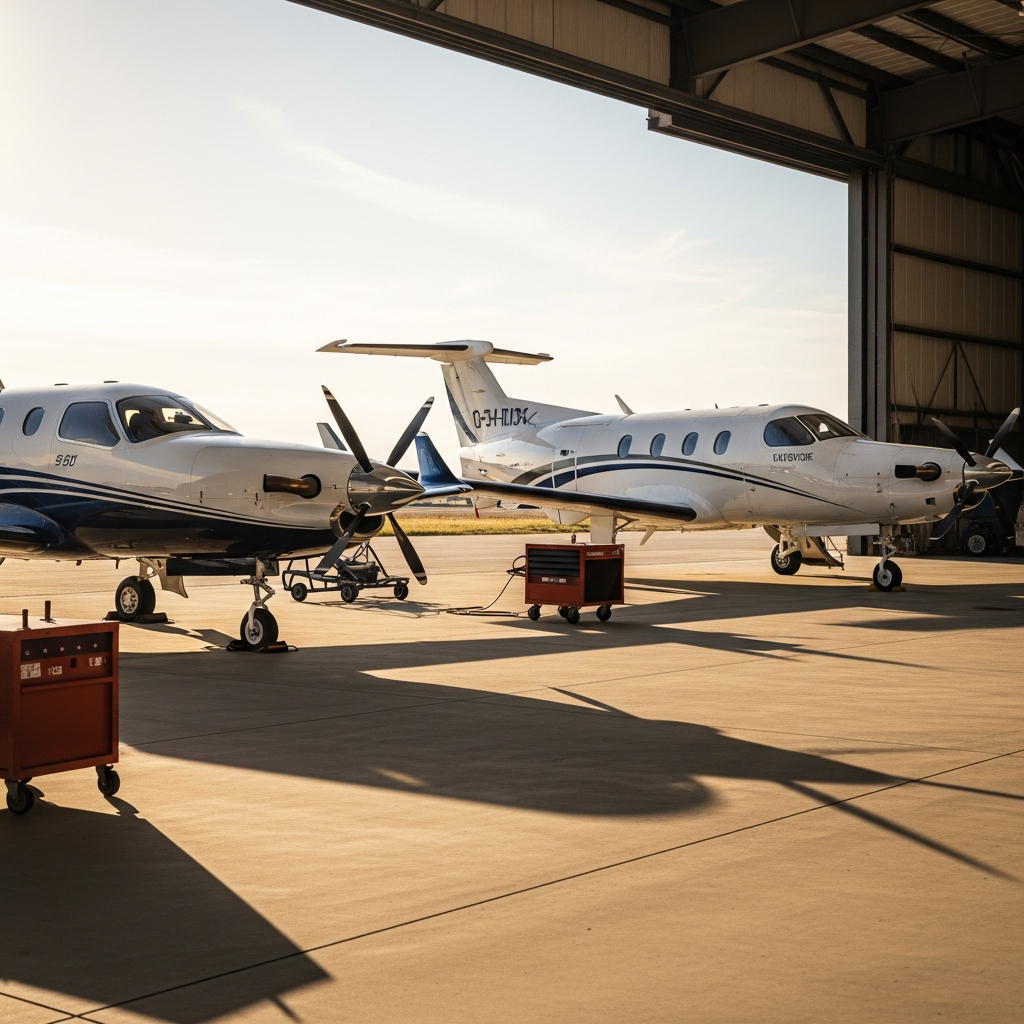
Two Philosophies — Speed Machine vs Swiss Army Knife
The TBM 960 vs PC-12 debate has gotten complicated with all the spec-sheet noise flying around. I’ve spent time in both left seats — and talked with owners who’ve switched directions on this decision more than once — so let me be straight with you: there’s no obvious winner here. The wrong choice is simply the one that doesn’t fit what you’re actually doing on a random Tuesday in November.
So, without further ado, let’s dive in.
Here’s the thirty-thousand-foot view. The TBM 960 is the fastest single-engine turboprop on the planet — 326 knots true airspeed at altitude. The Pilatus PC-12 NGX hauls 2,236 pounds of useful load through a cargo door that’s 53 inches wide and 52 inches tall, operates comfortably off 2,600-foot grass strips, and has been the preferred aircraft of backcountry operators, charter companies, and medevac programs for over two decades. These two airplanes were designed by engineers who started with completely different questions. Daher asked: how fast can a single-engine turboprop go? Pilatus asked: what’s the most useful one we can build?
Both questions have excellent answers. Your job is figuring out which question matches your actual life.
The TBM 960 entered service in 2022, powered by the Pratt & Whitney Canada PT6E-66XT — a FADEC-equipped evolution of the legendary PT6 family, producing 1,825 shaft horsepower. Six passengers, pressurized cabin, cruises at FL310 without blinking. The PC-12 NGX — Pilatus’s latest iteration of a line that’s been in continuous production since 1994 — runs the PT6A-67P at 1,605 shaft horsepower. Up to nine passengers in standard configuration, or reconfigured as a freighter in roughly four minutes. Different DNA entirely.
I’ve sat in the TBM 960 cockpit and felt what I can only describe as the airplane’s own eagerness — it wants to go fast. Low wing, retractable gear, narrow fuselage, aerodynamic obsession visible in every panel line. Then I climbed into a PC-12 NGX and felt the opposite energy. Spacious, utilitarian, confident. A truck that happens to cruise at 290 knots. That’s what makes each of these airplanes endearing to the pilots who choose them — they’re honest about what they are.
Here’s the core philosophical split: the TBM 960 makes your commute dramatically shorter. The PC-12 NGX changes what you can do with aviation entirely.
Performance Where It Matters
Spec sheets are marketing. Real missions are what matter. So let’s run two scenarios I hear owner-pilots describe constantly — a 600 nm trip and an 800 nm trip. Realistic reserves, real-world winds, no cherry-picking.
The 600 NM Mission
Flown in a TBM 960 at FL310, cruising at 326 KTAS with standard atmosphere and no wind: block time runs around 1 hour 52 minutes wheels-up to touchdown, climb and descent included. Fuel burn at that power setting is roughly 52 gallons per hour — so you’re looking at 95 to 100 gallons of Jet-A for the trip, before reserves.
The PC-12 NGX flying the same 600 nm at FL250, cruise at 290 KTAS, puts you on the ground in approximately 2 hours 10 minutes. Fuel burn at cruise is around 48 gallons per hour — roughly 100 gallons including climb.
Time savings on this leg: about 18 minutes. Fuel consumption: nearly identical. Is 18 minutes worth the trade-offs? Sometimes. Depends entirely on what happens after you land.
The 800 NM Mission
This is where the TBM starts building a real argument. Published range with IFR reserves sits at approximately 1,730 nm — an 800 nm trip is nothing. Block time comes in around 2 hours 28 minutes. The PC-12 NGX shows published range of about 1,803 nm with maximum fuel, though not with full passenger payload. At 800 nm with a full cabin and reserves, you’re still well within limits. Block time around 2 hours 47 minutes.
Time delta at 800 nm: about 19 minutes. Still under 20 minutes. The TBM’s 36-knot speed advantage never translates into dramatic savings — both aircraft spend significant chunks of every trip climbing, descending, and operating in terminal areas where speeds converge. The TBM really shines on missions beyond 1,000 nm, where cruise phase dominates. At that range you’re saving 25 to 30 minutes — and if passengers are paying clients or you’re connecting to a tight schedule, that genuinely matters.
One thing that surprised me when I first dug into these numbers: the PC-12 NGX is not dramatically slower in actual operational use. The gap feels bigger on paper than it does in the logbook. Owners who flew TBMs and switched to PC-12s say the same thing — they expected to feel the slowdown more than they actually did.
Short-Field Operations
This is where the comparison stops being close. The PC-12 NGX has a published ground roll at sea level, standard conditions, of approximately 1,246 feet. Comfortable operations off 2,600-foot strips. That unlocks hundreds of backcountry, resort, and rural airports the TBM simply cannot access safely.
The TBM 960 needs more pavement. High cruise speed and low-wing design mean it’s optimized for hard-surface airports with proper instrument approaches — fine for most missions. But if even 15% of your trips involve gravel strips, short grass runways, or mountain airports with density altitude challenges, the PC-12 NGX wins this category categorically. No contest.
The Cargo Door Changes Everything
Probably should have opened with this section, honestly. For a significant portion of people evaluating these two airplanes, the PC-12’s cargo door ends the comparison before it really starts.
That door — 53 inches wide, 52 inches tall — opens up the entire left rear fuselage. It’s not a baggage door. It’s a freight door. Mountain bikes, ski gear, medical equipment, construction samples, hunting and fishing supplies, large dogs, wheelchairs, gurneys. The kind of cargo that shows up in real people’s actual lives.
I know an owner in Montana — flies his PC-12 NGX for personal travel and light charter work — who regularly loads two full-size ATVs in the back and flies them to hunting camps. Try that with a TBM. You can’t. The TBM has a baggage door that’s useful for rolling bags and duffel bags. It’s a passenger airplane with luggage space. The PC-12 is a passenger airplane that transforms into a cargo hauler in about the time it takes to fold and remove the rear seats.
Pilatus designed the entire PC-12 cabin around a flat floor — standard from day one. The cargo door opening extends to within a few inches of floor level, making loading straightforward without improvised ramps or gymnastics. The TBM 960’s cabin is excellent for its class — comfortable, pressurized, well-appointed — but it’s narrower, shorter, with conventional baggage space in the nose and tail.
Here are the payload numbers side by side:
- PC-12 NGX useful load: approximately 2,236 lbs (varies by configuration)
- TBM 960 useful load: approximately 1,600 lbs with full fuel
- PC-12 NGX cabin volume: 330 cubic feet
- TBM 960 cabin volume: approximately 110 cubic feet
Three times more interior space in the PC-12. For owner-pilots flying with families, or who occasionally carry cargo or equipment, that’s a genuine operational differentiator — not a luxury preference.
I’m apparently someone who dismissed the cargo door early in his research, and that was a mistake. Don’t make my mistake. I initially wrote it off as a niche feature. Then I started talking to actual owners about their real missions and realized I had it completely backwards — the cargo door isn’t niche. It’s the primary feature for a large percentage of PC-12 buyers. The seating flexibility reinforces this: nine-seat passenger configuration, six-seat club layout, four-seat executive setup, or pure cargo. The TBM 960 is a six-seat airplane, full stop. Great seats. No configuration options.
Charter potential adds another angle. PC-12 NGX operators can generate revenue from cargo contracts that TBM owners simply cannot compete for. If you’re doing owner-flown charter work or placing your aircraft into a management program, the PC-12’s versatility translates directly to billing flexibility — and management companies will tell you PC-12s are easier to keep busy.
Avionics and Safety Systems — FADEC vs Traditional
Both airplanes run the Garmin G3000 integrated flight deck, so at the primary flight display level you’re working with the same fundamental system. Touchscreen GTCs, synthetic vision, integrated weather, TCAS, ADS-B. From a workload management standpoint, both are current-generation glass cockpits that owner-pilots can operate comfortably in actual IMC.
Where they diverge significantly is powerplant management.
The TBM 960’s PT6E-66XT with FADEC
The Full Authority Digital Engine Control on the TBM 960 is a genuine leap forward for single-pilot turboprop operations. You don’t manage torque, ITT, Ng, and prop RPM independently like a traditional turboprop. The FADEC handles all of that. Set a power lever position — essentially a throttle — and the engine management system optimizes every parameter automatically.
For owner-pilots transitioning from piston twins or earlier turboprops, this simplification is real. Cognitive load during high-workload phases — departure from a busy Class B, instrument approach in actual IMC, engine start sequence — measurably reduced. Pilots who trained in traditional PT6 aircraft describe the first flight in a FADEC-equipped TBM as almost unsettling. Too easy, in the best possible way.
The other headline feature on the TBM 960 is HomeSafe — Daher’s branded implementation of the Emergency Autoland system developed with Garmin. If the pilot becomes incapacitated, a passenger presses one button. The aircraft autonomously navigates to the nearest suitable airport, declares an emergency, communicates with ATC, configures for landing, and touches down. No pilot input required. The system monitors aircraft state continuously and can activate automatically under certain conditions.
This is not a small thing. For owner-pilots flying single-pilot IFR, HomeSafe addresses the incapacitation scenario that has historically made single-engine turboprop operations a calculated risk — especially for the families of those pilots. Whether your passengers are your kids or your business partners, an automated escape path changes the safety conversation in a fundamental way.
The PC-12 NGX’s PT6A-67P
The PC-12 NGX runs a conventional PT6A-67P — the same engine family that has powered turboprops for decades, with a demonstrated reliability record that’s hard to argue with. No FADEC. Traditional power management with separate torque, ITT, and prop controls. More pilot workload, but also more direct pilot authority and deep familiarity for anyone who came up on conventional turboprops.
Pilatus has integrated autothrottle capability into the G3000 on the NGX. But the engine management philosophy stays conventional. Pilots who fly both platforms consistently note that the TBM’s FADEC reduces training time and lowers error potential during power transitions. The PC-12 NGX rewards disciplined, experienced turboprop pilots who know the PT6 well. That’s not a knock — it’s just a different relationship with the airplane.
One important note: the PC-12 NGX does not currently offer an emergency autoland equivalent to HomeSafe. Pilatus has discussed autonomous safety features, but as of this writing the NGX does not have a passenger-activated autoland system. For owner-pilots who fly long single-pilot legs regularly, that gap is worth weighing seriously — honestly, it might be the deciding factor for some.
Type Rating Requirements
Both aircraft require a type rating. The TBM 960’s FADEC arguably makes initial type training faster for pilots without deep turboprop backgrounds — at least if you’re coming from a piston background. The PC-12’s conventional systems mean more detailed engine management training. Neither is dramatically harder to get rated in, but the ongoing recurrency burden may be slightly lower in the TBM for pilots who aren’t flying 300-plus hours annually.
What It Actually Costs to Own Each Airplane
Let’s be direct about numbers — I’ve seen too many ownership discussions dance around the cost question, and that’s not helpful to anyone making a real decision. These are significant financial commitments and the cost delta between these two airplanes is real.
Acquisition Costs
A new TBM 960 from Daher lists at approximately $4.5 million USD. A new PC-12 NGX from Pilatus lists at approximately $5.5 million. That’s a million-dollar spread at purchase. On the used market, both retain value well — PC-12 residuals in particular are strong, supported by the depth of the fleet and sustained commercial demand. Well-maintained used TBM 940s (the predecessor to the 960) trade in the $3.2 to $3.8 million range. Used PC-12 NGs — pre-NGX — start around $3 million and climb depending on avionics stack and total hours.
Direct Operating Costs
Operating cost estimates vary by source, region, and utilization. Here’s a realistic picture for owner-operators flying approximately 200 hours annually:
- TBM 960 direct operating cost: approximately $1,150–$1,250 per flight hour (fuel, maintenance reserves, engine reserve)
- PC-12 NGX direct operating cost: approximately $1,050–$1,150 per flight hour
The TBM burns slightly more fuel at max cruise than the PC-12 at its cruise power setting — roughly 4 to 8 gallons per hour depending on settings. At $6.50 per gallon Jet-A, that’s $26 to $52 per hour. Not dramatic, but it accumulates across a season.
Engine overhaul reserves are where the numbers get serious on both sides. The PT6E-66XT has hot section intervals and overhaul costs that need to be budgeted carefully. FADEC servicing adds a maintenance layer that traditional PT6 engines don’t carry. The PT6A-67P, meanwhile, has a well-established overhaul network and decades of mechanic familiarity. Finding a qualified shop for the PT6A-67P is considerably easier than tracking down FADEC-certified PT6E technicians — especially outside major aviation hubs.
Annual Budget at 200 Hours
Running the math for an owner flying 200 hours per year:
- TBM 960: Direct operating costs approximately $230,000–$250,000 annually, plus fixed costs — insurance, hangar, subscriptions, annual inspection — of roughly $60,000–$80,000, putting total annual ownership cost in the $290,000–$330,000 range
- PC-12 NGX: Direct operating costs approximately $210,000–$230,000 annually, plus comparable fixed costs, putting total annual ownership cost in the $270,000–$310,000 range
The PC-12 costs roughly $20,000 to $30,000 less per year to operate at 200 hours, while costing a million dollars more to buy new. Over a typical five-to-seven-year ownership period, the economics get closer than the sticker price gap suggests — but the TBM is the less expensive airplane to operate hour-for-hour.
Insurance deserves a specific mention. Hull value insurance on a $5.5 million PC-12 NGX runs meaningfully higher than on a $4.5 million TBM 960. Annual hull premiums for new aircraft in these categories typically run 1.0 to 1.5% of hull value for pilots with appropriate experience — figure roughly $55,000 to $82,500 annually for the PC-12 NGX and $45,000 to $67,500 for the TBM 960. That gap isn’t trivial across a decade of ownership.
Haunted by an early ownership calculation I made that completely ignored scheduled maintenance intervals, I’d add this caution: model your cost estimates around the manufacturer’s scheduled maintenance requirements, not just hourly reserves. Both aircraft have 100-hour and annual inspection requirements plus phased maintenance programs that create lumpy annual costs. Plan for the lumps.
The Verdict — Which Turboprop Fits Your Mission?
Here’s where I’ll give you a straight answer rather than a diplomatic both-are-great conclusion — that kind of hedging isn’t useful to you.
Buy the TBM 960 If
You fly single-pilot. Your trips are primarily point-to-point over 600 nm with standard passenger baggage. Your airports are paved, with instrument approaches. HomeSafe addresses a real anxiety you carry — for your family, your passengers, your peace of mind flying long solo legs in IMC. You want the FADEC simplicity and you’re willing to pay the purchase premium for the most advanced single-engine turboprop powerplant flying today. Speed is a genuine priority, not just an ego preference.
The TBM 960 is right for the owner-pilot doing high-frequency business travel between major airports, running a lot of solo legs, and for whom 18 to 25 minutes per trip genuinely matters. At 200 hours per year, those minutes accumulate into real schedule advantages. The FADEC and HomeSafe are advantages that don’t exist anywhere else in single-engine turboprops. You are paying for them — but they are real.
Buy the PC-12 NGX If
Your missions vary. Families with gear one week, charter the next, cargo or equipment the week after. You need short-field access to destinations without 5,000-foot runways. Your passengers value cabin space over block time. You want configuration flexibility — executive today, cargo tomorrow, medical transport conceivably next month — all from a single airframe. You have a solid turboprop background and the PT6A-67P’s conventional systems feel natural rather than burdensome.
The PC-12 NGX also makes sense if charter revenue is part of your ownership model. Nine-seat capacity, cargo door, short-field performance, and a proven commercial operating record give the PC-12 a revenue-generating profile the TBM simply cannot match. Management companies will tell you the same thing — PC-12s are easier to keep busy because they fit more mission types.
The Honest Middle Ground
Some owner-pilots genuinely sit in the middle of this decision. For them, here’s what I’d say: spend a day actually loading both aircraft for your real missions. Not the manufacturer demo — your actual Tuesday trip with your actual gear and your actual passengers. The PC-12’s cargo door either solves a problem you have or it doesn’t. HomeSafe either addresses an anxiety you carry or it doesn’t. Those answers will point you toward the right airplane faster than any spec comparison ever will.
I’ve watched pilots agonize over the speed difference, then discover once they’re actually flying their chosen aircraft that the 36-knot gap doesn’t define their experience the way they expected. What defines the experience is whether the airplane fits the mission — comfortably, repeatedly, without compromise.
The TBM 960 is the fastest single-engine turboprop built. The PC-12 NGX is the most capable. Fastest and most capable are different things. Know which one you actually need.
Both are exceptional aircraft — products of serious engineering by companies with decades of single-engine turboprop expertise. The pilots who end up unhappy with their choice are almost always the ones who bought the wrong airplane for their actual life, not the wrong airplane in the abstract. Know your mission first. Then let the airplane follow.
Stay in the loop
Get the latest aircraft insider updates delivered to your inbox.