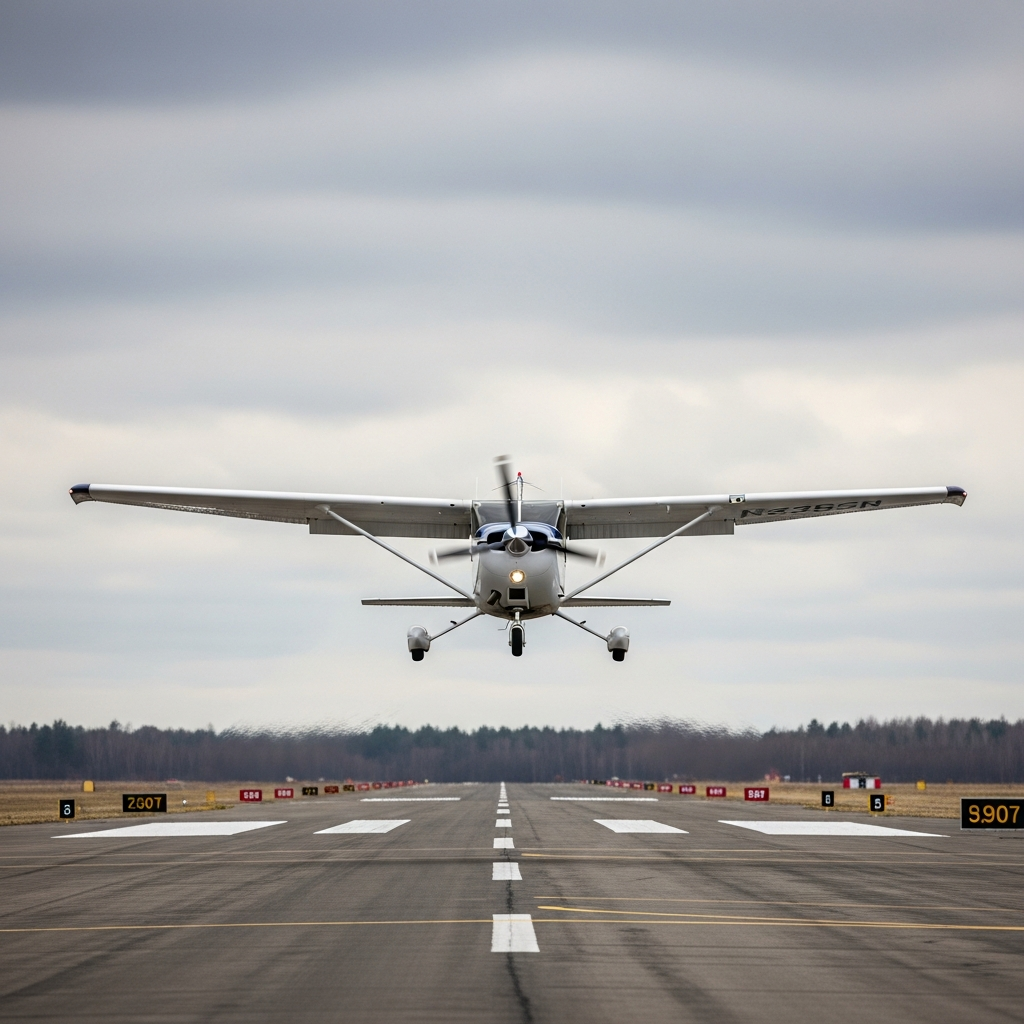
The First Three Seconds Determine Everything
Engine failure on takeoff in a Cessna 182 has gotten complicated with all the bad advice flying around. Some of it comes from pilots who’ve never actually lost an engine. Some comes from instructors who learned from instructors who never lost one either. I’m going to cut through it.
Here’s what the NTSB data actually shows: pilots lose two to four seconds to pure disbelief when the engine quits on climb. Two to four seconds. That doesn’t sound like much until you do the math at 60 knots and 400 feet AGL.
Your engine is producing power. Airspeed alive. You’ve rotated. Then — nothing. Zero thrust. The sound changes, not a sputter, just silence or a sudden drop to idle. Your brain flatly refuses to accept it for a beat. That beat kills you.
By the time you’ve processed what happened, altitude is already gone. Runway heading is already drifting. Options that existed three seconds ago have quietly expired.
This isn’t a POH checklist regurgitation. You already have that document. What this is — what this actually is — is a decision tree you’re going to load into your head right now, so when power fails, your hands move before panic gets a vote.
The best pilots don’t think during engine-out emergencies. They execute sequences they’ve mentally rehearsed until the response feels as automatic as pushing the throttle forward on departure. Today, I will share it all with you.
Below 500 Feet AGL You Have One Option
Let me be blunt about something your life depends on understanding: below roughly 500 feet AGL in a Cessna 182, you don’t have a viable turnback option. Not even close to one.
The math is ugly. A standard 182 at sea level produces around 865 feet per minute of climb when everything is working. During that climb, you’re probably sitting at 60 to 65 knots when the engine quits. You’ve got maybe 400 feet of altitude and you’re still accelerating through climb speed.
To turn back to the runway, you need a 180-degree turn. That turn — even at the shallowest bank angle that keeps you flying — bleeds altitude the way a slow leak empties a bucket. By the time you’re lined up again, you’re below 100 feet. If you even make it that far. You’re slow, you’re low, you’re done.
This maneuver has killed enough pilots that it earned a name: the impossible turn. NTSB investigators have documented it dozens of times. Plane goes up, engine quits, pilot banks hard toward the runway, pilot runs out of altitude somewhere in the turn, plane augurs in off to the side of the runway — never quite making it back. The wreckage pattern is almost always the same.
Below 500 feet, your only real option is straight ahead or a slight angle to avoid whatever obstacle is directly in your path. You land forward. You put the airplane down on whatever is in front of you — runway overrun, a road, a field, a dirt patch. Wings level. Nose slightly down. Avoid the stall. Everything else is secondary.
This decision has to be automatic. Pre-loaded. The moment you feel power loss at low altitude, your hands already know what to do: wings stay level, nose stays down, landing is happening right now.
Between 500 and 1000 Feet AGL — The Gray Zone
Probably should have opened with this section, honestly. This is where the actual thinking happens — and where most pilots are completely unprepared, because nobody briefs this specific altitude band before departure.
Between 500 and 1000 feet, the math becomes negotiable. Your options depend on variables that only you know, sitting in that seat, at that airport, on that particular morning.
How much runway is behind you? A 182 needs roughly 2,000 feet to land and stop under normal conditions. If you’ve only traveled 1,000 feet down the runway when power fails, you don’t have enough pavement behind you. Land forward. If you’ve burned through 2,500 feet and another 3,000 feet of usable runway stretches ahead, that calculation shifts considerably.
What’s the wind doing? A headwind on your turnback is your friend — it kills groundspeed and tightens your turn radius. A tailwind on the forward landing area is your enemy. You’re going to arrive faster and hotter than you want. These details matter, and they should be part of your pre-departure brief every single time.
What’s the terrain beyond the runway? At some airports, what’s ahead is genuinely worse than what’s behind — mountains, tree lines, power lines, buildings. At other airports, the departure end opens into flat farmland for two miles. You need to know this before engine start. Not when power fails at 700 feet.
Density altitude changes the whole picture. That same 182 at sea level on a 70-degree day? Around 865 feet per minute of climb. Put that airplane at 5,000 feet elevation on a 95-degree afternoon and you’re down to maybe 600 feet per minute — on a good day. Your altitude bleed rate during any turnback attempt goes up. Your options compress faster than you expect.
Here’s the honest part: this gray zone only works if you’ve pre-planned it. Not in the air. Before you start the engine. Brief every departure with a specific calculation — “if the engine fails between 500 and 1000 feet, here’s what we’re doing.” Establish your personal threshold altitude before power is applied. Some pilots set it at 700 feet. Some at 900. The specific number matters less than having it decided before the throttle goes forward.
That’s what makes pre-departure briefing endearing to us as pilots — it sounds procedural and boring right up until the moment it saves your life.
Above 1000 Feet AGL — Now You Have Choices
Above 1,000 feet, the immediate problem shifts. You’re not fighting to avoid planting the airplane in the dirt. You’re flying a glide emergency — and that’s an entirely different cognitive space.
First action: confirm the failure is real. Carb heat on. The 182’s carburetor is genuinely vulnerable to carb ice, especially during initial climb in high-humidity, cool-air conditions. Fuel selector check — on the fullest tank? Prime pump off. Mixture, verify it hasn’t somehow wandered.
Fuel-injected 182 owners can skip most of that. But if you’re flying a carbureted model and your carb heat wasn’t on for departure in humid conditions, icing is a real possibility. Carb heat on, wait five seconds. Sometimes the engine comes back. Sometimes it doesn’t — but you’ve ruled out the one fixable cause in under half a minute.
Once you’ve confirmed it’s an actual failure, priorities stack like this: best glide airspeed, a suitable landing area, and a pattern entry that doesn’t force you into altitude-eating turns you can’t afford.
A Cessna 182 glides at roughly 8-to-1 at best glide — around 70 knots indicated. From 1,000 feet with flat terrain below, that’s approximately 8,000 feet of forward distance. Elevation changes eat that margin quickly.
Declare the emergency now. One call: “Mayday, Mayday, Mayday, [your tail number], engine failure on departure, declaring emergency, will advise.” You’re not waiting for a rescue. You’re documenting the situation and clearing the airspace for your approach.
Your reentry pattern should be shallow and wide. Avoid the base-to-final turn that eats altitude and punishes any speed loss. A long straight-in approach is your friend if terrain allows. Slip the airplane if you’re arriving too high. Keep the approach stable and your inputs measured — the 182 is honest about what it wants, but it won’t forgive ham-fisted control inputs at low altitude with zero power margin.
How To Actually Practice This Before You Need It
Mental chair flying works. I’m apparently wired for it — sitting at a table with a cup of coffee works for me while simulator time alone never quite plants it the same way. Don’t make my mistake of skipping the mental rehearsal because it feels too simple to matter.
Sit down, close your eyes, and start at engine start. Walk through the takeoff roll. Climb to 200 feet — engine failure. What do you do? 400 feet — engine failure. 600 feet. 800 feet. 1,200 feet. Talk through the callouts, the control movements, the specific decisions at each altitude band. Do it every 200 feet. Do it until the sequence feels less like a procedure and more like muscle memory.
Ask your CFI for engine-idle simulations on departure. Most flight schools can do this safely on a longer runway with adequate overrun — the engine comes back to idle but doesn’t actually quit. You fly the glide, set up the approach, add power, climb away. That five-minute flight plants the scenario in your actual neuromuscular memory in a way that chair flying alone cannot replicate.
So, without further ado, here’s the brief you should run before every departure — out loud: “Engine fails at 400 feet, I’m landing straight ahead, wings level. Engine fails at 600 feet, I’ve got a decision — runway behind needs to be 2,000 feet minimum, terrain ahead is open field. Engine fails at 1,200 feet, I’m establishing best glide at 70 knots and finding the longest available option.” Say it out loud. Your brain processes vocalized information differently than silent rehearsal.
Know your personal threshold. Know the performance numbers for your specific 182. Know the airports you fly into well enough to visualize the terrain trade-offs before you ever push the throttle forward. Pilots who have survived these events didn’t survive because they got lucky in the moment — they survived because they’d pre-flown the scenario enough times that when it actually happened, they executed instead of froze.

Stay in the loop
Get the latest aircraft insider updates delivered to your inbox.