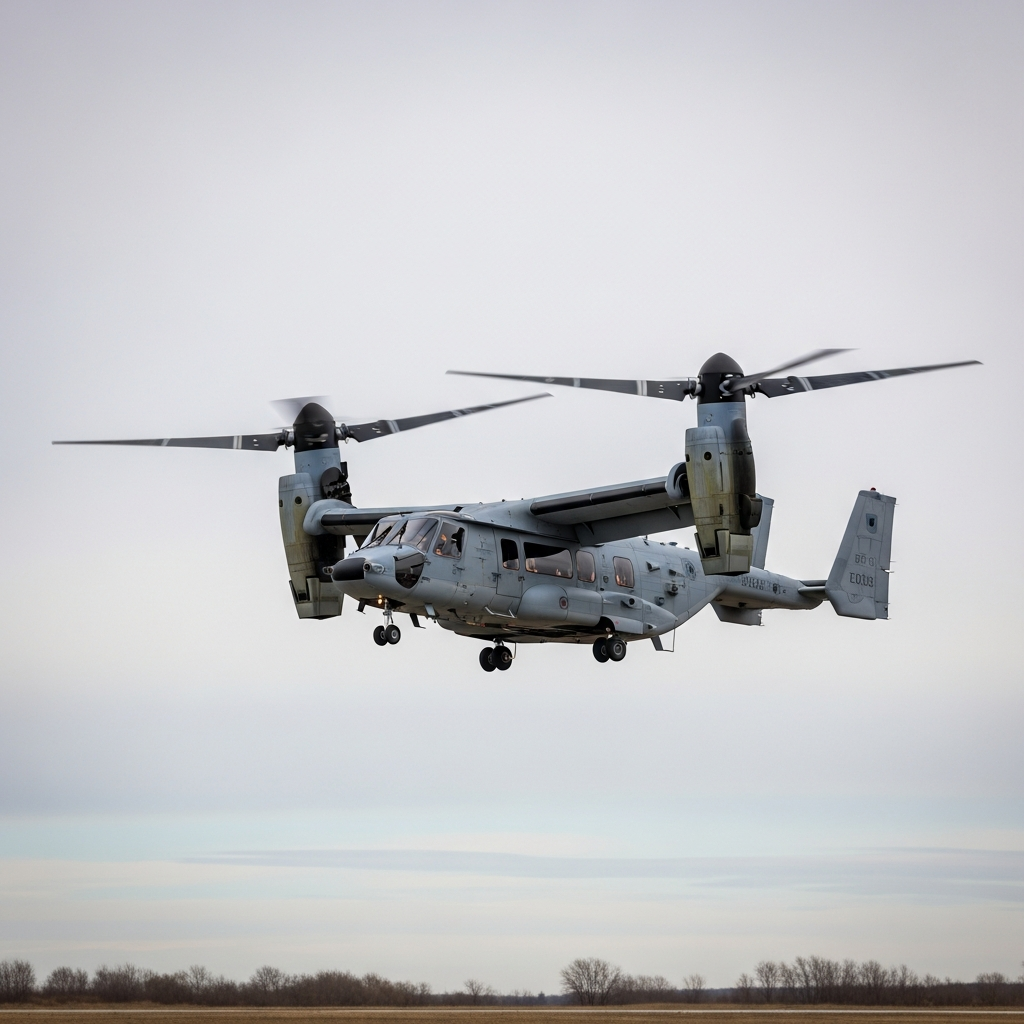
Army’s MV-75 Tiltrotor on Blazingly Fast Track — Troops Training Before First Aircraft Even Delivered
By AircraftInsider Staff | April 2026
The U.S. Army is training soldiers on the MV-75 tiltrotor before a single production aircraft has been delivered. Pentagon insiders are openly calling the procurement pace unprecedented for a program of this scale and complexity.
At the AUSA Global Force Symposium in March 2026, Army officials confirmed the service is already embedding MV-75 training into mid-grade officer professional development — and running soldiers through full-size simulators at Redstone Arsenal — even though fielding isn’t scheduled to begin until 2027 at the earliest. The first physical airframe has yet to fly.
A Compressed Timeline by Design
The accelerated pace traces directly to pressure from the top. On January 13, 2026, Army Chief of Staff Gen. Randy A. George stood at Fort Drum and made a blunt declaration during the first Army Senior Leader Situation Report:
“We have a new tiltrotor aircraft, and it was supposed to be delivered in 2031, 2032 and we said, ‘No, we need it, you know, very quickly.’ At the end of this year, we will actually have those flying out in formations.”
A service spokesperson walked that back slightly. The Army expects to accept a prototype airframe for testing by late 2026 or early 2027 — not operational formations flying by year’s end. The intent, though, is unambiguous: the Army is done waiting.
Four days after George’s remarks, Army Secretary Dan Driscoll visited Bell Textron’s facility in Wichita, Kansas — where the first six MV-75 test articles are currently being assembled — and reinforced the urgency.
“It’s a system built to win on the future battlefield,” Driscoll said.
What the MV-75 Actually Is
The MV-75 is Bell’s V-280 Valor tiltrotor, militarized and designated under the Army’s Future Long-Range Assault Aircraft (FLRAA) program. The designation carries meaning: “M” signals multi-mission; “V” stands for vertical takeoff and landing; “75” is a nod to 1775, the Army’s founding year. Bell won the FLRAA competition in December 2022, defeating the Sikorsky-Boeing SB-1 Defiant, and received a $1.3 billion development contract.
Powered by two Rolls-Royce AE 1107F turboshaft engines producing roughly 7,000 shaft horsepower each, the MV-75 cruises at approximately 280 knots — nearly double the UH-60 Black Hawk’s cruise speed. It can carry 14 troops or 12,000 pounds of internal cargo. Its dual cargo hooks can sling-load an M777A2 howitzer — weighing 10,000 pounds — at 150 knots, and maximum takeoff weight is expected around 30,000 pounds.
Unlike the V-22 Osprey, the MV-75 keeps its engines fixed while only the rotor heads and drive shafts tilt — a design that significantly reduces mechanical complexity. A central driveshaft running through the composite straight wing allows a single engine to power both rotors if one fails. The aircraft uses retractable landing gear, a V-tail configuration, and a triple-redundant fly-by-wire flight control system.
Final assembly is planned for Amarillo, Texas — Bell’s existing V-22 Osprey production site — with fuselage work ongoing in Wichita.
Training Infrastructure Already in Place
Two MV-75 Virtual Prototype simulators — replicating cockpit design, mission software, and flight dynamics — were delivered to Redstone Arsenal in June 2025 and to Fort Rucker approximately one month later. In July 2025, six Army experimental test pilots completed MV-22B Osprey familiarization flights at Marine Medium Tiltrotor Training Squadron VMMT-204, giving them foundational tiltrotor handling experience ahead of MV-75 flight test.
The 101st Combat Aviation Brigade has been named as the first unit to receive the aircraft. Special Operations provisions are being built into every production airframe from the start — pre-installed infrastructure for 160th SOAR mission equipment packages, a cost-reduction measure that Lt. Col. Cameron Keogh, SOCOM’s PEO-RW, called “a huge win.”
Funding Remains the Wild Card
Senior leaders are bullish. Not everyone is matching that energy. Maj. Gen. Clair Gill, Army Aviation Center of Excellence commander, offered a measured note of caution to Breaking Defense in March 2026:
“There are a number of variables that I don’t want to commit to a day on the calendar right now, because we have what we call a success-oriented schedule — a very optimistic outlook for something that we don’t have a lot of history with. A lot’s gonna have to do with funding as we go into a new year.”
The GAO published a review of the Army aviation portfolio on March 25, 2026, noting the structural restructuring senior leaders undertook to reduce costs — a sign that budget pressure is already shaping the program’s edges.
The first MV-75 prototype acceptance event is currently expected no earlier than late 2026. First flight — the program’s most consequential milestone to date — follows from there, as Bell moves from assembly to flight test in Amarillo.
Sources
- The War Zone — MV-75 Program Coverage, April 2026
- Breaking Defense — Maj. Gen. Clair Gill Interview, March 2026
- U.S. Army Official Releases — FLRAA Program Milestones
- GAO — “Future Vertical Lift: Senior Leaders Restructured the Army Aviation Portfolio to Reduce Costs,” March 25, 2026
- FlightGlobal — MV-75 Technical Coverage
- DVIDS — Special User Evaluation Releases, June & December 2025
Stay in the loop
Get the latest aircraft insider updates delivered to your inbox.