Verified update — July 30, 2026: This earlier report contains tactical and intelligence claims that are not supported by the official releases reviewed on July 30, 2026. Read the official-source F-15E shootdown and rescue account for the confirmed timeline and the details that remain unverified.
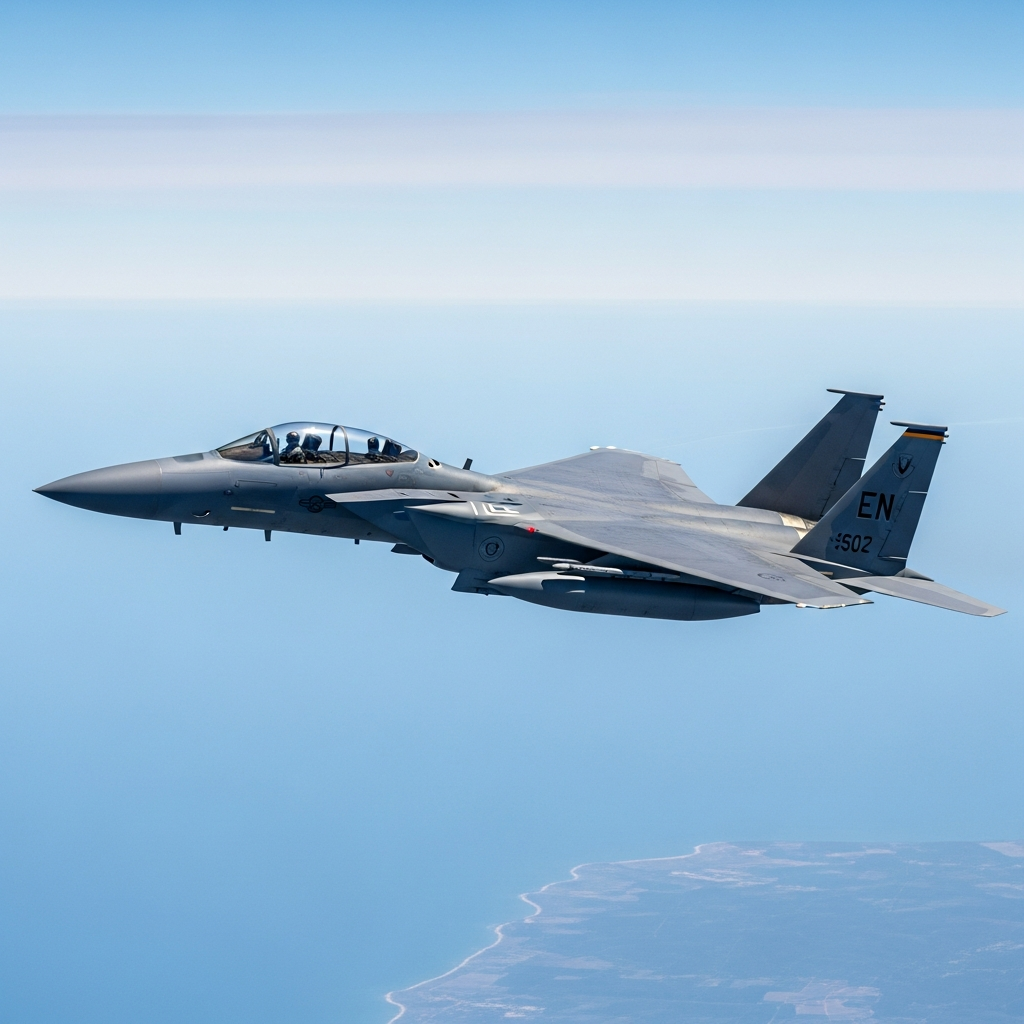
A U.S. Air Force F-15E Strike Eagle was shot down over Isfahan province, Iran, in the early morning hours of April 3 — not by a sophisticated missile battery, but by a single Iranian soldier on the ground who got lucky with a shoulder-fired MANPAD. The aircraft belonged to the 494th Fighter Squadron, 48th Fighter Wing, RAF Lakenheath. Both crew members ejected safely and were recovered alive after a nearly 48-hour rescue operation that President Trump called “one of the largest, most complex, most harrowing combat search and rescue missions ever attempted.”
The Shootdown
The aircraft, call sign DUDE 44, went down at approximately 4:40 a.m. local time on April 3. Chairman of the Joint Chiefs Gen. Dan Caine confirmed that the Joint Personnel Recovery Center immediately declared the pilot and weapons systems officer — flying as DUDE 44 Alpha and DUDE 44 Bravo — isolated in hostile territory.
At a White House press briefing on April 6, Trump explained the kill shot plainly: an Iranian soldier “got lucky” with a handheld heat-seeker that “got sucked right in by the engine.” The weapon was in the same class as Iran’s domestically produced Misagh missile. By that point, Iran’s integrated air defense network had already been largely dismantled — B-52s had been flying strike missions over Iran in late March — leaving a shoulder-fired MANPAD as the only viable remaining threat vector. This was not, however, the first significant U.S. aircraft loss of the campaign; three F-15Es were lost in a friendly fire incident over Kuwait on March 1, and an F-35 was struck by Iranian ground fire on March 19.
First Rescue — Pilot Extracted Under Fire
DUDE 44 Alpha, the pilot, was recovered first. In daylight. Trump’s Truth Social post noted U.S. forces spent seven hours over Iran during this phase of the operation. The rescue package was substantial: an HH-60W Jolly Green II helicopter, A-10 Thunderbolts flying traditional “Sandy” close-air-support suppression, HC-130J Combat King IIs on aerial refueling, and pararescuemen and combat rescue officers from Air Force Special Warfare on the ground.
It did not go smoothly. Gen. Caine described the scene without softening it:
“The HH-60W was engaged by every single person in Iran who had a small arms weapon.”
Two helicopters — a Black Hawk and a Pave Hawk — took multiple small arms hits. An undisclosed number of crew aboard the helicopters were injured. An A-10 supporting the mission was also struck by Iranian fire — it made it to Kuwaiti airspace before the pilot ejected safely, and the aircraft went down on Kuwaiti soil.
The Race for the WSO
The WSO — described by Trump as a “highly respected Colonel” who was seriously wounded — was a different problem entirely. Iranian and U.S. forces launched a simultaneous race across the Zagros Mountains to reach him first.
The airman evaded capture by scaling a 7,000-foot ridgeline on foot, hiding in a mountain crevice, and rationing his emergency beacon transmissions to avoid detection. Iran’s IRGC publicly offered locals a $60,000 reward for his capture. He reportedly managed one short radio transmission — “God is good” — before going quiet again.
The CIA ran a parallel deception operation, spreading disinformation inside Iran that both crew members had already been found and that U.S. forces were focused on exfiltration elsewhere. CIA Director John Ratcliffe confirmed the agency used technology reportedly developed by Lockheed Martin’s Skunk Works division to pinpoint the airman’s location inside the mountain terrain.
“While the Iranians were confused and uncertain of what was happening, the Agency used its unique, exquisite capabilities to search for — and find — the American.” — CIA official statement
The Extraction
Under cover of darkness on April 5, U.S. special operations forces — including elements of Delta Force and SEAL Team Six — penetrated deep into Iranian territory and pulled the WSO from the mountainside. He was moved toward waiting MC-130J Commando II aircraft for exfiltration. Then both MC-130Js became disabled on the ground.
U.S. forces destroyed both aircraft along with four special operations helicopters — reportedly MH-6 or AH-6 variants possibly from the 160th SOAR, though the specific variants have not been confirmed — to prevent Iran from recovering sensitive equipment. The WSO made it out with injuries reported variously as a sprained ankle, though Trump described him as seriously wounded. He is now being treated at Landstuhl Regional Medical Center in Germany.
Trump announced the rescue on April 5, calling it “an Easter miracle.”
“This is the first time in military memory that two U.S. Pilots have been rescued, separately, deep in Enemy Territory.” — President Donald Trump, Truth Social
Note: Trump’s characterization of both crew members as “pilots” is imprecise — one was a weapons systems officer, not a pilot.
Scale of the Operation
Trump disclosed the full footprint: 155 U.S. aircraft total — four bombers, 64 fighters, 48 tankers, and 13 rescue aircraft. Satellite imagery from Airbus, captured April 5 and analyzed by CNN, shows a roughly 40-foot-wide crater approximately 30 kilometers northwest of the MC-130J destruction site, consistent with a deliberate strike on crash site wreckage to deny Iran access to DUDE 44’s avionics and sensors.
CENTCOM separately claims the six-week campaign has struck more than 13,000 targets inside Iran and damaged or destroyed over 150 Iranian naval vessels.
What Comes Next
Two MC-130Js and multiple helicopters now sit on Iranian soil — or what remains of them. The immediate question is what Iran managed to recover before U.S. forces could destroy it. The shoot-down itself carries its own implication: a fourth-generation fighter downed by a MANPAD, after the supposed elimination of Iran’s integrated air defense network, is a reminder that degraded defenses are not the same as eliminated ones — and that this was not the first U.S. aircraft lost over the course of the campaign. Low-observable platforms remain operationally necessary in contested airspace, whatever the battle damage assessments say.
We’ll continue tracking CENTCOM’s assessments and any Iranian claims related to recovered U.S. hardware.
Stay in the loop
Get the latest aircraft insider updates delivered to your inbox.