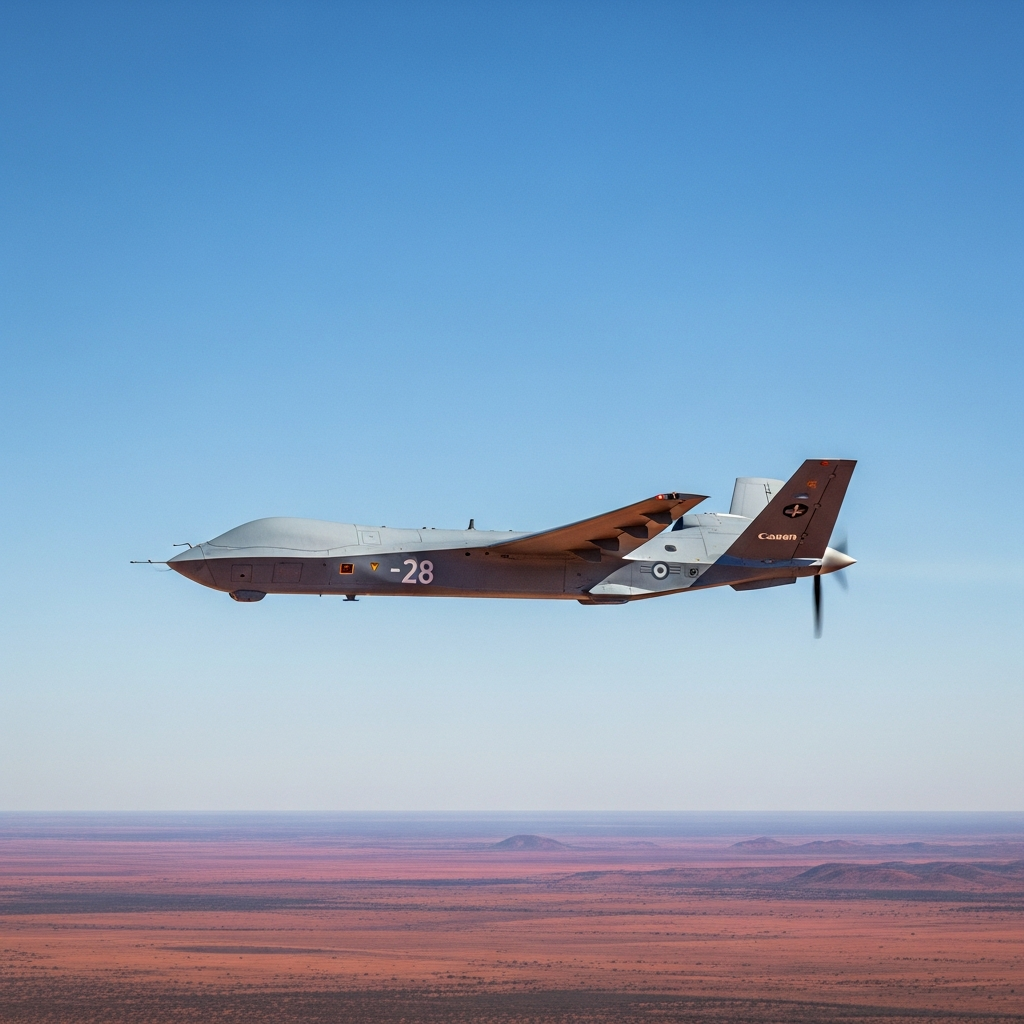
Australia’s Boeing MQ-28A Ghost Bat shot down a Phoenix jet-powered target drone on 8 December 2025 — destroying it with a live AIM-120 AMRAAM during Trial Kareela 25-4 at the Woomera Test Range in South Australia. It was the first air-to-air kill ever achieved by an Australian-designed combat drone, and it marked the moment the Ghost Bat became a combat-credible unmanned platform.
The engagement ran through a three-aircraft kill chain. An E-7A Wedgetail airborne early warning aircraft served as the command node. An F/A-18F Super Hornet identified and tracked the target. The Ghost Bat did the rest — executing the intercept autonomously after receiving just four high-level instructions: take off, enter a combat air patrol, commit, and intercept. Once authorised to engage, the MQ-28 manoeuvred independently to optimise missile performance, then provided AIM-120 mid-course guidance via its standard data link after firing. All three aircraft launched from separate locations and operated in coordinated formation throughout.
Boeing completed weapons integration for the test in under eight months — a figure the company attributes to the Ghost Bat’s open-systems architecture. The AMRAAM was carried on a single external pylon mounted on the left underside of the fuselage, directly below the engine air intake, a configuration made possible by the aircraft’s modular nose and flexible stores management.
“Australia is at the forefront of efforts to develop and field autonomous collaborative combat aircraft to provide asymmetric advantage and enhanced fighting depth for existing crewed platforms. … With Ghost Bat, the future of collaborative air combat is right here, right now.”
— Deputy Prime Minister Richard Marles
“The Ghost Bat transforms a single fighter jet into a formidable team — capable not only of surveillance but also of engaging adversaries. This delivers a vital layer of protection for our aviators who remain our most valuable asset.”
— Defence Industry Minister Pat Conroy
Funding and Production Commitment
The Australian government didn’t wait long to back the result. On 9 December 2025 — the day after the successful test — it announced an additional A$1.4 billion investment in the program, covering contracts for six further Block 2 operational aircraft and funding for an enhanced Block 3 prototype. Boeing Australia expects to deliver an operational-standard Ghost Bat to the RAAF by 2028. As of March 2026, the program has surpassed 150 test flights.
Block 2 and Block 3 — What’s Coming
Current Block 2 aircraft incorporate a refined wing design and upgraded GPS/INS over the original prototypes. Block 3 goes further. Now in development, it will extend the wingspan by 3 metres (10 ft) on each side — a total increase of 6 metres (20 ft) — delivering a 30 percent fuel increase — and introduce an internal weapons bay sized for one AIM-120 AMRAAM or two GBU-39/B Small Diameter Bombs. GBU-53/B StormBreaker glide bombs are also listed as a compatible option. The Williams International FJ44-A turbofan powers all three blocks.
Second in the World — But With NATO Credentials
Historically, the Ghost Bat was beaten to the milestone by Turkey’s Bayraktar Kızılelma, which fired a Gökdoğan beyond-visual-range missile on 28 November 2025 — roughly ten days earlier. The gap matters less than the weapon choice. The AMRAAM is a NATO-standard round with deep interoperability credentials across allied air forces, a detail not lost on potential export customers.
Germany’s defence minister Boris Pistorius signalled interest in the Ghost Bat during a visit to Australia on 27 March 2026. Four days later, on 31 March, Rheinmetall announced a teaming agreement with Boeing Australia to jointly offer the drone to the Bundeswehr. Japan established a cooperative framework for Collaborative Combat Aircraft activities in April 2026.
“… When we sit down with foreign customers and take them through where we’re actually at, most of them are blown away at how mature we are.”
— Glen Ferguson, Boeing MQ-28 Global Program Director, Singapore Airshow, February 2026
What to Watch
Block 2 aircraft are moving through ground testing. Block 3 design work is underway. The Ghost Bat’s developmental cadence is accelerating — and so is the human infrastructure behind it. The RAAF’s first non-Boeing qualified pilot, Wing Commander Phil Parsons, completed his training in June 2024, a sign the service is building the capacity to operate the fleet independently of its manufacturer.
Export decisions from Germany and Japan — both operating Eurofighters or F/A-18 variants with which the Ghost Bat is designed to integrate — could land before the end of 2026. The Block 3 first flight timeline and any formal export announcements are worth watching closely.
Stay in the loop
Get the latest aircraft insider updates delivered to your inbox.