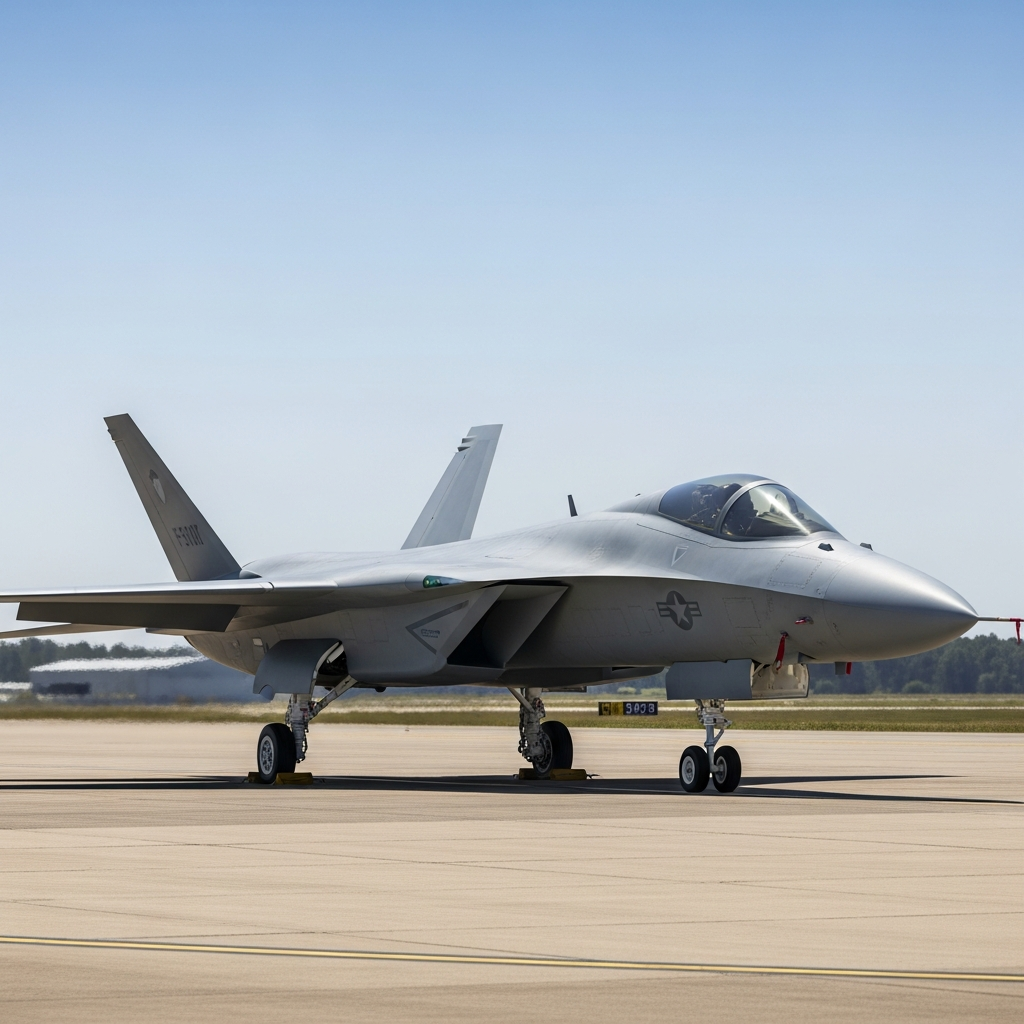
Northrop Grumman has formally unveiled its Talon uncrewed fighter concept — designated YFQ-48A by the U.S. Air Force on December 22, 2025 — built around the Scaled Composites Model 437 Vanguard airframe and positioned as a direct competitor in the Collaborative Combat Aircraft market. The reveal makes Northrop one of several major players to receive an official “FQ” prototype designation, joining General Atomics’ YFQ-42A Gambit, Anduril’s YFQ-44A Fury, and Lockheed Martin’s Vectis in what is shaping up to be the most consequential uncrewed aircraft competition in a generation.
The aircraft — registered N444LX — was publicly unveiled December 3–4, 2025, at Mojave Air and Space Port in California, with the “Talon Blue” name officially designated on February 23–24, 2026, reflecting its Air Force alignment. The timing matters. Northrop had previously been passed over for the Air Force’s CCA Increment 1 competition, and the Talon is a self-funded comeback built explicitly around the affordability lessons of that loss.
The Airframe — Model 437 Vanguard Roots
The YFQ-48A shares its outer mould line with the Scaled Composites Model 437 Vanguard — a single-engine, low-cost jet powered by a PW535 turbofan that completed its first flight at Mojave on August 29, 2024, and resumed envelope expansion flights on September 20, 2025 after hydraulic system upgrades and integration of Beacon autonomy subsystems. The Model 437 traces its lineage to Scaled’s earlier Model 401 and was originally conceived in 2021 as an attritable loyal wingman priced at $5–6 million per unit in series production.
The YFQ-48A features a long slender fuselage, swept lambda wings, a V-tail arrangement, and a single dorsal air intake — a layout that closely mirrors General Atomics’ YFQ-42A. Compared to Northrop’s original Increment 1 design, the Talon Blue is approximately 1,000 pounds lighter and contains roughly 50 percent fewer parts. The company claims its production process runs up to 30 percent faster, thanks to modular construction and composite materials. Projected unit cost sits in the $15–20 million range — well below the $75–150 million price tag of a crewed fighter.
Propulsion — Pratt & Whitney PW500
Pratt & Whitney confirmed on April 17, 2026, that its PW500 family turbofan will power the YFQ-48A — the same date Northrop announced the prototype’s successful first engine run. The PW500 family spans eight models producing between 2,900 and 4,500 pounds of thrust and has accumulated more than 24.5 million flight hours in commercial service. The Talon Blue is the first uncrewed fighter prototype to officially fly a Pratt & Whitney engine.
“We took a proven production engine, self-invested in key validation and capability improvement, and integrated it into this autonomous platform.” — Jill Albertelli, President of Military Engines, Pratt & Whitney
Autonomy — Talon IQ and the Beacon Ecosystem
The aircraft’s autonomous capability is driven by Northrop’s Talon IQ autonomy ecosystem, with the underlying Prism autonomy package already flight-proven on the company’s Beacon demonstrator program. Beacon — unveiled June 2025 — partners Northrop with six defense tech firms: Applied Intuition, Autonodyne, Merlin Labs, Red 6, Shield AI, and SoarTech. The Model 437 serves as the airborne testbed for Talon IQ maturation, with a safety pilot aboard during the flight test campaign.
“The whole concept behind Collaborative Combat Aircraft is all about affordable mass, which means you need to keep the cost down…” — Tom Jones, President, Northrop Grumman Aeronautics Systems
“This [Project Talon] was built to be produced quickly, not just to be affordable.” — Tom Jones, President, Northrop Grumman Aeronautics Systems
Marine Corps Contract and What’s Next
On January 8, 2026, the U.S. Marine Corps competitively awarded Northrop the MUX TACAIR CCA contract — the Marine Air-Ground Task Force Uncrewed Expeditionary Tactical Aircraft program. The award underscores the platform’s multi-service relevance at a moment when USMC leadership has publicly discussed CCA as a bridge toward a future stealth fighter replacement.
The USAF’s program executive officer for fighters offered measured but pointed encouragement:
“We are encouraged by Northrop Grumman’s continued investment in developing advanced semi-autonomous capabilities. Their approach aligns with our strategy to foster competition, drive industry innovation, and deliver cutting-edge technology at speed and scale.” — Brig. Gen. Jason Voorheis
With the first engine run complete and first flight projected for fall 2026, the central question now is how the USAF structures CCA Increment 2 competition — and whether Northrop’s self-funded gamble earns a formal place on that contract vehicle.
Stay in the loop
Get the latest aircraft insider updates delivered to your inbox.