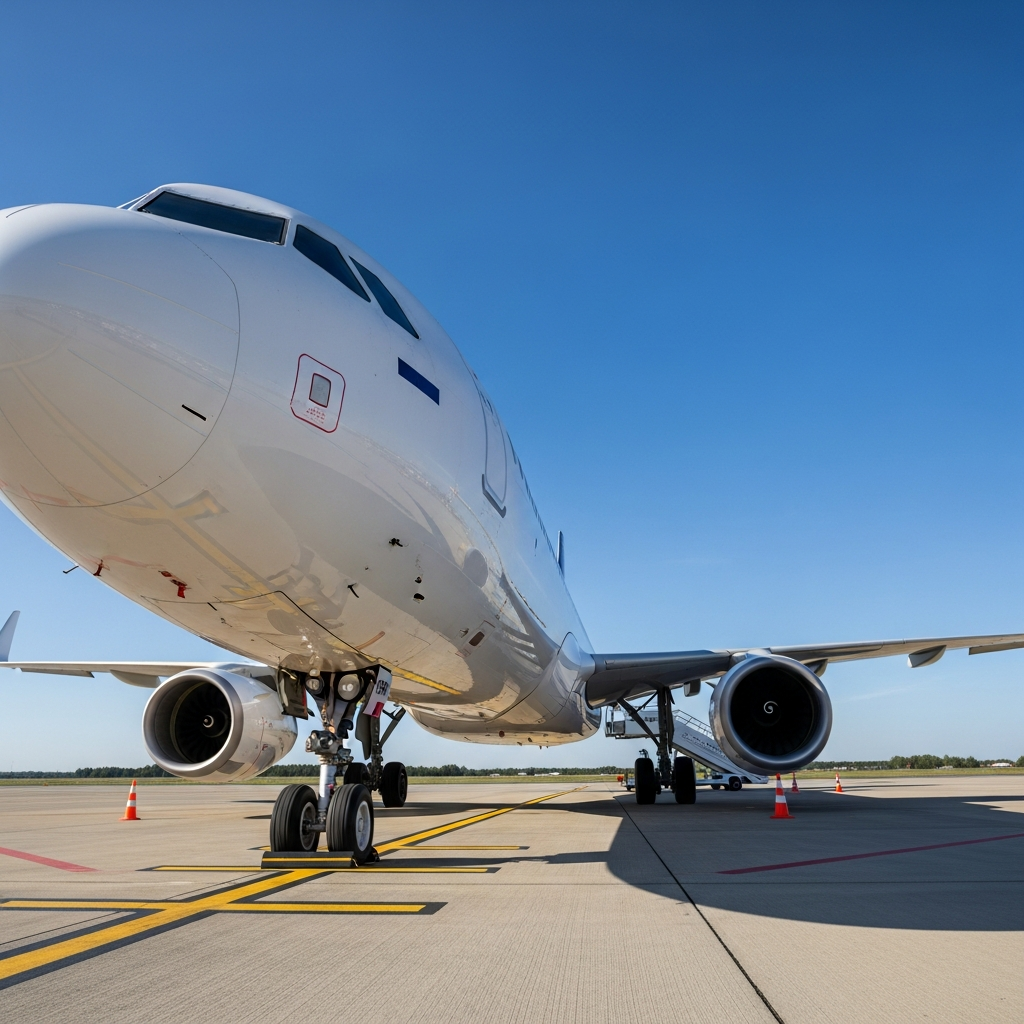
Southwest Airlines banned humanoid and animal-like robots from its aircraft on May 13, 2026 — two days after a 3.5-foot humanoid robot named Stewie walked through Harry Reid International Airport in Las Vegas, boarded a Boeing 737, took a window seat, and flew to Dallas Love Field without a hitch.
The prohibition is blanket. It covers all human-like and animal-like robotic devices regardless of size or purpose, in the cabin and as checked baggage, across every Southwest route in its network.
How Stewie Got Airborne
Aaron Mehdizadeh, owner of The Robot Studio in North Dallas, was heading home from Las Vegas when he decided to fly Stewie back rather than ship it as cargo. He bought the robot a standard extra seat — the same option Southwest offers for fragile oversized items like musical instruments or wedding dresses. Getting through TSA required one modification: Mehdizadeh swapped Stewie’s standard power pack for a smaller unit roughly equivalent to a laptop battery, bringing it within FAA carry-on lithium-ion limits.
Stewie walked independently through the terminal. It boarded the plane, settled into a window seat, and stayed there for the roughly three-hour flight. Passengers and crew reacted with visible surprise — though not, apparently, with alarm.
“Most people were very excited to see a robot flying and provided so much entertainment, and it was great,” Mehdizadeh said.
Two days later, Southwest moved to make sure it never happened again. Mehdizadeh posted on X with characteristic self-awareness:
“We just got robots banned from Southwest Airlines. You’re welcome 🫡”
Bebop Made It Worse
Stewie wasn’t even the first robot to give Southwest a headache that spring. On April 30, a passenger purchased an extra seat on Southwest flight 1568 from Oakland International (OAK) to San Diego International (SAN) for a 4-foot, approximately 70-pound humanoid named Bebop. Flight attendants flagged it almost immediately — the robot was seated in an aisle-adjacent position, a safety violation for oversized items, and had to be moved to a window seat.
Then came the bigger problem. Bebop’s lithium-ion power cells exceeded 100 Wh — the limit for installed batteries on commercial passenger aircraft. Spare batteries between 100 Wh and 160 Wh are sometimes permitted in carry-on luggage with prior airline approval, but above 160 Wh they are explicitly prohibited entirely.
“The device’s lithium battery exceeded the maximum allowable size, so the customer was asked to remove it,” a Southwest spokesperson stated.
Southwest confiscated the batteries before allowing the flight to continue. The aircraft arrived in San Diego an hour late. Two incidents involving walking robots in less than two weeks clearly forced the airline’s hand.
The Battery Problem — and Why It’s Bigger Than It Looks
FAA regulations cap installed batteries in carry-on devices at 100 Wh; spare batteries up to 160 Wh are permitted in carry-on only with prior airline approval. Stewie technically threaded that needle with its reduced-capacity unit. It doesn’t matter anymore. Southwest’s new ban operates above FAA minimums — battery compliance is now irrelevant for this device category. The door is simply closed.
The deeper issue is structural. No federal framework exists specifically for autonomous humanoid devices aboard commercial aircraft. A humanoid robot isn’t a passenger, a pet, a mobility aid, or a piece of checked freight in any existing regulatory sense — it occupies a category that nobody in aviation has formally defined. Aviation blogger Gary Leff, writing at View from the Wing, analyzed multiple dimensions of Southwest’s new policy, including pre-clearance requirements, robot body acceptability, battery size as a separate question, the requirement that robots be powered down and not walk the aisle, and window seat requirements — and noted that the policy hasn’t yet been incorporated into Southwest’s Contract of Carriage, a gap that could create real enforcement ambiguity at the gate.
IATA’s existing guidance treats most robot-scale battery systems as air cargo only. The FAA’s own lithium battery policy review — expected in the second half of 2026 — could establish the first federal rules specifically addressing robotic devices on passenger aircraft.
What Comes Next
No other major U.S. carrier has issued an equivalent policy. None has explicitly permitted humanoid robots either. That silence amounts to the same grey zone Southwest just escaped from. Companies that rent or transport humanoid robots — like Mehdizadeh’s Robot Studio — must now route their equipment through cargo channels, where battery rules are governed by a separate, stricter framework.
Mehdizadeh said he hopes Southwest will eventually reconsider, provided robots can meet verifiable safety requirements. The operators of Bebop were equally undeterred. Team member Eily Ben-Abraham indicated the robot would fly commercially again, noting: “At the moment, we got him under 100 pounds, so I shouldn’t have to worry about actually, like, walking him through the terminals.”
For now, Southwest is the only U.S. airline with a written answer to what happens when a robot tries to buy a ticket. Every other carrier is still working it out — one boarding pass at a time.
Sources
- Simple Flying — Southwest Airlines Humanoid Robot Ban Coverage (May 14, 2026)
- CBS News Texas — Southwest Airlines Robot Policy Statement
- NBC DFW — Aaron Mehdizadeh and The Robot Studio
- View from the Wing — Gary Leff Analysis on Robot Passenger Policy
- Interesting Engineering — Lithium Battery Regulations and Humanoid Robot Travel Context
Stay in the loop
Get the latest aircraft insider updates delivered to your inbox.