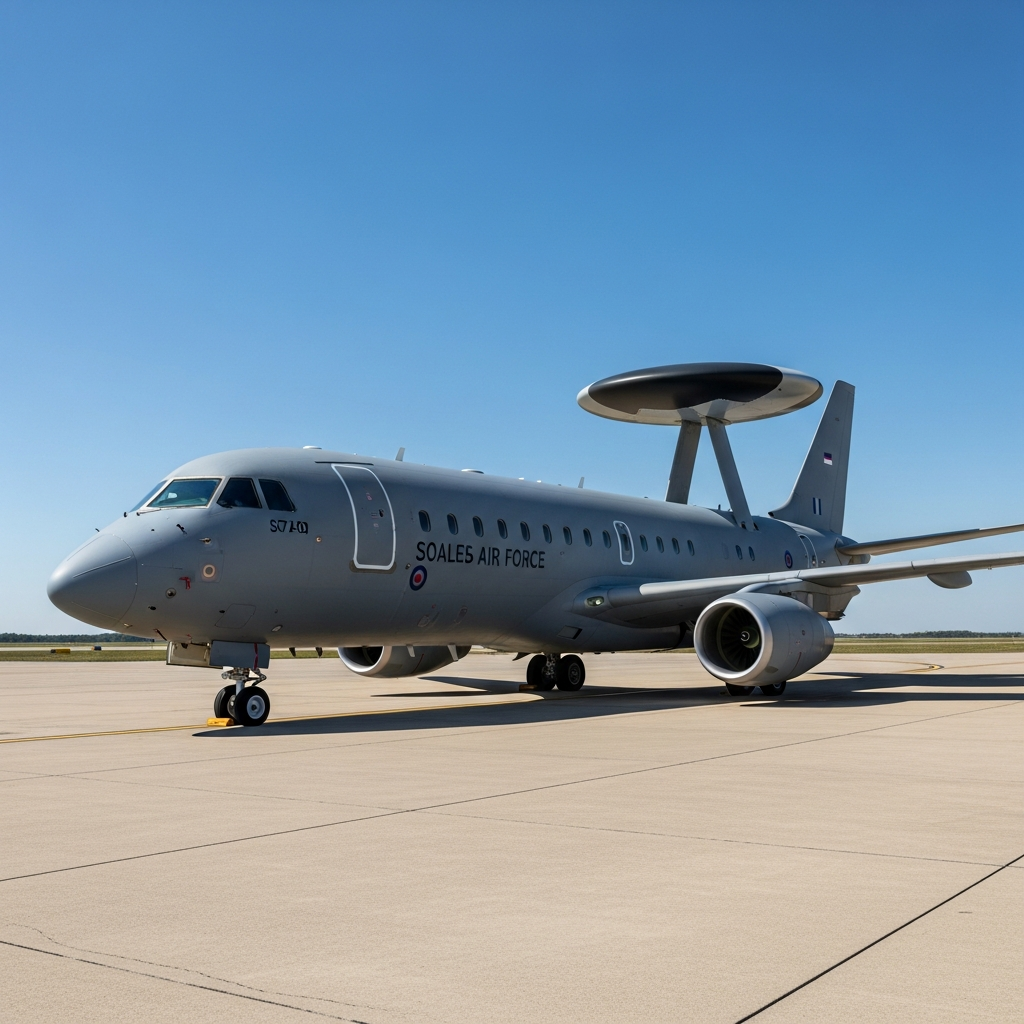
Canada has picked Saab’s GlobalEye airborne early warning and control aircraft over competing bids from Boeing and L3Harris—a major win for the Swedish manufacturer and a disappointment for U.S. defense contractors vying for a lucrative NATO allied contract.
Prime Minister Justin Trudeau made the announcement yesterday at the CANSEC defence exhibition in Ottawa. Canada will enter formal negotiations with Saab for six GlobalEye platforms, with the purchase estimated at more than $5 billion CAD ($3.6 billion USD) and deliveries expected to begin in the early 2030s.
“With a suite of advanced sensors and mission systems, Saab’s GlobalEye will be a key resource for the Canadian Armed Forces to detect and deter threats across the Arctic,” Trudeau said. “It builds Canadian strategic autonomy, creates Canadian jobs and reinforces Canada’s position as a global leader.”
Why GlobalEye Won
Built on the Canadian-manufactured Bombardier Global 6500 business jet airframe, the GlobalEye carries Saab’s Erieye ER extended-range S-band AESA radar and advanced multi-domain sensors. The system delivers mission endurance exceeding 12 hours and can detect threats—from ballistic missiles to jet-ski-sized maritime targets—at ranges exceeding 650 kilometers.
The smaller Global 6500 airframe gives GlobalEye significant operational advantages over Boeing’s E-7 Wedgetail, which relies on the larger Boeing 737. GlobalEye needs shorter runways, uses less fuel, operates with smaller crews, and costs less to maintain—all critical factors for Canada’s vast northern territories and Arctic operations.
This marks the first time a Canadian prime minister has attended CANSEC, underscoring the political weight of the decision. Sweden’s Prime Minister Ulf Kristersson welcomed Canada to “the GlobalEye family,” noting that the platform’s use of the Canadian-built Global 6500 airframe will continue supporting Canadian aerospace jobs.
What This Means for the RCAF
Canada currently operates no dedicated airborne early warning aircraft despite responsibility for 9.98 million square kilometers of territory and one of North America’s largest aerospace warning regions under NORAD. The Royal Canadian Air Force has relied on allied assets and fixed radar networks—the Cold War-era North Warning System—for air defense coverage, leaving the country vulnerable to modern threats including drones, cruise missiles, and stealthy aircraft.
The GlobalEye will provide sovereign airborne battle-management capability for NATO expeditionary operations and independent Arctic surveillance. It reduces dependence on U.S. E-3 Sentry aircraft and NATO AWACS detachments for coalition missions.
Why Boeing and L3Harris Lost
Boeing’s E-7 Wedgetail faces headwinds. Despite proven capability with Australia and an approaching first delivery to the RAF, the program has suffered production delays due to onboard systems obsolescence and Boeing’s manufacturing challenges. The RAF’s first Wedgetail arrived at RAF Lossiemouth on May 21, 2026—three years late—and has yet to enter operational service pending test and evaluation.
L3Harris’ Aeris X, developed jointly with Israel Aerospace Industries’ ELTA Systems, ran into complications stemming from Canada’s suspension of military export permits to Israel. The platform remains in early production after the company’s first sale to South Korea in 2025.
Industrial and Political Dimensions
The procurement decision aligns with Prime Minister Trudeau’s stated commitment to reduce Canadian military dependence on the United States. The government projects the GlobalEye purchase will create more than 3,000 specialized aerospace jobs, with Saab committing to Canadian participation in assembly, mission integration, sustainment, and software support.
Saab Canada has confirmed that if procurement proceeds, the company will transfer intellectual property and knowledge to enable domestic build, maintenance, and upgrades. The government estimates that at least one-third of GlobalEye aircraft ordered by various allies over the next 15 years will be assembled in Canada.
Canada becomes the fourth GlobalEye operator after the United Arab Emirates, Sweden, and France. Canada’s newly created Defence Investment Agency is leading negotiations, though no contract has been signed and no completion timeline has been disclosed.
Stay in the loop
Get the latest aircraft insider updates delivered to your inbox.