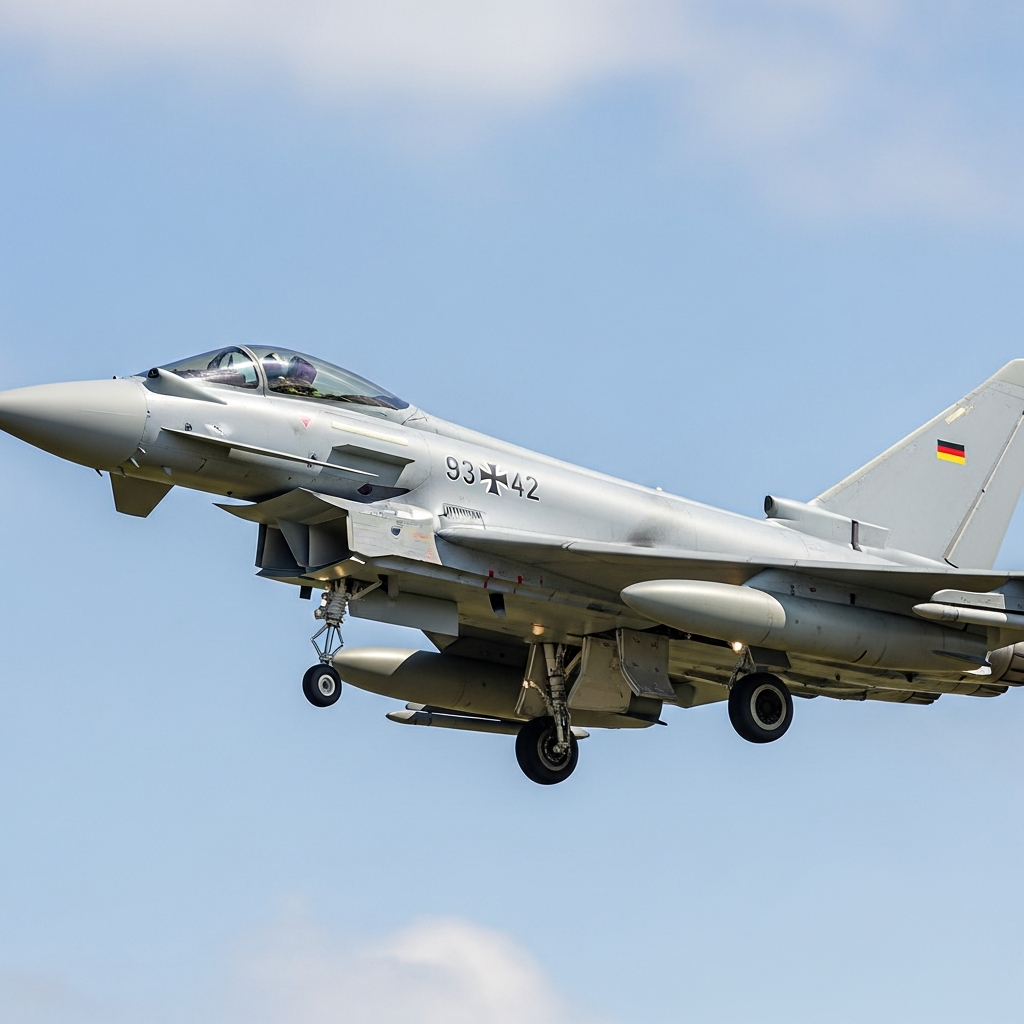
Germany’s Luftwaffe hit a major milestone on July 14, 2026. The first Eurofighter built under the Quadriga program completed its maiden flight from Airbus’s Manching facility near Munich—a significant moment for a modernization effort that has fallen roughly seven years behind its original schedule.
Airbus test pilot Stefan Auer took the single-seat fighter, registered 34+02, up for just over an hour. His mission: validate basic handling, engine performance, flight-control systems, hydraulics, electrical architecture, and the navigation suite. It all worked. The aircraft is the lead example of a 38-airframe order—comprising 30 single- and eight two-seat Eurofighters—Germany placed in November 2020, meant to replace aging Tornado Interdiction Strike and Electronic Combat Reconnaissance jets by the 2030 retirement deadline.
“During the production flight acceptance test, Airbus test pilot Stefan Auer tested the fighter jet to its limits for more than an hour to evaluate basic flight characteristics, engine performance, flight control system, hydraulics and electrical systems,” Airbus Defence & Space confirmed. “Everything worked flawlessly.”
What Makes Quadriga Different
The Quadriga jets are the first Eurofighter Tranche 4 standard—a generational leap forward in sensor and computing architecture. At their heart sits the European Common Radar System Mark 1 Step 0 (ECRS Mk1), an active electronically scanned array (AESA) radar developed jointly by Germany’s Hensoldt and Spain’s Indra. It replaces the mechanically scanned Captor-E radar carried by earlier Eurofighter variants.
AESA technology is a game-changer. The Eurofighter can now track multiple targets at once, switch between air and ground scanning in microseconds, and resist enemy jamming far more effectively than previous generations. The radar is jointly engineered to a standard already proven operationally in Kuwait and Qatar, though with enhancements tailored to German and allied needs.
Two Eurojet EJ200 turbofans power the aircraft—each producing roughly 90 kilonewtons in afterburner. The Eurofighter can sustain supersonic flight without continuous afterburner, a capability called supercruise that few fighters worldwide possess. The Quadriga variant also integrates the Taurus air-launched cruise missile, which significantly extends strike range and precision.
The SEAD Mission Returns
Fifteen of the 38 aircraft will be configured as dedicated electronic-attack variants. They’ll carry Saab Arexis wingtip suppression pods—restoring a suppression-of-enemy-air-defences capability the Luftwaffe will lose when its 90 Tornado ECR aircraft retire. That gap has left NATO’s European members dependent on American platforms and legacy assets.
Timeline to Service Entry
The first delivery is scheduled for later in 2026, following type certification. Deliveries of the initial 38 aircraft will run through 2030. The Step 1 radar variant—with upgraded hardware and software—is expected to begin entering service in mid-2027. Germany has also authorized a €412 million investment to modernize Eurofighter flight simulators to accommodate the new radar and future upgrades.
The seven-year slip from the originally planned 2025 entry reflects broader industrial challenges plaguing European defense programs. In October 2025, Germany ordered an additional 20 Tranche 5 aircraft, bringing the total new Eurofighter commitment to 58—a signal of sustained confidence in the platform as the Franco-German-Spanish Future Combat Air System (FCAS) faces persistent delays and workshare disputes with no operational aircraft expected before the 2040s.
Fleet-Wide Context
Germany currently operates roughly 138 Eurofighters across Tranches 1 through 3. The oldest Tranche 1 jets entered service in 2003. The Quadriga order will replace these aged airframes rather than serve as the primary Tornado replacement—the Tornado’s nuclear mission transfers to 35 F-35A Lightning IIs, while deep strike, EW, and reconnaissance roles go to the modernized Eurofighter.
Italy has ordered 24 Tranche 4 aircraft. Spain is acquiring 45 under separate Halcón programs. Turkey signed for 20 aircraft in October 2025. The Eurofighter production line sustains an estimated 100,000 jobs across Germany, Britain, Italy, and Spain—making continued orders a hedge against FCAS delays and an economic pillar for the consortium.
Stay in the loop
Get the latest aircraft insider updates delivered to your inbox.