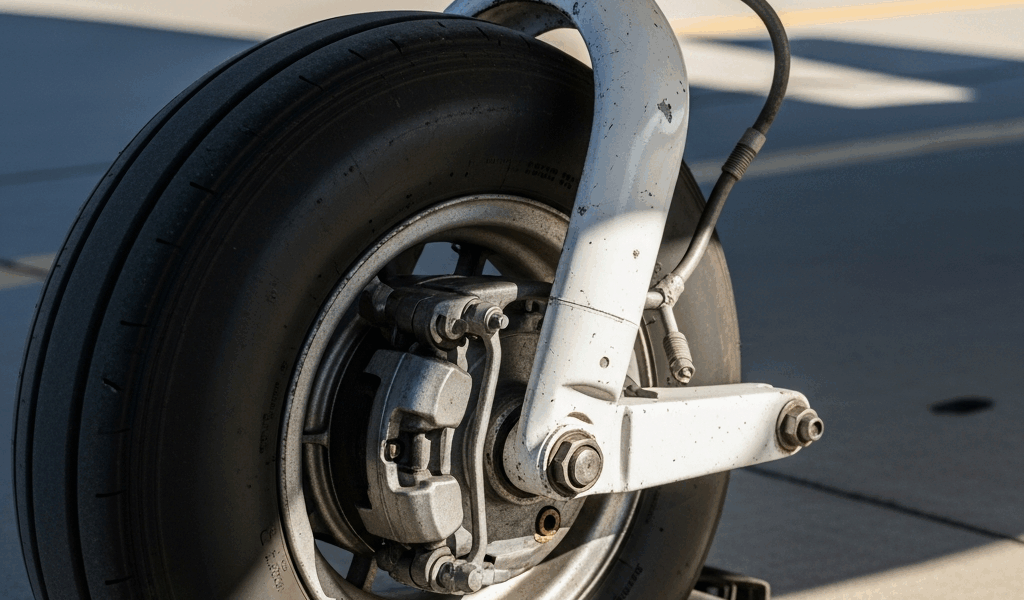
Why 172 Landing Gear Gets Ignored Until Something Goes Wrong
Cessna 172 landing gear has gotten complicated — or rather, the conversation around it has — with all the “it’s fixed gear, it takes care of itself” noise flying around. As someone who has logged over 800 hours in 172s and spent a fair amount of time on my knees during preflight walkarounds, I learned everything there is to know about what goes wrong with this gear and why. Today, I will share it all with you.
Fixed gear breeds a specific kind of complacency. No gear-up switch. No amber warning light. No hydraulic pump humming away on final. Most pilots treat the landing gear the way they treat the fuselage — just there, just working. Until it isn’t.
Retractable systems get obsessive attention. Every pilot who flies a Mooney M20 or a Piper Arrow can recite the emergency extension procedure cold. Fixed gear? We assume it’s maintenance-free. It genuinely is not. The shimmy on rollout, the squeak during taxi, the flat spot discovered two weeks after an all-day cross-country — these are what send student pilots searching at midnight for answers. And honestly, that instinct is correct. What I’ve pieced together from walkarounds, post-landing troubleshooting, and frank conversations with line mechanics is that a structured inspection catches 90 percent of issues before they escalate. That’s what we’re covering here, in order of how often these problems actually show up.
Shimmy on Touchdown or Rollout
Nose gear shimmy is the single most common complaint I hear from 172 pilots. The nose wheel oscillates side to side — right after touchdown, during rollout, sometimes both. Some pilots describe it as rapid vibration through the yoke. Others say the entire nose seems to bounce. Either way, it’s not normal.
Mild vibration from rough pavement? Normal. A small thump when the nose wheel first contacts the runway? Normal. But rhythmic, repeating oscillation you can feel in your hands or see in the nose cowling? That’s a shimmy damper problem — full stop.
But what is a shimmy damper? In essence, it’s a small hydraulic cylinder — about three inches long on a 172 — bolted between the nose gear fork and the fuselage. Its only job is to absorb and kill that oscillation before it cycles back through the structure. But it’s much more than that; it’s also your early warning system for other developing gear problems.
When the internal seal fails and fluid leaks out, or when the dampening material inside degrades from age, the damper stops working. Here’s exactly what to check during preflight: get on your knees — yes, actually on your knees — and look at the damper cylinder. It should be dry. No wet spots anywhere on the surface, no drips on the asphalt below it. Run your finger along the cylinder body. Should feel solid, no pitting. The attachment bolt at the fork end needs to be tight. Grab the damper with one hand and try to move it. If it moves, that bolt is loose — and a loose bolt is itself a secondary shimmy cause, independent of damper condition.
Replacement parts run about $400 to $600, plus shop labor. Catching this during walkaround is the whole game.
The Secondary Culprit: Nose Gear Fork Bolt
Vibration and thermal cycling work that fork bolt loose over months. It’s slow, gradual, and completely invisible until you grab the damper and feel it wiggle. Check it with a wrench during every 50-hour inspection — at least if you fly frequently. Torque spec is roughly 15 foot-pounds. Write it on your clipboard and actually do it.
Flat Spots, Uneven Wear, and Tire Pressure
Probably should have opened with this section, honestly. Flat spots are the thing most low-hour pilots notice first and understand least.
Here’s what happened to me: I arrived at a remote strip — Minden-Tahoe, 2019 — to pick up a 172 I hadn’t flown in about five weeks. The main gear tires had visible white creases where the rubber had compressed against the hot asphalt and stayed there. The airplane had been sitting outside in direct sun. It felt horrible during taxi — rhythmic thumping you could feel in the seat — and I ended up ferrying it home at reduced speed and scheduling tire replacement the next morning.
Don’t make my mistake. Check tire pressure cold, before every flight. Main gear tires on a 172 take 36 PSI. Nose gear takes 24 PSI. Those numbers are specific and they matter. Under-inflate by 4 or 5 pounds and let the airplane sit for three weeks — flat spots become almost inevitable.
Uneven wear is a different signal. One main tire bald on the inboard edge, fresh tread on the outboard? That points to alignment issues or — more commonly — a shimmy problem that got ignored. The vibration preferentially wears one part of the contact patch. By the time you notice the wear pattern, the shimmy has probably been there for a month. That’s what makes the shimmy damper so endearing to us 172 pilots as a diagnostic clue — it tells you about problems that haven’t announced themselves yet.
Tire cupping — small scalloped indentations around the circumference — is the dead giveaway of an unresolved shimmy. See cupping, stop flying, get the damper replaced. Not optional.
Brake Squeal, Soft Pedals, and Pulling on Landing
Three complaints. One diagnostic framework. So, without further ado, let’s dive in.
Soft or spongy pedals mean air has gotten into the hydraulic line, or the fluid reservoir is low. The reservoir lives under the instrument panel on the pilot’s side — small cylindrical canister, easy to miss on a quick scan. Fluid should reach the fill line. If it’s low, top it off with MIL-H-5606 — that’s the only fluid the 172 uses, and substituting anything else causes seal damage. But understand that topping off doesn’t fix a leak. It buys you information. Find the weep, then schedule maintenance.
Pulling to one side during rollout almost always means uneven pad wear or a sticking caliper. Pull the wheel fairings and compare pads left to right. One pad shiny and glazed while the other looks chalky? Uneven wear. A sticking caliper is harder to diagnose by eye — that one goes to your A&P.
Brake squeal is glazed pads. I’m apparently sensitive to it — a faint squeal bothers me immediately while other pilots never notice it until the pads are gone. The Cessna Cleveland 30-63 brakes that come stock on most 172s are particularly prone to glazing if they’ve been overheated even once. Glazed pads don’t bite as hard. You’ll need more runway to stop. Not an emergency, but not something to defer through two more annuals either.
When to Ground the Plane and Call a Mechanic
Some discoveries end the flight before it starts. Period.
- Visible crack in a wheel fairing or brake dust cover
- Brake fluid pooling under the wheel — even a small puddle, even just drips
- Nose gear with lateral play greater than roughly a quarter inch when you push it by hand
- Tire cord showing — the white or colored thread visible beneath the rubber surface
- A flat spot deep enough to fit your fingertip into the depression
Finding these things during preflight means the system worked. You caught a safety problem before it became a safety event. That’s a win — genuinely.
Annual inspections exist specifically to surface gear issues before your walkaround ever sees them. A thorough annual — and I mean thorough, not a rubber-stamp sign-off from someone who spent 40 minutes on the whole airplane — runs $1,500 to $2,500 at most shops. That number stings less when you consider that an emergency fix after something fails in the field routinely runs double. Ask me how I know.
Walk around your 172 every single time. Your instinct to question what feels wrong is exactly right.

Leave a Reply