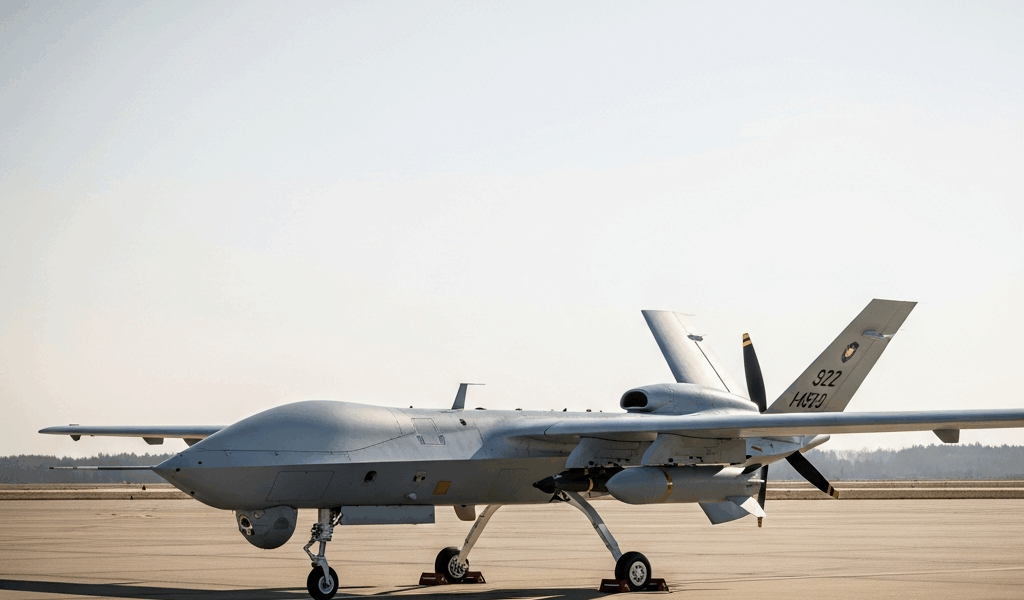
U.S. Central Command has stood up its first dedicated one-way attack drone squadron — and it’s flying reverse-engineered copies of Iran’s own Shahed-136 kamikaze aircraft against Iranian targets. It’s the first time American forces have used long-range expendable attack drones in combat.
Task Force Scorpion Strike (TFSS) was established in December 2025, four months after Secretary of War Pete Hegseth directed the accelerated fielding of affordable drone technology. The unit flew its first combat missions on February 28, 2026, striking Iranian targets during Operation Epic Fury. CENTCOM confirmed the operation through spokesman Capt. Tim Hawkins.
“CENTCOM’s Task Force Scorpion Strike — for the first time in history — is using one-way attack drones in combat during Operation Epic Fury. These low-cost drones, modeled after Iran’s Shaheed drones, are now delivering American-made retribution.”
The Drone — LUCAS
The system is called LUCAS — Low-Cost Uncrewed Combat Attack System. It was developed by SpektreWorks, an Arizona-based unmanned systems firm that received a $30 million APFIT contract in FY2025. The company had already built the FLM-136, a Shahed-inspired target drone used for counter-drone training, and evolved that airframe directly into LUCAS.
The geometry is nearly identical to the Shahed-136’s delta-wing configuration. LUCAS runs about 10 feet long with an 8-foot wingspan, carries up to 18 kilograms of explosives in its nose, and cruises at roughly 74 knots — with a dash speed approaching 105 knots. Range is quoted at 500 miles. Unit cost sits between $10,000 and $55,000; CENTCOM officially pegs it at approximately $35,000 per airframe. For context, a single PAC-3 interceptor costs roughly $4 million. That’s a cost-exchange ratio of 114-to-1 — a gap that has repeatedly exposed the limits of conventional air defense economics, historically favoring Iran over U.S. air defenses.
LUCAS launches via catapult or rocket assist, operates beyond line of sight, and carries anti-jamming and swarming software. According to defense analysts, LUCAS may tap SpaceX’s Starshield military satellite network for navigation and communications resilience.
How the U.S. Got Here
The U.S. military captured at least one Shahed-136 several years before 2025 and quietly reverse-engineered it. The effort accelerated under Deputy Assistant Secretary of Defense Michael C. Horowitz between 2022 and 2024, as footage from Ukraine made the case hard to ignore — Russian forces had deployed Shaheds at scale, and Ukrainian commanders say strike drones now account for 60–70 percent of all hits on Russian targets.
“We obtained an Iranian Shahed, examined it, and replicated it. The LUCAS drone is the product of these efforts. It essentially follows the Shahed design.” — Anonymous U.S. official
LUCAS drones appeared on a CENTCOM area tarmac in photography dated November 23, 2025. On December 16, 2025, USS Santa Barbara (LCS-32) conducted the first naval launch of a LUCAS in the Persian Gulf, operating under Task Force 59. Army testing at Yuma Proving Ground using inert payloads followed later that same month under Marine Corps sponsorship.
Combat Performance and Scale
The system caught on fast. By March 5, 2026, CENTCOM commander Admiral Brad Cooper called LUCAS “indispensable” to U.S. forces in the theater. By April 7, CENTCOM announced “hundreds” of unmanned platforms active in Operation Epic Fury — LUCAS among them in the long-range strike role. Pentagon Top Official for Defense Research & Engineering Emil Michael said the system had worked “very well so far” and called it “a useful tool in the arsenal.”
“Costing approximately $35,000 per platform, LUCAS is a low-cost, scalable system that provides cutting-edge capabilities at a fraction of the cost of traditional long-range U.S. systems.” — Capt. Tim Hawkins, CENTCOM
Defense analysts note that LUCAS swarms serve a dual function: direct strikes against soft targets like power infrastructure and command nodes, and radar saturation to punch corridors open for more expensive precision munitions aimed at hardened facilities.
What Comes Next
Marine Corps Systems Command issued a sources-sought notice on April 8, 2026, for a $50–75 million support contract tied to the OPF-L loitering munition, with fielding expected to begin in September 2026. The U.S. Air Force is pursuing its own expendable strike drone programs. Analysts flag that extended-range LUCAS variants could eventually complicate Chinese air defenses across the Pacific — a theater where saturation tactics would carry strategic weight well beyond the Middle East.
Task Force Scorpion Strike’s operational tempo and any confirmed expansion of the LUCAS fleet into additional combatant commands will be tracked as developments emerge.
Sources
- FlightGlobal — Defence
- DefenseScoop — Task Force Scorpion Strike Coverage
- U.S. Central Command — Official Statements
- SpektreWorks — FLM-136 / LUCAS Platform
- U.S. Department of Defense — APFIT Program & Drone Dominance Directive

Leave a Reply