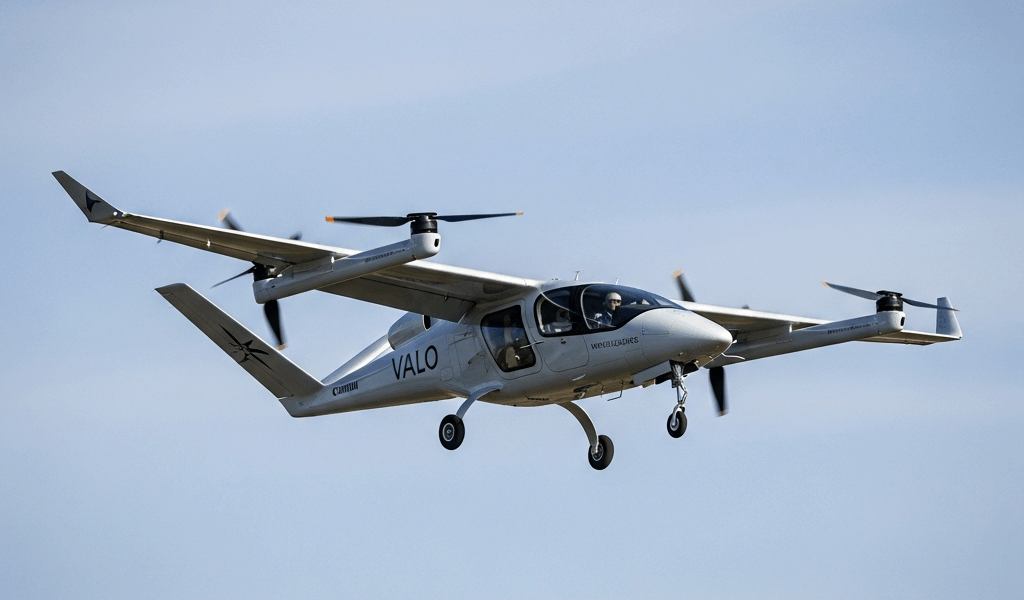
Vertical Aerospace VX4 Prototype Completes Historic Piloted Transition — Takes Off Like a Helicopter, Cruises Like a Plane
On April 2, 2026, test pilot Paul Stone lifted Vertical Aerospace’s full-scale VX4 eVTOL prototype off the runway at Cotswold Airport, transitioned it into wingborne cruise flight, and brought it back down — with a conventional runway landing. The flight, conducted at Vertical’s Flight Test Centre in Gloucestershire, is the most significant milestone in the company’s ten-year history. It also places Vertical among a very small group of eVTOL developers to have pulled off that maneuver at full scale with a pilot on board.
What Happened on April 2
Stone flew the prototype through a structured transition sequence: vertical takeoff under thrustborne control, forward tilt of the front propellers, smooth acceleration into wingborne cruise, then a conventional runway landing. The aircraft hit approximately 65 knots — roughly half its projected top speed of 130 knots. As wing lift assumed the load, the rear propellers stowed entirely, demonstrating the core aerodynamic handoff that makes a winged eVTOL design viable in the first place.
Vertical announced the milestone publicly on April 6, four days after the flight — standard practice while post-flight data is reviewed and release language is cleared with the UK Civil Aviation Authority. The CAA issued a Phase 4 Permit to Fly in November 2025 and has maintained active regulatory oversight throughout the test campaign.
“This marks a turning point not just for Vertical Aerospace, but for the entire advanced air mobility industry. Achieving piloted thrustborne transition under active regulatory oversight — alongside the recently announced financing package — demonstrates that we have solved the hardest engineering challenges, have the regulatory relationships to complete certification, and now have the financial foundation to see this through to commercial service.” — Stuart Simpson, CEO, Vertical Aerospace
The Architecture That Makes It Hard
Transition is the moment where winged eVTOL designs either prove themselves or don’t. Vertical’s Valo uses eight electric propulsion units in a tiltrotor-influenced arrangement — forward props tilt to generate forward thrust during transition while aft props manage vertical lift before stowing in cruise. April 2 used the prototype VX4 airframe. The production Valo refines that with a 20% reduction in wetted area versus the VX4, a 1-meter wingspan increase, and a 15% lower takeoff mass, driven by airframe shaping, a revised V-tail and empennage, and updated battery packaging.
There’s an important caveat. What Stone demonstrated is only the first half of a full two-way transition sequence. A complete mission profile — vertical takeoff, wingborne cruise, deceleration back through transition, vertical landing — still needs to be demonstrated. Vertical is expanding the envelope from both ends simultaneously and has not announced a date for that full sequence.
Where This Puts Vertical in the Competitive Field
Vertical is now the third commercial-generation western eVTOL developer to achieve a piloted transition flight, though crewed eVTOL transitions date back further — including a Zee Aero prototype in August 2017. In the current generation of commercial programs, Beta Technologies got there in April 2024, Joby Aviation in April 2025. Both have since completed the full two-way maneuver. Archer is still working through piloted VTOL testing. Eve Air Mobility conducted its first remotely piloted hover in December 2025.
$850 Million and a Tight Timeline
On March 30, 2026 — one week before the flight milestone was publicly announced — Vertical confirmed an agreement in principle for a financing package of up to $850 million. The structure: $50 million in equity already issued, $30 million to follow within weeks, $50 million in new convertible secured notes from Mudrick Capital, $250 million in Series A convertible preferred shares from Yorkville Advisors Global, and a $500 million equity line of credit from the same source. Mudrick also extended the maturity of existing notes to December 2030. Definitive documents are targeted for completion by mid-to-late April 2026.
“This financing package provides immediate working capital and provides management with flexible tools to access additional capital in a manner that promotes capital efficiency, as we progress through our certification milestones.” — Domhnall Slattery, Chairman, Vertical Aerospace
The urgency is real. Vertical ended 2025 with approximately $93 million in cash against a projected $190–200 million burn rate over the next twelve months — which makes closing this financing package essential, not optional. The company estimates total certification costs at around $700 million. Plans call for assembling the first conforming Valo aircraft later this year as part of a certification fleet of up to seven aircraft, following a critical design review. Cantor Fitzgerald reiterated an Overweight rating with an $8.00 price target after the announcement.
What to Watch Next
Three markers will define the next chapter for this program. First, the two-way transition — decelerating from wingborne flight back through to a vertical landing — is the remaining technical gate before Vertical can credibly demonstrate a full operational mission. Second, the $850 million financing package needs to be finalized. Third, a critical design review timeline needs to be published. All three are worth watching closely.


Leave a Reply