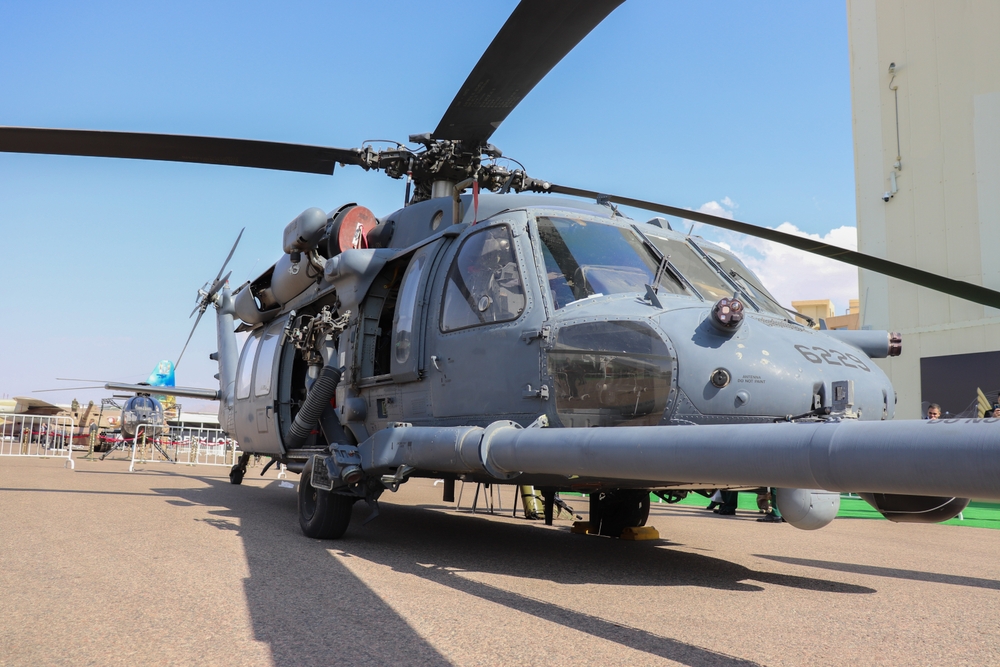
The HH-60W Jolly Green II is the U.S. Air Force helicopter built to recover isolated personnel from hostile or denied territory. It replaces the HH-60G Pave Hawk and adds more internal fuel, digital mission systems, improved threat warning, tactical data links and updated weapons.
The HH-60W first flew on May 17, 2019. The Air Force declared it combat ready in October 2022, and the service deployed the type to East Africa in June 2026. It also supports civil search and rescue, medical evacuation, humanitarian relief, disaster response and noncombatant evacuation.
The aircraft is based on the Army's UH-60M Black Hawk production design, but it is not simply a Black Hawk with a rescue hoist. Sikorsky and the Air Force integrated a combat-rescue fuel system, sensors, communications, armor, defensive aids, weapons and cabin displays around the personnel-recovery mission.
HH-60W specifications
| Specification | Published Air Force figure |
|---|---|
| Primary role | Personnel recovery in hostile conditions |
| Manufacturer | Sikorsky, a Lockheed Martin company |
| Engines | Two General Electric T700-GE-701D turboshafts |
| Published engine output | 1,940 shaft horsepower each |
| Rotor diameter | 53 ft 8 in (16.36 m) |
| Length | 64 ft 11 in (19.79 m) |
| Height | 16 ft 11 in (5.16 m) |
| Maximum takeoff weight | 22,700 lb; 23,500 lb with cargo load |
| Fuel capacity | 4,300 lb |
| Crew | Two pilots and two special-mission aviators |
| Armament | Two 7.62 mm miniguns or two .50-caliber machine guns |
| Aerial refueling | Yes |
| First flight | May 17, 2019 |
| Initial operating capability | 2022 |
These values come from an Air Combat Command fact sheet. Another current Air Force installation fact sheet rounds the dimensions differently and publishes an operating weight of 22,500 pounds. Operating weight and maximum takeoff weight are not interchangeable.
Why official range and speed figures differ
Air Force sources do not publish one self-explanatory performance table.
The Air Combat Command fact sheet lists:
- maximum airspeed of 176 knots
- range of 480 nautical miles without aerial refueling
- ceiling of 14,000 feet
The Davis-Monthan Air Force Base fact sheet lists:
- 176 mph / 153 knots indicated airspeed at sea level
- range of 690 statute miles / 599 nautical miles
- ceiling of 20,000 feet
Those numbers should not be mixed into a single record-setting specification. “Maximum airspeed” differs from indicated airspeed at sea level, and range varies with fuel reserve, payload, altitude, profile and the point at which the mission is measured. “Ceiling” can also refer to different operating or service limits.
For planning purposes, the durable conclusions are:
- the helicopter is air-refuelable
- it carries substantially more internal fuel than the HH-60G configuration it replaces
- published unrefueled range depends on the source's test or mission definition
Sikorsky says the HH-60W doubles internal fuel capacity compared with the HH-60G without using cabin-consuming auxiliary tanks. That adds reach while preserving mission space, but it does not eliminate payload-versus-range tradeoffs.
What the HH-60W is designed to do
The primary mission is combat search and rescue, more broadly described by the Air Force as personnel recovery. Commanders can use HH-60W units to recover isolated people:
- in hostile or denied territory
- by day or night
- in adverse weather
- in conventional or chemical, biological, radiological and nuclear threat environments
The mission is wider than retrieving a downed pilot. Isolated personnel can include aircrew, ground forces or civilians who must be located, supported and extracted.
The Air Force also lists humanitarian assistance, civil search and rescue, disaster relief, medical evacuation and noncombatant evacuation. Those missions use many of the same capabilities: a trained crew, hoist and recovery equipment, medical support, communications, range and the ability to operate away from a prepared landing area.
Mission systems and situational awareness
The HH-60W has integrated cockpit and cabin displays rather than treating mission information as a collection of separate add-on boxes. Air Force material identifies:
- multifunction cockpit displays
- tactical moving maps
- advanced communications
- Link 16
- Situational Awareness Data Link
- Automatic Dependent Surveillance-Broadcast
- integrated cockpit and cabin mission information
Link 16 and the Situational Awareness Data Link help crews exchange tactical information with other participants. ADS-B supports cooperative air-traffic awareness. These systems serve different networks and should not be collapsed into a generic claim that the helicopter “sees everything.”
Integrated information reduces crew workload and improves coordination, but coverage, classification, line of sight, emissions control and the wider force package still shape what data is available.
Defensive systems and armor
Combat rescue can require entering an area where the event that isolated a person has not ended. The HH-60W therefore includes a layered set of warning, countermeasure and protection systems.
The Air Force lists:
- digital radar warning receiver
- laser warning
- missile warning
- hostile-fire warning
- integrated chaff and flares
- cockpit and cabin armor
- upturned infrared-masking exhausts
Threat-warning receivers alert the crew to certain emissions or events. Chaff and flares can help defeat radar- or infrared-guided threats under the right conditions. Armor protects against some ballistic hazards, and exhaust treatment can reduce infrared signature.
None makes the helicopter invulnerable. Effectiveness depends on the threat, geometry, tactics, warning time, countermeasure programming and support from other aircraft and forces.
Weapons
Air Force fact sheets list two possible door-gun arrangements:
- two 7.62 mm miniguns
- two .50-caliber machine guns
The GAU-21 .50-caliber installation gives the HH-60W a capability not available on the previous platform in the same form, according to the Air Force program office.
The weapons support suppressive fire and self-protection during a recovery. They do not turn the HH-60W into an attack helicopter. The aircraft's central purpose remains reaching, protecting and extracting isolated personnel.
Crew and rescue team
The published baseline aircrew is:
- two pilots
- two special-mission aviators
Mission personnel can also include pararescuemen and medical or recovery specialists. The total number aboard changes with the task, patients, equipment and weight limits.
Special-mission aviators operate weapons and support cabin, hoist and mission tasks. Pararescuemen can provide trauma care and reach survivors when the helicopter cannot land directly at the recovery point.
It is more accurate to distinguish the four-person aircraft crew from the mission team than to define every flight as “two pilots plus pararescuemen.”
HH-60W versus HH-60G Pave Hawk
| Area | HH-60W improvement |
|---|---|
| Airframe foundation | New-build aircraft based on UH-60M production |
| Fuel | Roughly twice the internal fuel capacity without cabin auxiliary tanks |
| Cockpit | Digital integrated displays and mission information |
| Networking | Link 16, Situational Awareness Data Link and advanced communications |
| Threat awareness | Digital radar, laser, missile and hostile-fire warning |
| Protection | Cabin and cockpit armor, chaff/flares and IR-masking exhausts |
| Weapons | 7.62 mm or .50-caliber door guns, including GAU-21 capability |
| Maintenance | Newer production baseline and onboard fault-reporting capability |
The HH-60G remains an important part of Air Force rescue history, but age and high flight hours made replacement increasingly difficult. The HH-60W brings a new production and avionics baseline while retaining the familiar H-60 family architecture.
Combat-ready status and operational fielding
Air Combat Command declared the HH-60W combat ready on October 4, 2022. The Air Force described that milestone as initial combat capability—the minimum required capability for the combat search-and-rescue mission—not the end of testing or upgrades.
The first fielding and training organizations included:
- 41st Rescue Squadron at Moody Air Force Base, Georgia
- 512th Rescue Squadron at Kirtland Air Force Base, New Mexico
Reserve and Guard units have also been transitioning. The California Air National Guard's 129th Rescue Wing received its first two HH-60Ws in February 2025 and planned a six-aircraft conversion.
On June 10, 2026, the 56th Expeditionary Rescue Squadron brought HH-60Ws to Camp Lemonnier, Djibouti. The Air Force described the deployment as a new rotary-wing rescue capability in East Africa supporting regional response, personnel recovery and medical evacuation.
That deployment is stronger evidence of current operational status than the generic statement that the aircraft is “America's new rescue helicopter.”
How many HH-60Ws will the Air Force operate?
The program quantity has changed over time. Sikorsky described a 113-aircraft program of record in 2021. Later Air Force plans reduced the production objective, while Congress added aircraft in subsequent budgets.
The Air Force's fiscal 2027 budget highlights project total HH-60W inventory increasing from 85 at the end of fiscal 2026 to 100 at the end of fiscal 2027. A projected total inventory is not the same as aircraft already delivered to operational units.
The fiscal 2026 aircraft-procurement book shows 75 prior-year production aircraft, 10 in fiscal 2024 and four in fiscal 2025, plus support and obsolescence funding in 2026. Because budget requests and appropriations can change, articles should state the document and fiscal year instead of repeating 113, 85 or 100 as a permanent fleet total.
Unit cost
Air Combat Command publishes a $40.1 million unit cost in fiscal 2023 dollars. That is a reference unit figure, not the all-in cost of an operational squadron or an average derived from every contract.
Program spending can include:
- aircraft procurement
- mission and defensive equipment
- training devices
- spares and interim supply support
- field representatives
- depot activation
- engineering changes and obsolescence work
Dividing one budget line by aircraft quantity can therefore produce a different number. Use the Air Force's labeled unit cost for a simple specification and the relevant budget exhibit for acquisition analysis.
Why the name “Jolly Green II”?
The Air Force revealed the name in February 2020. It honors earlier “Jolly Green” rescue crews and helicopters associated with combat rescue, especially the Vietnam-era tradition summarized by the motto “That Others May Live.”
The “II” signals continuity of mission and culture rather than a direct one-for-one redesign of a single earlier helicopter model.
Bottom line
The HH-60W is a purpose-built Air Force combat-rescue version of the H-60 family. Its most important improvements are increased internal fuel, aerial refueling, integrated mission displays and data links, modern threat warning, armor and updated weapons.
It became combat ready in 2022 and was operationally deployed to East Africa in 2026. Its published performance numbers must be read with their definitions: official Air Force sources give different range, airspeed and ceiling values, while consistently describing an air-refuelable helicopter optimized for personnel recovery in dangerous conditions.
Frequently asked questions
What does HH-60W replace?
It replaces the Air Force's HH-60G Pave Hawk as the dedicated combat-rescue helicopter.
How far can the HH-60W fly?
Air Combat Command publishes 480 nautical miles without aerial refueling, while another Air Force fact sheet publishes 599 nautical miles. Mission profile, payload, reserve and measurement definitions matter. The HH-60W can also refuel in flight.
How fast is the HH-60W?
One Air Force fact sheet lists 176 knots maximum airspeed. Another lists 176 mph, or 153 knots indicated, at sea level. These are different definitions, not values that should be treated as a single contradiction-free maximum.
Is the HH-60W armed?
Yes. Published configurations use two 7.62 mm miniguns or two .50-caliber machine guns for self-protection and suppressive fire during recovery.
Is the HH-60W operational?
Yes. The Air Force declared it combat ready in October 2022 and deployed the type to East Africa in June 2026.
How many people crew the HH-60W?
The published aircrew is two pilots and two special-mission aviators. A mission can add pararescuemen, medical personnel, survivors and task-specific equipment, subject to weight and configuration.
Primary sources
- U.S. Air Force, Davis-Monthan HH-60W fact sheet: https://www.dm.af.mil/About-DM/Fact-Sheets/Article/2844068/hh-60w-jolly-green-ii/
- Air Combat Command, HH-60W fact sheet: https://www.acc.af.mil/Portals/92/Docs/Fact%20Sheets%20-%202020%20Update/Facts%20Sheets%20-%202023%20Update/HH-60W%20Jolly%20Green%20II_FEB%2023.pdf
- Air Force Life Cycle Management Center, combat-ready declaration: https://www.afmc.af.mil/News/Article-Display/Article/3193874/us-air-force-declares-hh-60w-combat-ready/
- U.S. Air Force, 2026 East Africa deployment: https://www.af.mil/News/Article-Display/Article/4527925/56th-expeditionary-rescue-squadron-deploys-hh-60w-jolly-green-ii-to-east-africa/
- Air National Guard, 129th Rescue Wing conversion: https://www.ang.af.mil/Media/Article-Display/Article/4070565/california-air-guards-129th-rescue-wing-upgrading-aircraft/
- Lockheed Martin/Sikorsky, first production delivery and program milestones: https://www.lockheedmartin.com/en-us/news/features/2021/us-air-force-takes-delivery-of-first-production-jolly-green-ii-combat-rescue-helicopter.html
- Department of the Air Force, FY2026 aircraft procurement: https://www.saffm.hq.af.mil/Portals/84/documents/FY26/FY26%20Air%20Force%20Aircraft%20Procurement%20Vol%20I.pdf
- Department of the Air Force, FY2027 budget highlights: https://www.saffm.hq.af.mil/Portals/84/documents/FY27/BOB2027_PrintInHouse%20Final.pdf
Stay in the loop
Get the latest aircraft insider updates delivered to your inbox.