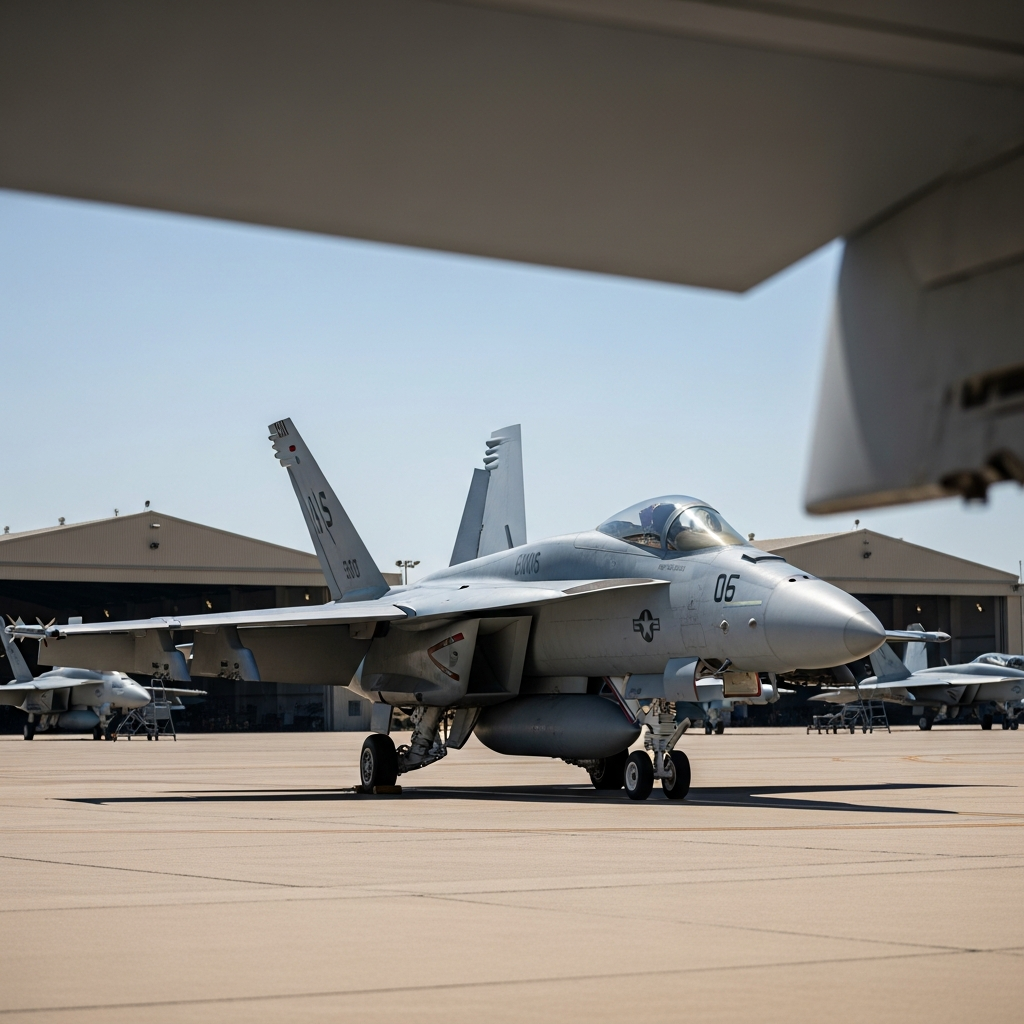
The U.S. Navy will soon announce which company won the competition to build the F/A-XX, its next-generation carrier fighter. This decision—expected this month—represents the biggest military aviation acquisition in a decade and will test whether America’s defense industry can handle building two advanced fighters at once.
Chief of Naval Operations Adm. Daryl Caudle confirmed the August 2026 timeline at the Sea-Air-Space Expo on April 20. “I think you’re going to see a downselect on this in August,” he said. “I think that’s the month that they have committed to deciding on the program.” The Navy had originally planned to announce the winner in March 2025, but Pentagon leadership delayed the decision after raising concerns about whether contractors could actually deliver.
Boeing and Northrop Grumman remain the only two bidders still in the running. Lockheed Martin dropped out in early 2025. The winner will oversee development of a fighter designed to eventually replace more than 470 aging F/A-18E/F Super Hornets—some of which are now thirty years old.
The Capacity Constraint
The Pentagon’s hesitation speaks to a real problem: overcommitment. Boeing is already developing the F-47 sixth-generation fighter for the Air Force—a program getting $5 billion in the Trump administration’s FY2027 budget request. The F/A-XX, by contrast, received $140 million in the FY2027 budget request. The Air Force handed Boeing the F-47 contract in March 2025 with a first flight goal of 2028.
Adm. Caudle didn’t sugarcoat it: “The Navy’s got a lot of demand… making sure that we don’t, again, fall into a trap of oversubscribing. One of the contractors who would make this plane for us is in a place where they really can’t deliver in the timeframe we need it.”
That funding gap reflects a deliberate choice by the Trump administration to prioritize Air Force fighters over Navy ones. In 2025, the Pentagon even asked Congress to shift $500 million away from F/A-XX to F-47, warning that “simultaneously pursuing two sixth-generation fighters risks under-delivery on both.” Congress objected—loudly. The Senate Armed Services Committee directed $750 million toward F/A-XX acceleration and later appropriated $897.3 million to push the program into Engineering and Manufacturing Development.
What’s at Stake
The F/A-XX needs to be a workhorse—and a long-range one. Navy specifications demand a combat radius around 1,000 miles, roughly 25 percent farther than today’s Super Hornets. It also has to work with existing catapult and arresting gear on Nimitz and Ford-class carriers. The jet will operate alongside F-35Cs and unmanned MQ-25A Stingray tankers, coordinating with cheap autonomous drones under the Collaborative Combat Aircraft program.
Northrop released detailed renderings on April 20—the same day Adm. Caudle confirmed the August decision. The design shows a tailless stealth shape with folding wings and a dramatically enlarged nose packed with a more powerful AESA radar than any current carrier aircraft. Boeing’s concept—shown at Tailhook ’25 in August 2025—borrows heavily from its F-47 design, with smooth, deliberately ambiguous geometry built for stealth.
Neither fighter will be combat-ready until the mid-2030s at earliest. That creates a dangerous gap—aging F-22 Raptors and F/A-18s will need extended service lives just to keep the fleet flying. The U.S. defense industrial base has shrunk dramatically over recent decades, dropping from 51 prime contractors to just 5, which means there’s almost no room for mistakes or delays.
The winner gets a thirty-year program. The loser watches from the sidelines as their competitor shapes naval aviation for a generation.
Stay in the loop
Get the latest aircraft insider updates delivered to your inbox.