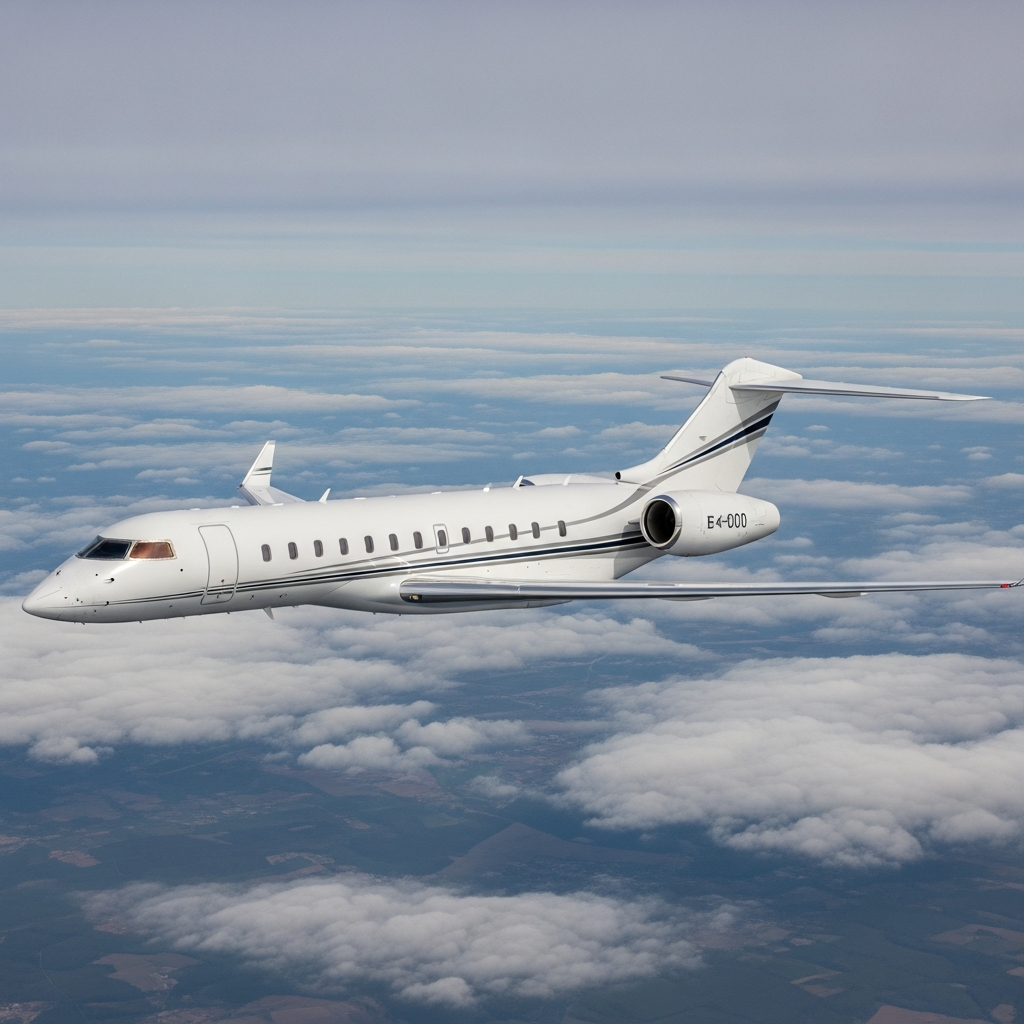
Bombardier handed over the first Global 8000 business jet to VistaJet at London Biggin Hill Airport on April 15, 2026 — putting the world’s fastest civil aircraft into passenger charter service for the first time. It’s a milestone that extends well beyond the two companies involved. No production aircraft has cruised this close to the sound barrier since Concorde retired in 2003.
The Fastest Civil Jet Since Concorde
The numbers are striking. The Global 8000 tops out at Mach 0.95 and carries a maximum range of 8,000 nautical miles, enough to connect London to Singapore or New York to Dubai without a fuel stop. That speed beats the Gulfstream G700’s Mach 0.935 ceiling and nudges civil aviation back into territory it hasn’t occupied in over two decades. Bombardier also certifies a first-ever transcontinental ultra-high-speed cruise at Mach 0.92 — a figure the company says redefines the ultra-long-range segment entirely.
The Global 8000 isn’t an entirely new airframe. It shares the same fuselage, wing, and General Electric Passport 20 engines as the Global 7500, which has accumulated more than 100 city-pair speed records since entering service in December 2018. Performance gains come through fuel-storage optimization in the wet wing — increasing usable fuel load without enlarging the tanks — alongside targeted software updates across multiple aircraft systems. Bombardier EVP of Engineering Stephen McCullough describes the process as “software changes in multiple areas” that unlock the 8000’s performance envelope from the existing 7500 design.
The Upgrade Path — 14 Days, $3 Million Per Aircraft
That retrofit capability sits at the center of VistaJet’s fleet strategy. Vista took delivery not of a new-build aircraft but of the first of 18 Global 7500s converted to Global 8000 standard. The conversion program — certified by Transport Canada, the FAA, and EASA — takes approximately 14 days per aircraft and costs around $3 million per unit. Vista is running conversions at two aircraft per month, with full fleet completion targeted by the end of 2026. When that’s done, Vista will operate the world’s largest subscription-based Global 8000 fleet.
This VistaJet delivery is actually the third Global 8000 handover on record. The first went to Canadian entrepreneur Patrick Dovigi on December 8, 2025 — a new-build aircraft. NetJets received the second on March 26, 2026. The type earned Transport Canada certification on November 5, 2025, FAA approval on December 19, 2025, and EASA certification on January 23, 2026.
What the Aircraft Offers Passengers
The cabin spans four zones and seats up to 19 passengers. Bombardier claims the lowest cabin altitude in business aviation production at 2,691 feet — a figure that meaningfully reduces fatigue on intercontinental sectors. The aft suite can be configured with a steam shower. A 195-cubic-foot baggage hold is accessible inflight at any altitude. Bombardier’s Pūr Air system, featuring HEPA filtration and VOC removal, pairs with the Soleil circadian lighting system to address jet lag on exactly the kind of long-range missions the aircraft is built for.
“The Global 8000 stands apart as a truly no-compromise aircraft, delivering unmatched speed, exceptional comfort and industry-leading field performance.” — Éric Martel, President and CEO, Bombardier
“For our Members, greater speed and extended range translate directly into practical benefits such as reaching their destination faster or travelling more efficiently with direct flights.” — Thomas Flohr, Founder and Chairman, Vista Global
Vista’s Broader Bombardier Commitment
The Global 8000 program sits inside a deepening commercial relationship between the two companies. In February 2026, Vista placed a firm order for 40 Bombardier Challenger 3500 aircraft — valued at $1.18 billion, with options for 120 additional jets that could push the total to $4.72 billion. Vista frames the Global 8000 fleet expansion as a direct response to growing demand for continent-spanning routes, particularly Europe–Asia corridors, across both business and leisure segments.
With conversions running at two aircraft per month and full fleet completion targeted before year-end, Biggin Hill is effectively functioning as the operational hub for this program. The broader market question is whether the Global 8000’s Mach 0.95 ceiling accelerates competitive pressure on Gulfstream’s G700 program, which tops out at Mach 0.935.
Stay in the loop
Get the latest aircraft insider updates delivered to your inbox.