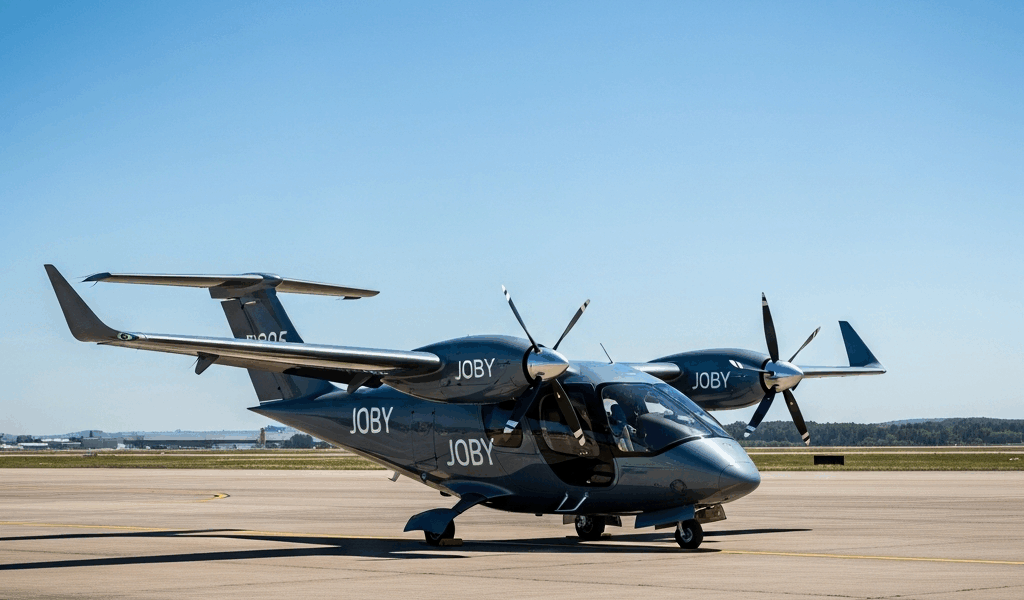
Joby Aviation cleared Stage 4 of its FAA type certification process in late March 2026. It’s the most consequential regulatory milestone any electric vertical takeoff and landing manufacturer has ever reached with American aviation authorities — and the clearest signal yet that the first commercial eVTOL certificate in U.S. history is a matter of when, not if.
The FAA confirmed the Stage 4 clearance after completing a critical airworthiness conformity review of Joby’s S4 aircraft — a five-seat, six-rotor design with tilting rotors and fixed propellers capable of 200 mph cruise speeds and roughly 150 miles of range per charge. What Stage 4 required, specifically, was proof that the physical hardware rolling off Joby’s production lines precisely matches the design documented in the certification application. As part of that conformity review, the FAA validated propulsion system reliability and fly-by-wire redundancy — two of the most technically contested elements of the S4 certification plan. It’s distinct from final compliance flight testing. But passing it means the FAA has validated the conformity of the actual aircraft, not just the drawings.
No other eVTOL manufacturer has reached this stage with the FAA. Not Archer. Not Wisk. Not any of the European players still standing after a brutal industry shakeout that claimed Lilium and Volocopter — among at least six manufacturers that have entered insolvency since 2023.
What Stage 4 Actually Unlocks
The FAA’s five-stage type certification process for novel aircraft categories is among the most demanding regulatory pathways in civil aviation. Stage 4 specifically constituted a critical airworthiness conformity review — validating that the physical hardware matches the approved design, with propulsion system reliability and fly-by-wire redundancy among the key elements confirmed in the process. Joby is certifying under Part 21.17(b), a provision the FAA uses when an aircraft doesn’t fit cleanly into either the airplane or rotorcraft category. That requires a custom mosaic of airworthiness standards assembled specifically for the S4’s powered-lift architecture.
The agency issued its first formal powered-lift certification standards in October 2023. Everything before that ruling was largely speculative on timeline. Joby began this process in 2018.
“We are working methodically with the FAA to complete the remaining steps. The goal has always been to build something people can trust with their lives.” — JoeBen Bevirt, Founder & CEO, Joby Aviation
Richard Aboulafia, Managing Director at AeroDynamic Advisory, put the industry significance plainly:
“What Joby has done is demonstrate that the eVTOL certification process, while long, is workable under the new powered-lift standards. That matters enormously for every other applicant behind them.”
What Comes Next — and When
Three regulatory gates remain before Joby can carry a paying passenger. First: FAA-witnessed compliance flight testing — the Type Inspection Authorization phase already underway, with Joby pilots flying ahead of FAA pilots taking the controls. Second: Type Certificate issuance, estimated for late 2026, which constitutes final FAA confirmation that the S4 design meets all applicable airworthiness standards. Third: an Air Carrier Certificate, an entirely separate authorization required before commercial operations can begin.
Infrastructure adds another layer. Joby and Delta Air Lines — which has disclosed up to $200 million in investment exposure — are developing dedicated vertiport facilities at JFK International and Los Angeles International. Delta has framed the partnership as a premium, zero-emission airport connector. Industry analysts have estimated initial fares could run between $150 and $300 per trip before manufacturing scale brings costs down; Joby has not announced official fares.
In March 2026, Joby was also selected for five of the FAA’s eVTOL Integration Pilot Program projects, covering the New York/New Jersey metro area, Texas, Florida, North Carolina, and Utah. It’s a meaningful signal of federal confidence in the program’s operational readiness trajectory.
Joby has previously targeted late 2026 for commercial launch in New York and Los Angeles. SMG Consulting, which tracks eVTOL developers’ production and service-entry progress, has projected entry into service closer to mid-to-late 2027. The FAA declined to commit to any external timeline, stating that certification schedules “depend on applicant performance and the resolution of any open compliance findings.”
The Industrial Picture
Joby’s manufacturing posture is worth noting. The company employs more than 2,000 people globally, has procured capital equipment to double production from two to four aircraft per month at its Marina, California facility, and is manufacturing carbon fiber propeller blades — 30 per aircraft, five blades per rotor — at its Dayton, Ohio operation, with capacity potentially reaching 15,000 blades annually at scale. Toyota closed a $250 million strategic investment tranche in May 2025.
Stage 4 clearance doesn’t hand Joby a certificate. But it puts one within documented, procedural reach — something no eVTOL company has managed before. The compliance flight-test phase is the next thing to watch as the FAA moves toward its final airworthiness determination.


Leave a Reply