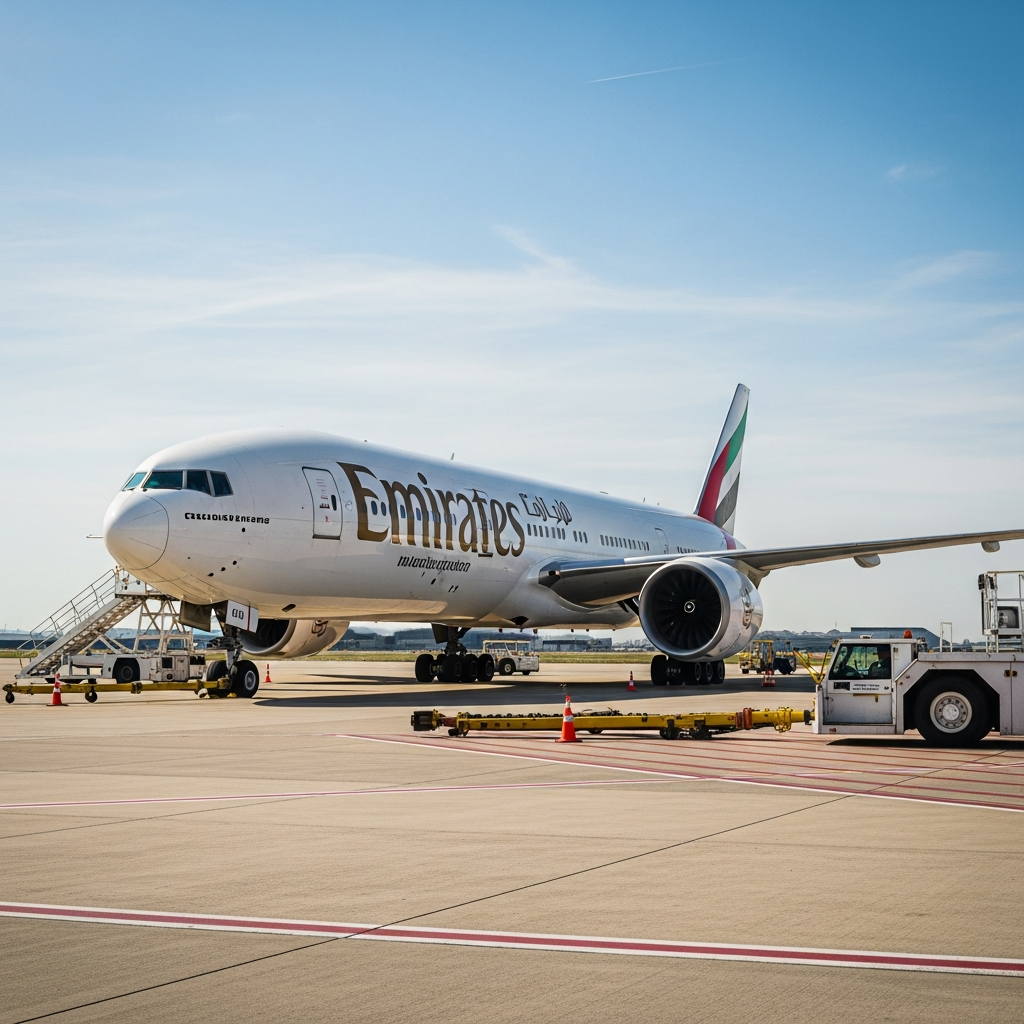
Around 90,000 transiting passengers per day are now caught in the fallout from a severe Middle East airspace crisis. Dubai, Doha, and Abu Dhabi — the three mega-hubs that hold intercontinental long-haul travel together — are operating under sweeping closure orders triggered by U.S.-Israeli strikes on Iran that began February 28.
Emirates, Qatar Airways, and Etihad all suspended operations on Day Zero. Emirates and subsidiary flydubai halted all flights until March 2 at 15:00 UAE time. Etihad suspended departures and arrivals through 02:00 UAE time on March 2. Qatar Airways posted a social media statement confirming suspension of all flights “to, and from, Doha due to the closure of Qatari airspace.” At the peak of the initial chaos, more than 20,000 travelers were stranded across UAE terminals alone — thousands more gridlocked at Hamad International in Doha.
Airports Struck — Debris, Casualties and Diverted Jets
The threat was never abstract. Abu Dhabi’s Zayed International Airport confirmed that a drone targeting the facility was intercepted on March 2, with falling debris killing one Asian national and injuring seven others. Four Dubai Airport staff were injured in a separate incident. Three inbound flights were held outside UAE airspace during a fresh ballistic missile wave — two Etihad aircraft diverted to Muscat, while an Emirates flight from Mumbai turned back mid-route before eventually completing the journey to Dubai.
The UAE GCAA briefly closed the entire national airspace overnight on March 16–17 as a precautionary measure during new missile and drone threats, disrupting already-limited operations into both OMDB and OMDW.
The Routing Nightmare — FIRs, GPS Spoofing and a 4-Hour Penalty
EASA issued Conflict Zone Information Bulletin CZIB 2026-03-R5 on February 28 — coinciding with the start of strikes. It covered all 12 affected Flight Information Regions and elevated the threat to Level 2 (highest). The full list: Bahrain (OBBB), Iran (OIIX), Iraq (ORBB), Israel (LLLL), Jordan (OJAC), Kuwait (OKAC), Lebanon (OLBB), Oman (OOMM), Qatar (OTDF), UAE (OMAE), Saudi Arabia (OEJD), and Syria (OSTT). EASA has since extended its advisory through April 24, 2026.
The Emirates FIR (OMAE) remains partially open, with overflights restricted to a single western corridor via waypoint LUDID. Qatar’s Doha FIR (OTDF) permits only approved arrivals via LAEEB and departures via DATRI — tightly controlled flows, not normal airspace. Then there’s the GPS spoofing problem. Widespread interference across the Persian Gulf has caused civil airliners to deviate from cleared paths, raising the spectre of accidental engagement by hair-trigger SAM systems. Airlines operating into the region have MH17 and Ukraine International Flight 752 front of mind. Avoiding Iranian and Iraqi airspace adds two to four hours to transpacific and Europe-Asia routes — a fuel and cost penalty compounding by the day.
Qatar’s A380 Fleet — Grounded, Stored, and Counted
Qatar Airways grounded its entire active Airbus A380 fleet through April and May, parking all eight superjumbos at Hamad International. It’s the largest A380 standdown since COVID-19. Confirmed tail numbers include A7-APC, A7-APD, A7-APE, A7-APF, A7-APG, A7-APH, and A7-APJ — recalled from London Heathrow, Bangkok, Paris CDG, and Rayong between late March and early April. The eighth active aircraft’s tail number remains unconfirmed.
Four A330 widebodies were ferried to Tarmac Aerosave at Teruel, Spain, for deep storage on March 18. Teruel is an airport that typically receives two aircraft per day; separately, Reuters reported ten widebodies — including an A380, A350s, and a Boeing 787 — arrived on a single Friday in a distinct delivery event. A planned return of five A380s to service on June 1 — targeting Heathrow, Bangkok, Singapore, CDG, and Sydney — remains conditional on circumstances that do not currently exist.
Fuel Crisis — The Bill Nobody Can Absorb
Jet fuel is now averaging $4.65 per gallon globally. U.S. city prices are up more than 80% month-over-month. United Airlines CEO Scott Kirby laid out the arithmetic in a stark internal memo on March 20:
“The reality is, jet fuel prices have more than doubled in the last three weeks. If prices stayed at this level, it would mean an extra $11 billion in annual expense just for jet fuel. For perspective, in United’s best year ever, we made less than $5 billion.”
European carriers are privately warning of potential fleet groundings if disruptions worsen. Across all operators, scheduled A380 flights in April and May 2026 total 12,449 round-trips — a 7% week-over-week decline. Emirates’ A380 services alone are down 14% from the prior week.
Strait of Hormuz — Open, Closed, Open, Closed
Iran declared the Strait of Hormuz “completely open” on April 18, briefly sending Brent crude down 11%. By April 19, Iran’s military announced the strait had “returned to its previous state.” IRGC gunboats fired on at least three commercial vessels, ending the ceasefire window. The announcement followed President Trump’s statement that port blockades on Iran would remain in place.
The situation as of this morning remains fluid. Any further deterioration will directly determine whether European carriers follow through on their grounding warnings.
We’ll continue to monitor NOTAM updates for OMAE, OTDF, and OIIX. The next critical marker is whether EASA extends CZIB coverage beyond April 24.

Stay in the loop
Get the latest aircraft insider updates delivered to your inbox.