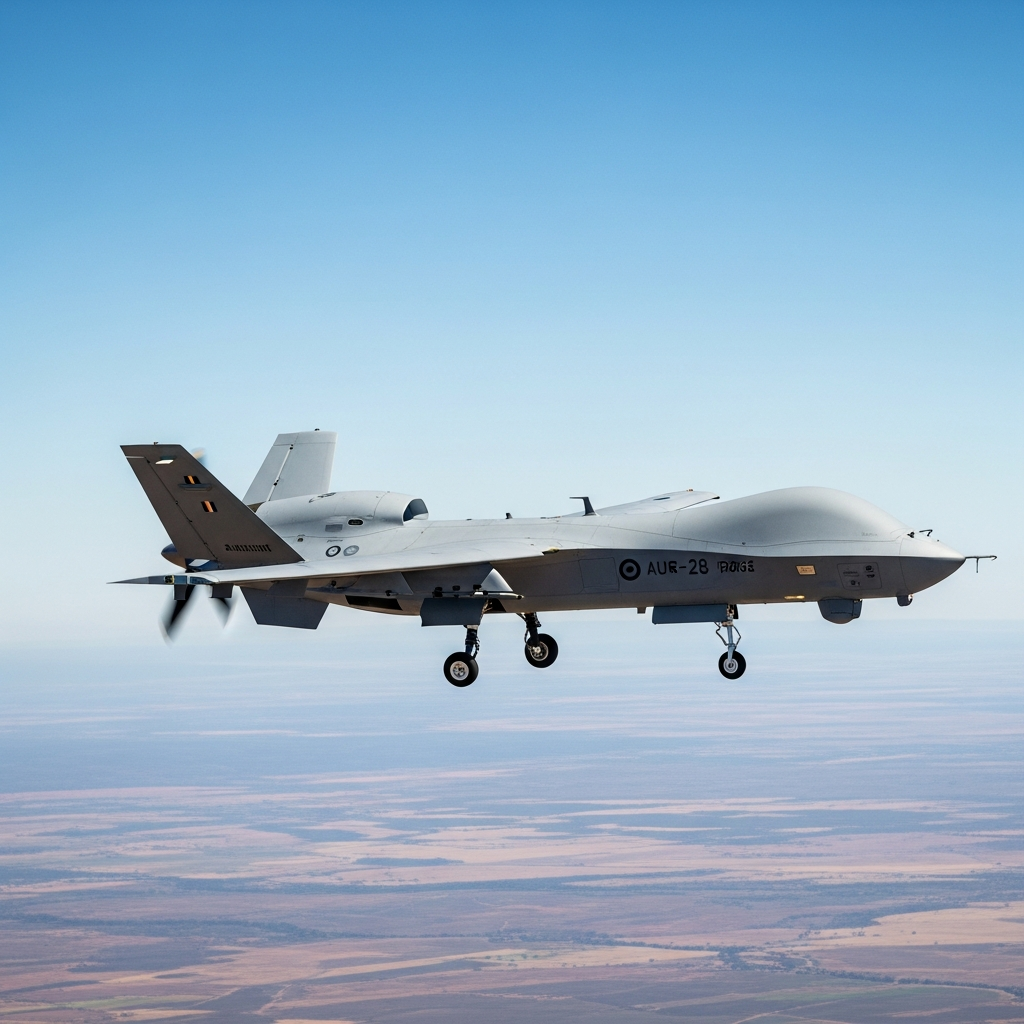
On December 8, 2025, a Boeing MQ-28A Ghost Bat destroyed an aerial target with a live AIM-120 AMRAAM missile over the Woomera test range in South Australia — the first weapons firing in anger for the type, and reportedly the first time any unmanned aircraft has put an AMRAAM into a live engagement.
The trial, designated Kareela 25-4, used a three-aircraft kill chain. An F/A-18F Super Hornet flew in combat formation with the Ghost Bat, identifying and tracking the target — an Australian-made Phoenix jet-powered drone. Above them, an E-7A Wedgetail airborne early warning aircraft served as the command node, relaying authorization to engage. The Ghost Bat then maneuvered autonomously to a firing solution and launched at an “operationally representative” beyond-visual-range distance, providing mid-course guidance to the missile after release.
The autonomy element is what sets this apart. Boeing says the MQ-28 received just four high-level commands during the entire sequence: take off, establish a defensive counter-air patrol orbit, leave the CAP and intercept the target, and arm and release when within parameters. Everything else the aircraft handled on its own.
The AMRAAM was carried on a purpose-built external pylon on the port underside of the fuselage, directly below the engine air intake — a deliberate workaround, since the Ghost Bat’s internal weapons bay won’t arrive until the Block 3 configuration. That bay is sized for one AIM-120 or two GBU-39/B Small Diameter Bombs, with two GBU-53/B StormBreakers also listed as an option. Boeing confirmed weapons integration for this test was completed in under eight months, enabled by the aircraft’s open-systems architecture.
What the Government is Buying
The day after the test, on December 9, the Australian government announced an investment of approximately A$1.4 billion into the program. Contracts were signed covering six additional Block 2 operational aircraft plus development of a Block 3 prototype. Block 2 aircraft incorporate a refined wing design and upgraded GPS/INS over the eight Block 1 developmental test assets already flying. Future production is planned at a new Boeing facility in the Wellcamp Aerospace and Defence Precinct west of Brisbane.
“The Ghost Bat transforms a single fighter jet into a formidable team – capable not only of surveillance but also of engaging adversaries. This delivers a vital layer of protection for our aviators who remain our most valuable asset. The MQ-28A programme is also building a stronger sovereign defence industry and increasing Australia’s resilience with over 70 per cent of this investment remaining on our shores, providing high-tech, high-paying jobs for Australians.” — Pat Conroy, Australian Minister for Defence Industry
“Australia is at the forefront of efforts to develop and field autonomous collaborative combat aircraft to provide asymmetric advantage and enhanced fighting depth for existing crewed platforms. This landmark demonstration proves the MQ-28A Ghost Bat is a world-leading collaborative combat aircraft made and designed in Australia.” — Deputy Prime Minister Richard Marles
Global Context — A Close Second
Australia is the second country to demonstrate a live air-to-air missile firing from a combat drone. Turkey’s Bayraktar Kizilelma fired a Gökdoğan beyond-visual-range missile on November 28, 2025 — beating the Ghost Bat by roughly ten days. The AMRAAM, though, is a NATO-standard weapon with deep allied interoperability implications that the Gökdoğan simply doesn’t carry.
Boeing’s MQ-28 Global Program Director Glen Ferguson confirmed at the Singapore Airshow in February 2026 that the December engagement validated the platform’s architecture, describing the aircraft as “compliant with US and allied standards.” That language matters more than it might seem. Germany’s Defence Minister Boris Pistorius visited Australia in March 2026 and confirmed Berlin is actively evaluating the Ghost Bat as a loyal wingman for its Eurofighter Typhoon fleet. Rheinmetall and Boeing have since announced a formal partnership to tailor the aircraft for Bundeswehr requirements, with Rheinmetall CEO Armin Papperger citing revenue potential “in the range of three-digit millions of euros.”
What Comes Next
The Ghost Bat program has moved faster than Boeing publicly forecast as recently as March 2025, when company executives were still projecting a weapons shot “by end of 2025 or early 2026.” It delivered on the near end of that window. Block 3 development is now underway. With German interest hardening into an industrial partnership, the platform’s export trajectory is no longer speculative — Block 3 first flight timing and further AMRAAM or SDB integration testing are the milestones to watch.
Stay in the loop
Get the latest aircraft insider updates delivered to your inbox.