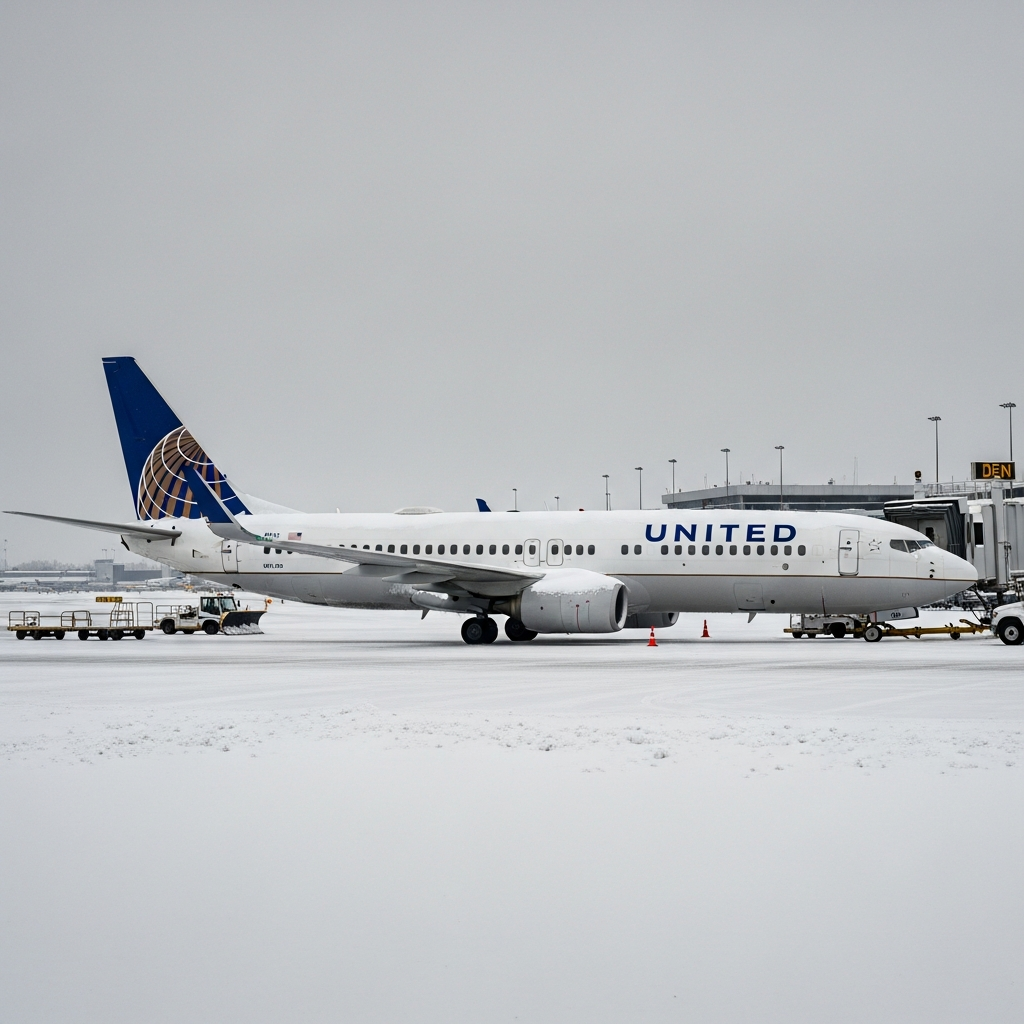
A United Airlines Boeing 737-800 collided with two de-icing trucks at Denver International Airport on the morning of March 6, 2026. The flight crew had begun taxiing while Aeromag ground crews were still actively spraying the aircraft — a sequence of events severe enough to tip one truck onto its side and send a de-icing operator to hospital.
The aircraft, registered N27213, was a 27-year-old Boeing 737-824 (MSN 28773) operating as United Airlines Flight 605 to Nashville. It was parked at de-icing pad C, spot C5, with four Vestergaard Elephant Beta de-icers applying Type 4 fluid. Two trucks — MAG 94 and MAG 95 — were positioned forward of the wings; MAG 28 and MAG 30 worked aft. The NTSB preliminary report cited 136 total occupants including crew, though passenger counts across sources range from 122 to 130, with two pilots and four cabin crew aboard.
What Happened
According to the National Transportation Safety Board’s preliminary report, released around April 10, 2026, the flight crew was mid-conversation when the first officer heard what he interpreted as a post-de-ice briefing from the Aeromag team — confirming all vehicles were behind the clearance lines. The captain wasn’t sure the call was even directed at their flight. The first officer acknowledged it anyway, read back the key details, and the crew moved through their post-de-ice checks before receiving ATC taxi clearance.
What they did not have was clearance to exit the de-icing pad itself.
As N27213 began rolling forward, de-ice agents on the pad had no way to stop it. The aircraft’s left wing struck MAG 94. The right wing hit MAG 95 hard enough to roll it onto its side. The operator of the overturned truck sustained minor injuries and was transported to a local hospital on a backboard. It was only after the aircraft stopped that the flight crew learned from Aeromag they had never been cleared to leave the pad.
“It was just a little shocking because we were going through the de-icing process and we started moving. There were some loud noises and the plane kind of jolted.” — Passenger aboard UA605
Denver Fire Department units surrounded the aircraft while paramedics treated the injured truck operator. Passengers deplaned via air stairs, were bused back to the terminal, and eventually left on a replacement aircraft — with a new estimated departure time of 1:13 p.m., roughly five hours late.
Damage Assessment
N27213 was declared non-airworthy on the scene. The NTSB confirmed substantial damage: the left winglet, right aileron, slats 1, 5, 6, 7, and 8 on the left wing, and lower skin panels on the right wing. The aircraft stayed out of commercial service for over three weeks — completing a 20-minute circuit flight on March 23 and a nearly two-hour functional check flight on March 29 before finally returning to revenue service.
A Communication Chain With a Critical Gap
The NTSB’s preliminary findings indicate that pilot distraction played a significant role, alongside ambiguous communication. The incident unfolded in a section of Denver’s airfield where, according to the FAA, air traffic control holds no direct oversight of ground movements — leaving coordination responsibility entirely with the flight deck and ground service operators.
That gap matters. FAA Advisory Circular AC120-60B explicitly warns against three-way communications, cautioning they can be “confusing, misleading, or misdirected.” SAE ARP 6257A — the governing standard for de-icing communication phraseology — demands absolute clarity on procedure, fluid type, holdover time, and areas treated before crew acknowledgement. On March 6, that chain broke.
The parallels to Continental Airlines Flight 1713 are hard to ignore. In that November 1987 Denver crash, the NTSB attributed the accident to the captain’s failure to have the plane de-iced a second time, poor takeoff performance, and confusion between pilots and ATC — with nearly three minutes of non-pertinent cockpit conversation cited as a contributing factor. Investigators are unlikely to overlook the comparison.
United’s Response
“A de-icing truck made contact with a United aircraft in Denver on Friday morning, leading to an employee of the de-icing contractor being transported to the hospital.” — United Airlines initial statement
That framing — truck struck plane, not plane struck trucks — was at odds with the FAA’s account and passenger video shot from inside the cabin, which showed the aircraft moving at the moment of impact. United has not issued a comprehensive response to the NTSB’s preliminary findings.
What Comes Next
The investigation remains active, with NTSB specialists, the FAA, and United Airlines all named as parties. The final NTSB report is expected to carry specific recommendations targeting de-icing pad communication protocols, cockpit resource management during ground operations, and potentially the regulatory gap in ATC oversight of de-icing areas at major U.S. hubs. The FAA is already under mounting pressure following a string of high-profile ground operations incidents — UA605 adds fresh weight to calls for tighter coordination standards across the industry. We’ll continue to monitor the investigation as findings develop.
Denver has also experienced a separate runway emergency involving an unauthorized pedestrian. Our Frontier Flight 4345 confirmed-facts report distinguishes the airport and FAA statements from unsupported early claims.
Stay in the loop
Get the latest aircraft insider updates delivered to your inbox.