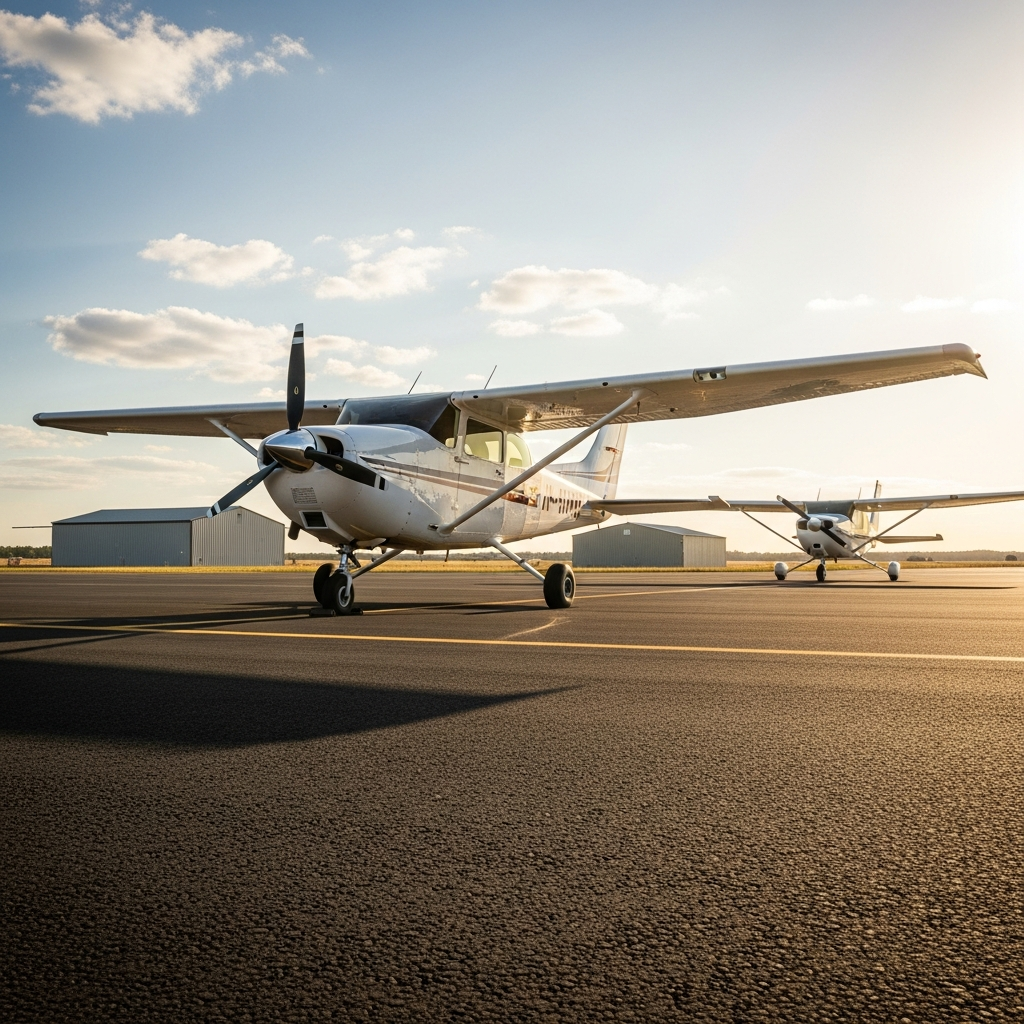
Cessna 182 Skylane vs 172 Skyhawk — Which One Should You Actually Buy
Why Pilots Even Compare These Two
The Cessna 182 vs 172 debate has gotten complicated with all the hot takes and forum arguments flying around. And honestly, I get why. These two airplanes look nearly identical from across a ramp, share most of their DNA, and land in the same general price neighborhood. But they’re built for different jobs — and I’ve personally watched more than a few pilots drop six figures on the wrong one.
The person asking this question is usually one of three pilots. A renter who’s finally ready to stop writing checks to the flying club. A 172 owner who keeps bumping into weight and balance headaches. Or a first-time buyer with somewhere between $80,000 and $120,000 burning a hole in their pocket and a family who expects a seat on the plane. If any of those sound like your situation, keep reading. This one’s for you.
Performance Numbers That Actually Matter
Forget the spec sheets for a minute. Most comparison articles just stack up numbers without telling you what those numbers mean when you’re standing on a ramp in Flagstaff in July with three people, two duffel bags, and a full fuel order. Here’s what actually changes your life in practice — and what doesn’t.
Useful Load — The Real Differentiator
A 2005 Cessna 172S carries a useful load of roughly 878 pounds. A 2005 Cessna 182T comes in around 1,110 pounds. That’s 232 pounds of difference. Put another way — that’s a third adult, or two adults plus actual luggage, or full fuel plus a heavier crew without doing awkward weight-and-balance math on every single preflight.
As someone who once tried to stretch a club 172 across a cross-country with my wife, our teenage son, and what I genuinely believed was a reasonable amount of camping gear, I learned everything there is to know about this limitation the hard way. We made it work, barely — fueled to tabs instead of full tanks, recalculated three times, stress-ate a granola bar on the ramp. It wasn’t dangerous. It was annoying and limiting in a way that followed me the whole trip. The 182 would have made that weekend trivial. Don’t make my mistake.
Climb Rate and Cruise Speed
The 182T runs a Lycoming IO-540 making 230 horsepower. The 172S runs a 180 hp IO-360. That 50 horsepower gap shows up most in climb — the 182T pulls about 924 feet per minute versus the 172S’s 730 fpm. Noticeable in day-to-day flying. Genuinely useful at high-density-altitude airports where the air just isn’t cooperating.
Cruise speed? Smaller gap than people expect — and this surprises almost everyone. The 172S cruises around 124 knots. The 182T does roughly 145 knots at 75 percent power. You’re buying 21 knots, not 50. On a two-hour flight, that’s maybe 20 extra miles covered. Nice. Not transformational. That’s what makes the useful load story so much more compelling when you actually sit with the numbers.
Service Ceiling
The 182T is certified to 18,000 feet. The 172S tops out at 14,000 feet. If you fly Rocky Mountain routes or cross the Sierra regularly, that ceiling difference has real operational weight. If your flying is mostly Midwest flatlands and Northeast corridor work, it honestly doesn’t move the needle much in practice.
What It Actually Costs to Own Each One
Probably should have opened with this section, honestly. Cost kills more airplane purchase decisions than anything else — and most pilots dramatically underestimate what the 182 premium looks like spread across 12 months of ownership.
Purchase Price
A solid mid-2000s 172S — clean logs, good engine, no deferred squawks — is moving in the $85,000 to $105,000 range based on recent transactions. A comparable 182T from the same era with similar total time runs $115,000 to $145,000. That’s a $30,000 to $40,000 difference before you’ve turned a prop. Worth knowing upfront.
Fuel Burn
The 172S burns approximately 8.5 GPH at 75 percent power. The 182T burns 12 to 13 GPH in the same regime. Call it 4 GPH of difference. At $6.50 per gallon for avgas — and it’s often higher — that’s $26 extra per hour in fuel alone. Fly 100 hours a year and that’s $2,600 more annually. Over five years, $13,000. It adds up quietly, the way these things always do.
Insurance
Budget $1,400 to $1,900 annually for a 172S if you’re carrying 500-plus hours total time and an instrument rating. A 182T with similar pilot credentials typically runs $1,800 to $2,500 per year. Hull value drives most of that gap — the 182 is simply worth more, so insuring it costs more. Straightforward math, but easy to forget when you’re focused on the purchase price.
Annual Inspection
A routine annual on a well-maintained 172 at a reputable shop — Yingling Aviation in Wichita, or a comparable regional shop you actually trust — runs $800 to $1,500 when nothing unexpected surfaces. The 182 annual tends to land at $1,000 to $2,000 for the same scenario. The IO-540 just has more to inspect and its parts carry higher price tags. Engine overhaul costs diverge significantly too — an IO-360 overhaul runs around $18,000 to $22,000, while the IO-540 comes in at $28,000 to $35,000.
All in, budgeting $10,000 to $14,000 annually for a 172S at 100 hours of flying is realistic. For the 182T, think $14,000 to $20,000. Neither number is shocking on its own. But pilots who go in thinking the only real difference is fuel burn end up genuinely surprised when their first big annual lands on the table.
Which One Fits Your Flying
Regular Family Trips — 182 Wins
Two adults, two kids, real bags, and a destination you’d actually like to reach without a fuel stop? The 182 is the right airplane. Full fuel on a 182T leaves roughly 915 pounds of remaining useful load for people and bags. Full fuel on the 172S leaves about 628 pounds. That’s the difference between a comfortable family trip and a logistical puzzle you’re solving on the ramp while everyone watches.
Primary Training or Low-Cost Personal Flying — 172 Wins
Flying solo or two-up over flat terrain below 5,000 feet MSL? The 172 is cheaper to own, cheaper to operate, and perfectly capable for that mission. I’m apparently a 172 guy for most of my actual flying — and the math works for me while the 182 overhead never quite did. I’ve talked with several pilots who stepped up to a 182, flew it for two years, and quietly stepped back down because the extra capability never showed up in their logbooks. Know your actual mission before you write the check.
Backcountry and Short-Field Operations — 182 Edges Ahead
The climb advantage earns its keep out of short high-elevation strips — grass strips in central Idaho, mountain airports sitting above 7,000 feet MSL. Getting airborne isn’t usually the problem in either airplane. Getting airborne with four people and bags and a positive climb rate that actually clears the terrain ahead — that’s where the extra 50 horsepower starts pulling its weight. Landing performance on both airplanes is similar enough that it’s not the deciding factor. Neither one is a Maule or a Super Cub. We’re clear on that.
Instrument Currency Flying — 172 Is Cheaper for Logging Hours
Shooting approaches to stay current, building time, using the airplane as a platform for additional ratings? The 172’s lower hourly cost means more hours for the same budget. Simple math — but easy to overlook when you’re standing in front of a shiny 182T with fresh paint and a new Garmin panel.
The Verdict — Step Up or Stay Put
Frustrated by consistent weight and balance headaches on cross-country flights with family aboard, a lot of 172 pilots eventually land in the same place: the 182 justifies its premium only when the payload advantage actually gets used on a regular basis. That’s the whole thing, really.
Buy the 182T if you consistently fly with three or four people and bags, regularly depart from airports above 4,000 feet MSL, or plan to shoot instrument approaches in actual IMC where the extra speed and climb rate provide real operational margin. The airplane earns its costs in those scenarios. It’s not hard to justify — once the mission actually matches.
Stay with the 172S if you fly solo or two-up the majority of the time, operate on low-elevation flat terrain, and your honest flying history doesn’t push the weight envelope. The 172S is an excellent airplane. Not a compromise. Not a consolation prize. The right tool when it’s the right tool — and that’s what makes the Skyhawk endearing to pilots who’ve flown both.
The 182 is heavier, thirstier, and more expensive to maintain. None of that is a reason to avoid it. But none of it disappears once you own it either.
So, without further ado, here’s the one question worth sitting with before you write the check: How many of my last ten flights would have actually been better in a 182? Honest answer of six or more — step up. Two or three — save the money and keep flying.
Stay in the loop
Get the latest aircraft insider updates delivered to your inbox.