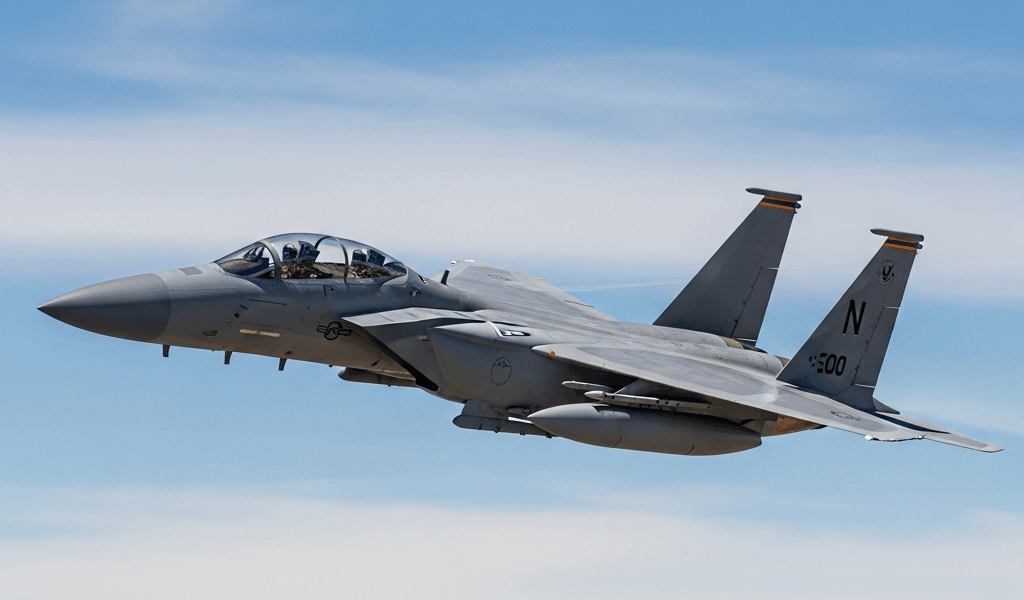
An F-15E Strike Eagle from the 494th Fighter Squadron, 48th Fighter Wing, RAF Lakenheath, went down over southwestern Iran in the early hours of April 3, 2026. The jet was lost during a combat strike mission under Operation Epic Fury — one of the most significant American aircraft losses in decades — and what followed was a 50-hour rescue operation involving hundreds of special operations personnel and 155 aircraft.
The jet’s call sign was Dude 44. It was struck at approximately 4:00 a.m. local time by what President Trump later described as a shoulder-fired, heat-seeking missile — apparently a MANPADS round — that “got sucked right in by the engine.” Both crew members ejected safely but came down miles apart in hostile Iranian territory. The pilot, Dude 44 Alpha, landed in the Khuzestan Province area. The weapons system officer — Dude 44 Bravo, identified by Trump as a colonel — came down near the Zagros Mountains foothills.
First Rescue — Pilot Recovered in Broad Daylight
The Joint Personnel Recovery Center for U.S. Central Command declared an isolated personnel recovery event at 4:40 a.m. local time on April 3. A combat search and rescue task force assembled fast: 10 A-10C Thunderbolt IIs in the Sandy suppression role, HC-130J Combat King IIs, HH-60W Jolly Green II helicopters, and Air Force Special Warfare airmen including pararescuemen and combat rescue officers.
Dude 44 Alpha was recovered seven hours after the shootdown. In broad daylight, according to Trump. Aboard an HH-60W, under close-range gunfire. During the rescue effort, an A-10 Thunderbolt II supporting the CSAR package took Iranian fire — the pilot ejected safely and the aircraft crashed in Kuwait.
WSO Evades Capture for 50 Hours
The second rescue was exponentially more complex. Despite being described as “bleeding profusely,” the WSO employed SERE tactics across rugged terrain, climbed a 7,000-foot ridgeline in the Zagros foothills, and concealed himself in a mountain crevice — deliberately restricting his emergency beacon to avoid Iranian detection. Iranian state-linked media posted photos of an ejection seat in a desert landscape and later identified wreckage as belonging to the 494th Fighter Squadron. A regional governor offered a bounty — reportedly the equivalent of $60,000 — for the crew.
Before U.S. forces located the WSO, the CIA launched a deception campaign inside Iran, spreading word that American forces had already found him and were attempting a ground exfiltration. CIA Director John Ratcliffe credited the agency’s “unique, exquisite capabilities” with confirming the WSO’s identity and location. Trump later described surveillance by a “camera” that observed the airman for 45 minutes before positive ID.
MQ-9 Reaper drones provided protection overhead, striking Iranian personnel who closed within three kilometers of the airman. U.S. B-1 bombers dropped approximately 100 two-thousand-pound bombs during the operation — hitting roads, IRGC garrisons, and cratering approach routes to prevent Iranian reaction forces from reaching the extraction zone. Delta Force and SEAL Team Six were among the special operations units involved.
Dude 44 Bravo was recovered in the early hours of April 5 — Easter Sunday — approximately 50 hours after the shootdown. Two MC-130J Commando IIs that malfunctioned at the extraction site were intentionally destroyed by U.S. forces to prevent capture, along with four special operations helicopters — reported to be MH-6 or AH-6 aircraft from the 160th SOAR. Two UH-60 Black Hawks were damaged by Iranian fire. Total munitions expended across both rescues: 339.
“This was an incredibly dangerous mission, an incredibly dangerous undertaking. But a filled promise made to every American warfighter that you will not be left behind.” — Gen. Dan Caine, Chairman of the Joint Chiefs of Staff
“High-end combat against a capable, integrated air defense system is never risk-free. What distinguishes modern Western airpower is not invulnerability, but the ability to survive, penetrate, and sustain operations while keeping losses exceptionally low.” — Ret. Lt. Gen. David Deptula, AFA Mitchell Institute
Trump called the recovery “an Easter miracle” and confirmed the WSO was “seriously wounded” but safe. The loss of the Lakenheath-based Strike Eagle — and the extraordinary resources required to bring its crew home — lays bare the real cost of operating against a contested, layered air defense environment, even one that U.S. and Israeli strikes have significantly degraded since February 28.
What to Watch
Iran’s foreign ministry has already floated the claim that the rescue operation may have been cover for “stealing enriched uranium” — a transparent propaganda effort, but one that signals Tehran intends to extract political mileage from the incident. Official CENTCOM damage assessments, the WSO’s medical status, and whether the loss of additional CSAR aircraft — two MC-130Js, four special operations helicopters, and an A-10 that crashed in Kuwait — prompts any public review of CSAR doctrine in high-threat environments all remain worth watching.
Sources
- Combat Aircraft — Breaking News
- CBS News — U.S. Officials Confirm Shootdown
- Axios — CIA Deception Campaign and Rescue Details
- Aviation Week — Dude 44 F-15E Crew Recovery Coverage


Leave a Reply