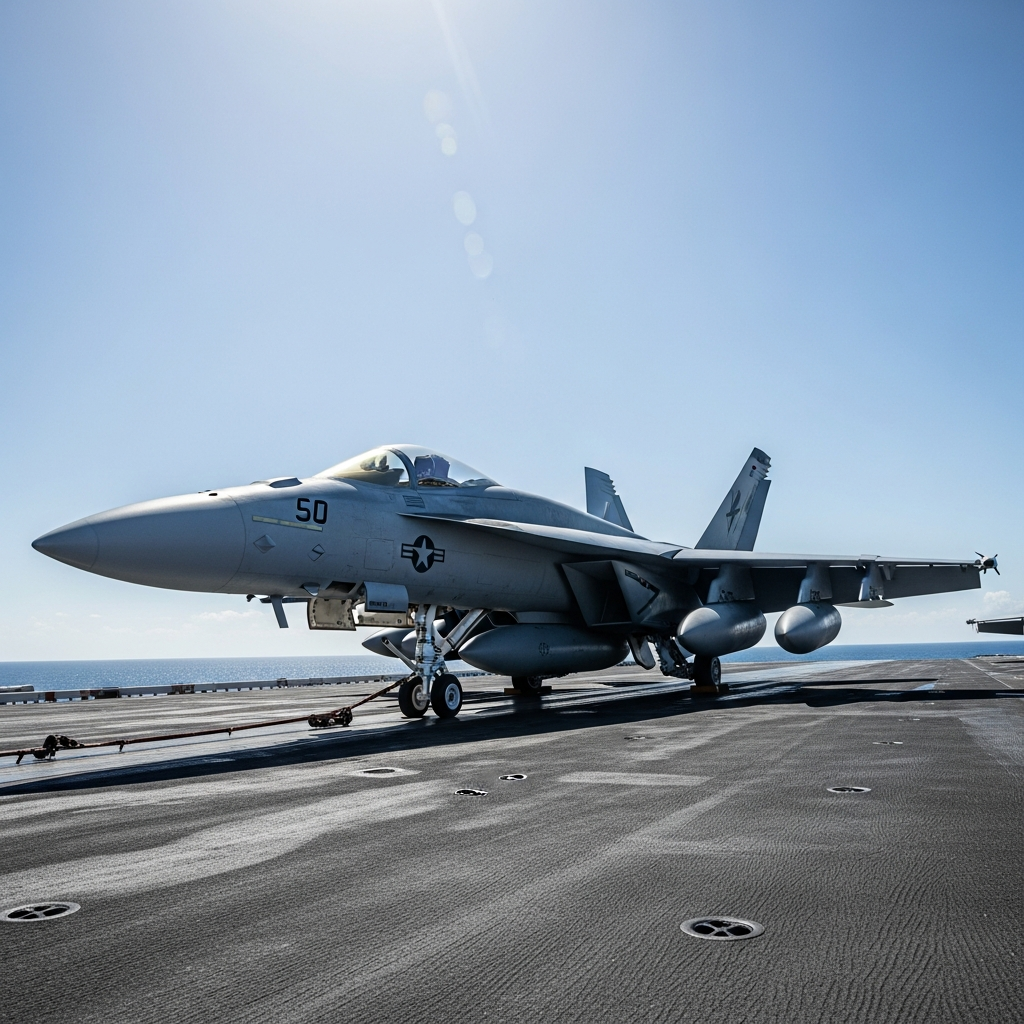
The U.S. Navy will award its F/A-XX sixth-generation carrier-based fighter Engineering and Manufacturing Development contract in August 2026 — and the officer leading the service has already signaled that one of the two companies competing for it can’t actually deliver on time. Chief of Naval Operations Admiral Daryl Caudle confirmed the August timeline Monday at the Sea-Air-Space 2026 symposium in National Harbor, Maryland, while offering an unusually blunt assessment of the competition between Boeing and Northrop Grumman.
The warning didn’t come out of nowhere. After years of delays, budget fights, and at least two near-cancellations, Caudle told reporters at the Navy League’s annual symposium that conversations with Deputy Secretary of Defense Steve Feinberg had produced a firm commitment to a downselect this August — narrowing the field to a single EMD contractor.
“One of the contractors who would make this plane for us is in a place where they really can’t deliver in the timeframe we need it,” Caudle said, declining to name the company.
The implication wasn’t subtle. Boeing is already under contract to produce the Air Force’s F-47 sixth-generation stealth fighter — awarded in March 2025 — and is still building F/A-18 Super Hornets while participating in F-35 production. Caudle acknowledged the industrial math directly: “We’ve got an F-35 program. We’ve got an F-47 program. We’re still building the Super Hornet. There’s a lot of airplanes being built.”
Northrop Grumman has no competing sixth-generation airframe in production, though its B-21 Raider program at Palmdale remains a significant industrial commitment. Northrop CEO Kathy Warden pushed back on the CNO’s characterization during an April 21 earnings call. She said the company expects a third-quarter award and is confident it can deliver — pointing specifically to B-21 as evidence of what Northrop can execute on a complex aircraft.
“We and our suppliers are prepared to bring the workforce and infrastructure that’s needed to execute the program, and our track record on B-21 demonstrates that ability to deliver a complex aircraft on schedule,” Warden said.
A Program That Nearly Died Twice
The F/A-XX contract was originally supposed to be awarded in March 2025. Congress had appropriated $454 million in the FY2025 full-year continuing resolution specifically timed to that milestone. The Navy missed it — spending nearly all of that funding on contract extensions that lawmakers later characterized as delivering “minimal demonstrated value.” Then the FY2026 budget request landed, and the Pentagon moved to shelve the program indefinitely, citing resource competition with the Air Force’s F-47, which received $3.4 billion in FY2026 funding compared to F/A-XX’s $76 million.
Congress stepped in. The conferenced FY2026 defense appropriations act, signed in January 2026, injected an additional $897 million in research-and-development funds — bringing the total to $972 million — and directed the Secretary of Defense to obligate those funds toward awarding an EMD contract to a single performer in accordance with an accelerated Initial Operational Capability timeline.
What F/A-XX Has to Do
The urgency is straightforward. F/A-XX is designed to replace both the F/A-18E/F Super Hornet and EA-18G Growler in carrier air wings, operating from Nimitz-class and Gerald R. Ford-class carriers in contested anti-access/area-denial environments where neither platform can currently survive. The requirement calls for at least 25 percent more combat radius than the F-35C, more sophisticated jamming than the Growler, integrated low-observable design, and the ability to command multiple Collaborative Combat Aircraft — the Navy’s loyal wingman drones, with five vendors currently under contract including Anduril, Boeing, General Atomics, Lockheed Martin, and Northrop Grumman.
“Our ability to fly with impunity with our existing airframes is fleeting. If I don’t start building that immediately, you’re not going to get it for some time,” Caudle warned at the Apex Defense conference in January.
The aircraft will also operate alongside the MQ-25A Stingray tanker drone, expected to reach IOC later in 2026, extending carrier strike range across the fleet.
What Comes Next
August is the date to watch. A single EMD winner walks away with what will almost certainly be one of the largest defense contracts of the decade. The loser — and Caudle has all but telegraphed his concern about which company that may be — will be left on the sideline as the next generation of naval aviation takes shape without them. A formal source selection announcement is expected to follow the downselect decision.
Stay in the loop
Get the latest aircraft insider updates delivered to your inbox.