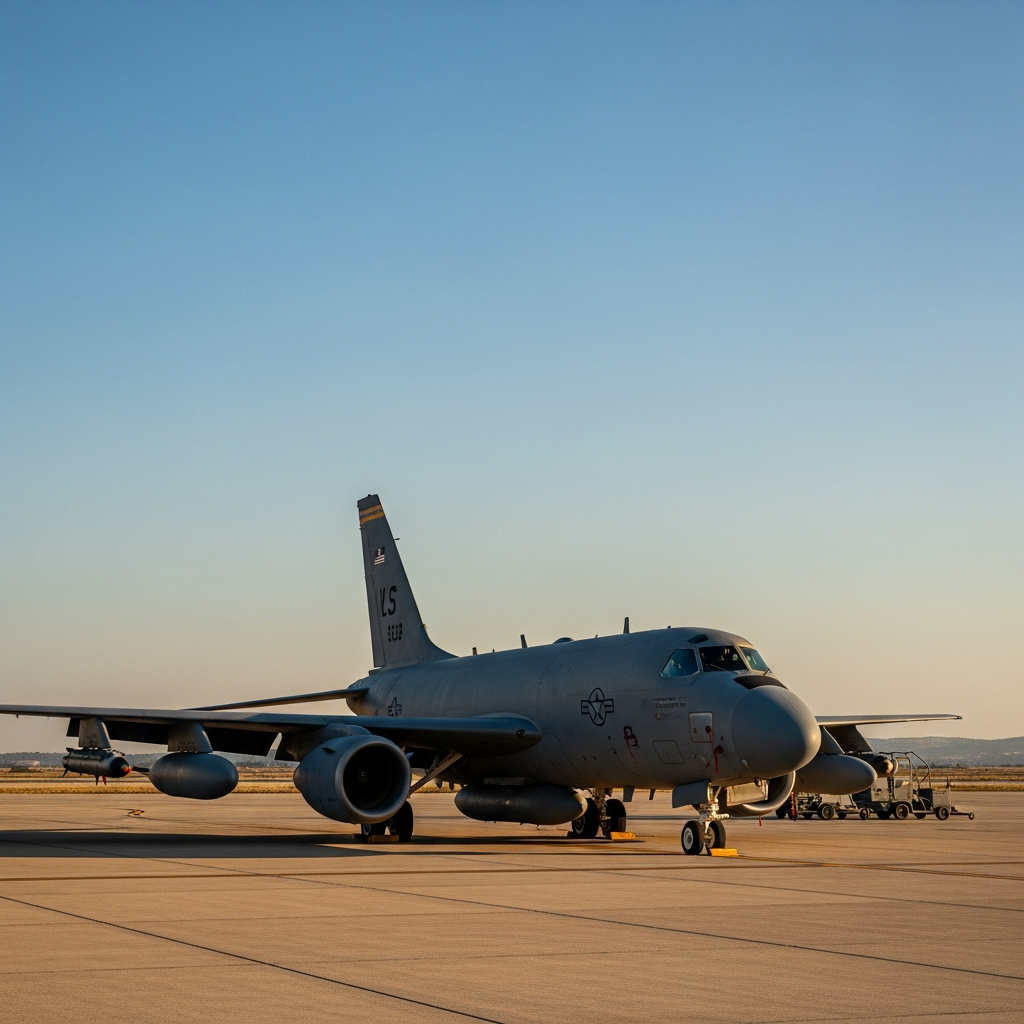
On the night of March 27–28, 2026, Italy turned away U.S. military aircraft — believed to be strategic bombers supporting Operation Epic Fury — from Naval Air Station Sigonella in Sicily. It’s the sharpest public break between Washington and a NATO ally since the Iran conflict began.
The aircraft were already airborne when the landing request reached Italian authorities. Italy’s Chief of Defence Staff, General Luciano Portolano, was notified by the air force’s general staff that U.S. aircraft had filed flight plans showing a scheduled stop at Sigonella before continuing toward the Middle East. No prior authorization had been requested. Italian military leadership hadn’t been consulted at all. Portolano informed Defence Minister Guido Crosetto, who issued the directive: no landing.
The Aircraft and the Base
No official confirmation has been released on aircraft type, tail numbers, or unit designations. Given the operational tempo of Epic Fury and the range demands of strikes on Iran, the aircraft were most likely B-52H Stratofortress or B-1B Lancer bombers. For heavy bombers transiting toward the Persian Gulf corridor, Sigonella is not just a fuel stop — it compresses transit time, reduces crew fatigue, and widens operational windows. Losing that staging option forces longer routes, heavier fuel loads, and tighter scheduling margins.
Sigonella is one of the most strategically loaded airfields in the Mediterranean. The dual-runway installation near Catania — runways measuring 2,462 meters and 2,442 meters — routinely handles C-17 and C-5 transports, KC-135 and KC-10 tankers, P-8A Poseidons from rotational detachments, MQ-4C Tritons operated by VUP-19 “Big Red,” and NATO’s RQ-4D Phoenix surveillance drones. Roughly 7,000 personnel are based there. It serves as the primary transit hub for U.S. Sixth Fleet operations and missions across Africa, the Black Sea, and Southwest Asia.
The Legal Trigger
Under bilateral defence agreements dating to 1954, routine and logistical U.S. flights at Italian bases require only technical authorizations. Operations that could implicate Italy in armed hostilities require advance parliamentary consultation. ANSA reported that checks confirmed the flights were neither routine nor logistical — placing them outside existing standing agreements and squarely in the category requiring prior political clearance Italy never received.
“I want to reiterate that there is no cooling or tension with the US — because they know the rules that have governed their presence in Italy since 1954 just as well as we do.” — Defence Minister Guido Crosetto, on X
Crosetto confirmed the denial publicly on March 31, after Corriere della Sera broke the story. He framed it as a procedural matter rather than a political statement. Palazzo Chigi backed that line — issuing a statement that relations with Washington “are solid and based on full and loyal cooperation” and that all requests are evaluated “on a case-by-case basis.”
Alliance Fallout
Italy isn’t alone. Spain’s denial of access to Rota and Morón was established in early March — well before the Italian incident — when Spanish government officials confirmed that U.S. jets and refueling aircraft would not be permitted to use those bases for flights connected to the Iran war. On March 30, Spain publicly confirmed that block. Spanish Defence Minister Margarita Robles put it bluntly: “Two countries went to war and expected us to join them.”
President Trump responded on Truth Social with a direct warning to European allies: “You’ll have to start learning how to fight for yourself, the U.S.A. won’t be there to help you anymore, just like you weren’t there for us.” Secretary of State Marco Rubio went further, directing his criticism specifically at Spain, blasting Madrid for denying the use of its airspace and bases and questioning the value of an alliance where the U.S. pledges to defend members who then deny basing rights when American forces need them.
“If NATO is just about us defending Europe if they’re attacked, but them denying us basing rights when we need them, that’s not a very good arrangement.” — Secretary of State Marco Rubio
Senator Lindsey Graham called on the administration to relocate aircraft from Spain to “a country that we can actually rely on in a time of great need.” A senior NATO diplomat, speaking anonymously to the Irish Times, called the emerging dynamic “a complete own goal, without question.”
What Comes Next
On April 7, Crosetto appeared before Parliament and cited historical landing and UAS traffic data at Sigonella — 2,919 landings in 2022 alone, plus 1,293 remotely piloted aircraft flights — to argue the Meloni government has not materially altered the access framework. The Pentagon publicly maintained Italy was “supportive.” CENTCOM declined to comment entirely.
The real question now is whether Washington attempts to formalize emergency basing arrangements outside Italy and Spain, or presses both governments for revised standing agreements that reduce the parliamentary consultation threshold. Developments at Sigonella and across U.S. European basing posture will continue to bear watching as the conflict in Iran goes on.
Sources
- Defense News — Italy denies U.S. aircraft landing at Sigonella
- Corriere della Sera — Original reporting on the Sigonella denial, March 31, 2026
- Newsweek — Pentagon and White House responses to NATO base denials
- ANSA — Italian government source confirmation and legal framework reporting
- The Aviationist — Technical context on Sigonella operations and U.S. aircraft activity
- Reuters — Spain confirms airspace block for Iran conflict flights, March 30, 2026
- Al Jazeera — Alliance fracture coverage and Trump Truth Social statement
- Euronews — Crosetto parliamentary address, April 7, 2026
- Combat Aircraft — Operation Epic Fury and strategic bomber deployment context

Stay in the loop
Get the latest aircraft insider updates delivered to your inbox.