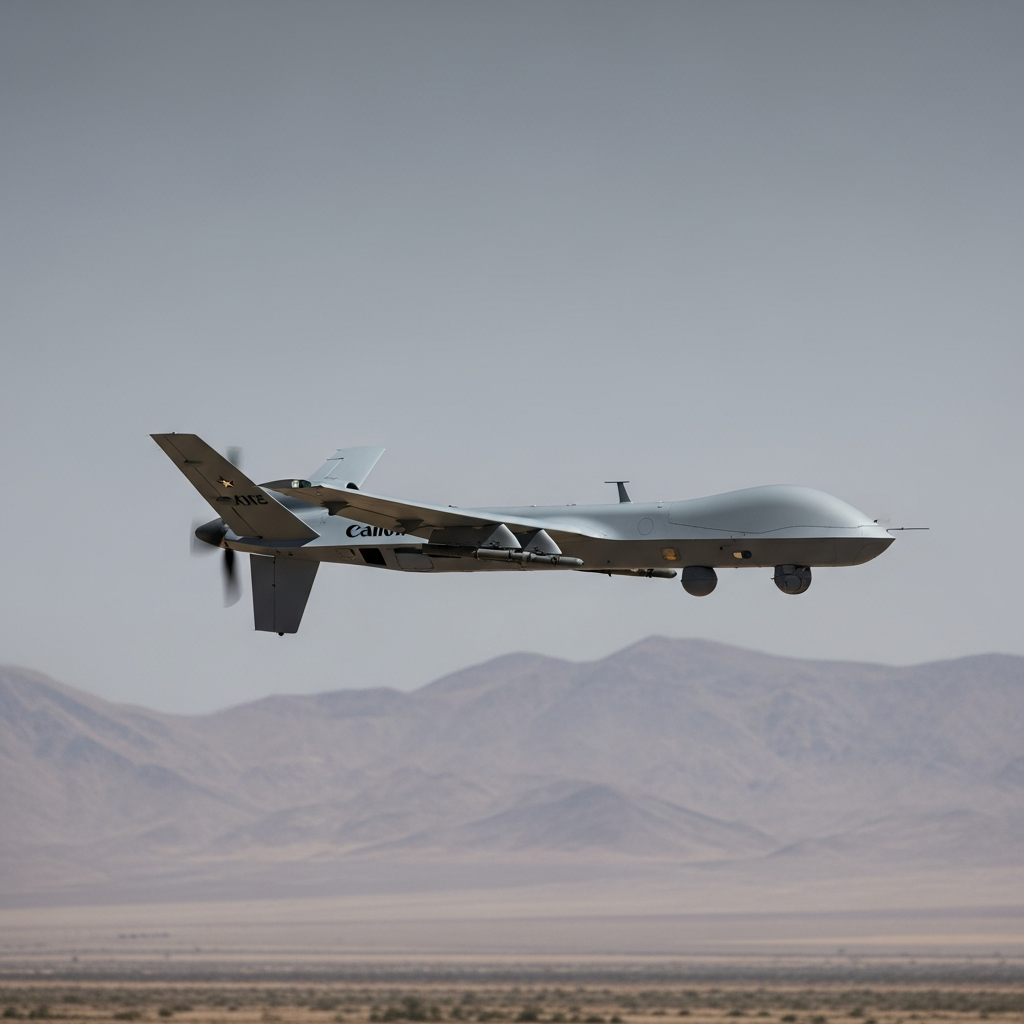
Anduril Industries landed a $100.3 million contract modification from the Pentagon on May 8, 2026 — the latest cash infusion tied directly to the Trump administration’s push to field 30,000 attack drones across the U.S. military, and a sign that American drone procurement is moving faster by the month.
The award modifies an existing indefinite-delivery contract, lifting the ceiling value from $99.7 million to $200 million, with completion targeted by September 2027. The underlying vehicle funds Anduril’s mesh networking work for the Space Surveillance Network — the constellation of ground-based radars and sensors that tracks satellites, debris, and orbital threats. Authority for the funding traces back to President Trump’s presidential memorandum and Executive Order 14307, with Defense Secretary Pete Hegseth signing a corresponding Defense Secretary directive on July 10, 2025, titled “Unleashing U.S. Military Drone Dominance.”
The Memo Behind the Money
Hegseth’s July 2025 directive didn’t leave much to interpretation. It ordered every U.S. Army squad equipped with small, one-way attack drones by the end of fiscal 2026, pulled procurement authority away from Pentagon bureaucracy and handed it directly to warfighters, and set a hard ceiling of 30,000 attack drones fielded across the services. “I am rescinding restrictive policies that hindered production and limited access to these vital technologies,” Hegseth said at the time. Separately, he made clear the stakes of the shift: “Drone dominance will do two things: drive costs down and capabilities up.”
The first major shakeout came in February 2026 — a testing event called “Gauntlet” at Fort Benning, Georgia, where 25 competing vendors flew their systems and were evaluated head-to-head by military operators. That evaluation is now producing contract dollars.
Anduril’s Expanding Pentagon Footprint
The May 8 modification is only the latest in a run of significant awards. On March 14, 2026, the Army announced a $20 billion enterprise counter-drone contract. Two days later, on March 16, the Army awarded the first $87 million task order to Anduril’s Lattice AI platform as the command-and-control backbone under the Army-run counter-drone task force. Three weeks after that, on April 7, the Army handed Anduril a separate $16.8 million contract for Ghost-X small drone hardware. The Ghost-X is built for hunter-killer teaming — scout drones identify targets, strike drones finish the job.
At Arsenal-1, Anduril’s 5-million-square-foot hyperscale manufacturing campus south of Columbus near Rickenbacker International Airport, the YFQ-44A Fury Collaborative Combat Aircraft entered serial production on March 24, 2026. The facility runs 22 workstations across three shifts, with a rated capacity of 150 aircraft annually. The YFQ-44A sits at roughly half the dimensions of an F-16 — 6.1 meters long, 5.2-meter wingspan — and is designed to pull 9g maneuvers at Mach 0.95, fly semi-autonomously alongside F-22s, F-35s, and the planned F-47, and carry AIM-120 AMRAAMs. Known prototype tail numbers 25-1001 and 25-1003 have been flying since October 2025. By April 16, Airmen from the Experimental Operations Unit at Edwards AFB were conducting hands-on semiautonomous sorties.
“Conflicts in Ukraine, Iran and elsewhere have the U.S. and other nations scrambling to stockpile weapons. There’s a need to be able to produce these assets for ourselves and our allies at a rate that hasn’t been done for a long, long time.” — Keith Flynn, Anduril SVP of Production
Hegseth has been equally blunt about the cost logic driving the whole enterprise. “We cannot afford to shoot down cheap drones with $2 million missiles,” he said earlier this year — a doctrine that shapes both the Ghost-X hunter-killer program and the Roadrunner-M reusable interceptor, for which Anduril has delivered over $350 million in orders, including a $250 million package for 500-plus units paired with Pulsar electronic warfare systems.
What to Watch
The indefinite-delivery structure of the May 8 modification is worth noting. It’s designed for rapid scaling — no new competitive solicitation every time the Pentagon needs more capability. Arsenal-1 is also slated to begin producing Barracuda cruise missiles and at least one classified program before year’s end, making Anduril’s manufacturing throughput a critical variable in whether the 30,000-drone goal stays on schedule. Contract awards, CCA flight test milestones, and Gauntlet evaluation results will continue to be tracked as they emerge.
Stay in the loop
Get the latest aircraft insider updates delivered to your inbox.