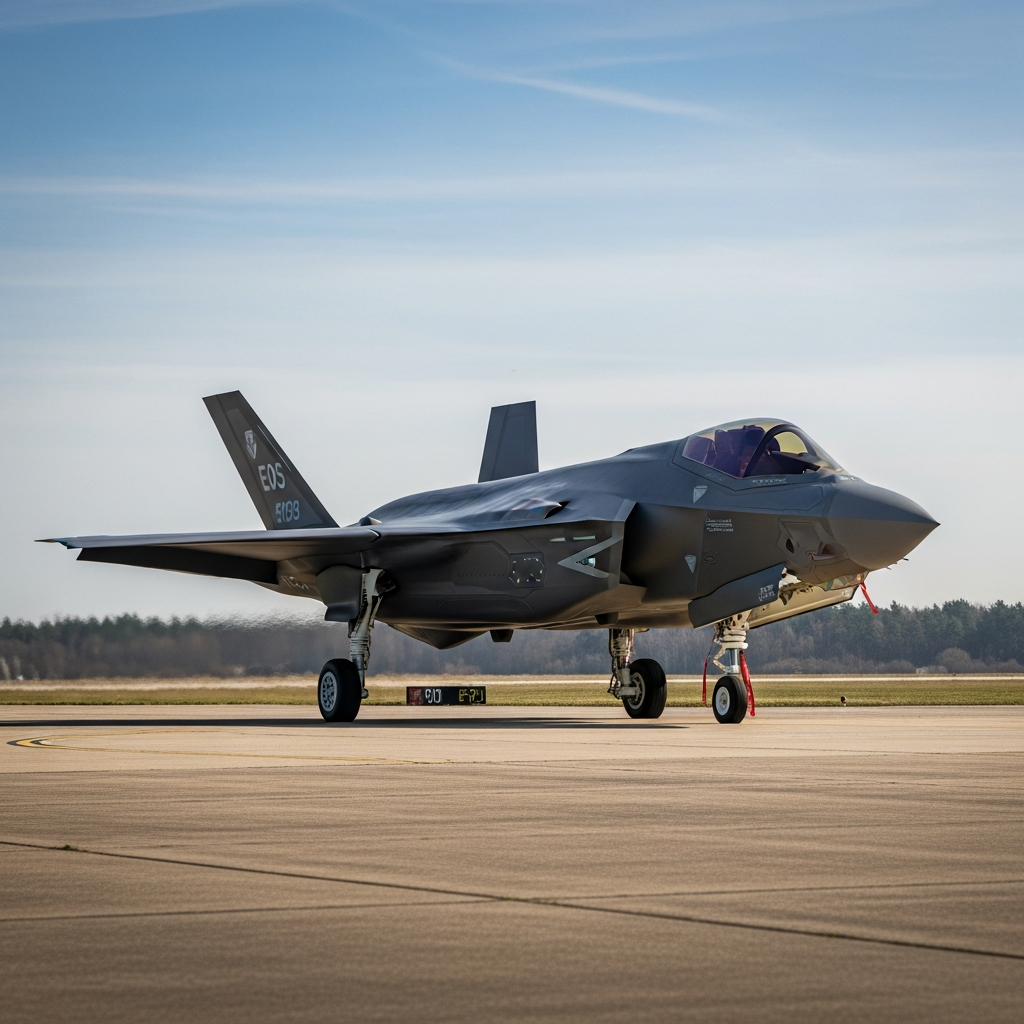
Poland has taken delivery of its first three Lockheed Martin F-35A Lightning II fighter jets at Łask Air Base. It’s a milestone moment—NATO’s first fifth-generation combat aircraft have now arrived on the alliance’s eastern flank, sending a direct strategic message to Russia as tensions along Europe’s borders remain acute.
The three F-35As—tail numbers 3509, 3510, and 3511—touched down at the 32nd Tactical Air Base in Łask on May 22, 2026. They had departed from Fort Worth, Texas on May 20, making stopovers including the Azores before arriving under escort from two Polish F-16 fighters. Base firefighters greeted them with a traditional water salute. Polish Defence Minister Władysław Kosiniak-Kamysz was on hand to welcome the jets, declaring: “These are the first fifth-generation fighters on NATO’s eastern flank capable of detecting threats before they themselves are spotted.”
The delivery caps off a six-year procurement cycle that began with Poland’s January 31, 2020 Letter of Offer and Acceptance for 32 F-35A Conventional Take-Off and Landing variants—the second-largest defence deal in the country’s history. Poland has designated the jets “Husarz,” a name drawn from the famous 16th-century winged hussar cavalry units.
Strategic Positioning and Force Structure
Choosing Łask as Poland’s primary F-35 base made strategic sense. The airfield completed F-35 certification in March 2026 and sits positioned to cover both western approaches and Poland’s 418-kilometer eastern border with Belarus and the Russian exclave of Kaliningrad. The remaining 29 aircraft will eventually split between Łask and the 21st Air Base in Świdwin in northwestern Poland—where Soviet Su-22s were once stationed.
Poland is building a two-tier air combat model that NATO considers among the most effective approaches for modern warfare. The F-35s will handle penetration and intelligence-gathering missions while Poland’s entire fleet of 48 F-16 fighters undergoes modernization to the F-16V standard—a $3.8 billion program announced last year. The integration enables real-time data sharing across air, ground, and naval assets.
Weapons and Capability
The Polish F-35As arrived equipped with serious firepower. They carry AIM-120D-3 AMRAAM air-to-air missiles with 180-kilometer range, AGM-88G AARGM-ER anti-radar missiles, and potential access to future systems including AGM-158 Joint Stand-Off Weapons with 555-kilometer range and GBU-39 Small Diameter Bombs. A separate $500 million contract signed in November 2025 secures additional AIM-120D-3 missiles for the F-35 fleet. There’s more—Poland’s F-35s could possibly be armed with B61-12 thermonuclear bombs in the future, as Warsaw increasingly looks to field a nuclear deterrent capability.
Polish pilots have already logged over 1,000 flight hours on the type during training at Ebbing Air National Guard Base in Arkansas, where pilot training commenced on January 31, 2025. Colonel Krzysztof Duda, commander of the 32nd Tactical Air Base, estimates the cost of training each pilot at approximately $55 million.
What’s Next
An official acceptance ceremony is scheduled for June 12, 2026. Initial Operational Capability will arrive in 2027, followed by Full Operational Capability two years later. Additional aircraft are expected to arrive in batches as production continues at both Fort Worth and the final assembly line in Cameri, Italy—with 16 aircraft allocated to each facility.
Poland’s F-35 deployment marks a major transformation into one of NATO’s most capable air forces. As the only NATO member bordering Russia, Ukraine, and Belarus simultaneously, Warsaw has allocated 4.8 percent of GDP to defence spending—the largest relative defence budget in the alliance. Beyond the F-35, Poland has ordered 48 FA-50 fighters from South Korea, numerous tanks, air-defence systems, and attack helicopters. The arrival of fifth-generation fighters signals that NATO’s eastern flank now possesses technological parity with potential adversaries in ways that would have seemed impossible a decade ago.



Stay in the loop
Get the latest aircraft insider updates delivered to your inbox.