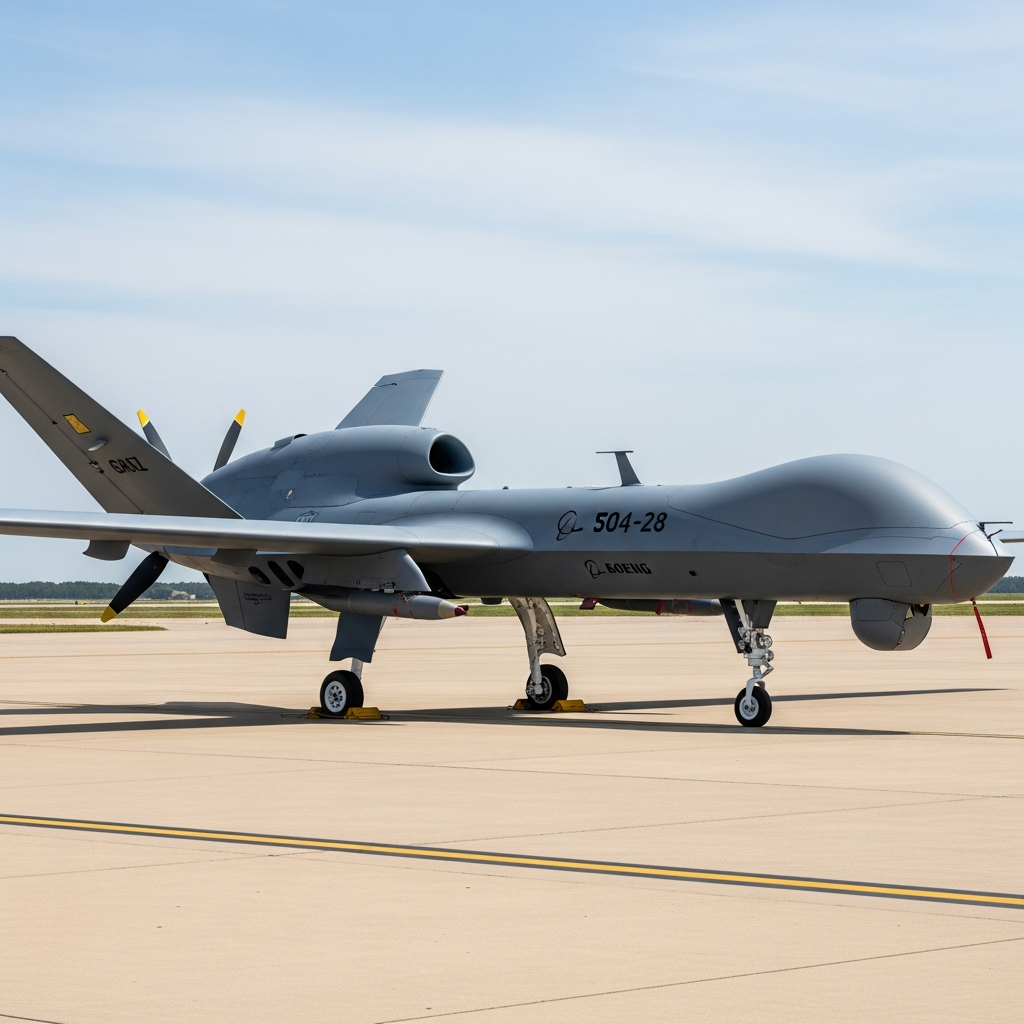
Boeing’s MQ-28 Ghost Bat just completed its first three flights over U.S. soil at Naval Air Station Point Mugu. It’s a big moment for the Australian-developed autonomous loyal wingman—and proof the aircraft is ready for integration with U.S. Navy carrier operations and collaborative combat missions.
The three sorties over the Point Mugu Sea Range mark the first time this 38-foot-long unmanned combat aircraft has operated outside Australian airspace since initial development began in 2013. These flights are building momentum toward carrier-based Collaborative Combat Aircraft (CCA) trials, positioning Boeing competitively within the Navy’s ongoing competition to field autonomous wingmen alongside legacy and fifth-generation fighters.
Glen Ferguson, MQ-28 Global Program Director at Boeing, framed the testing as validation of the platform’s exportability and allied interoperability. “The activity at Point Mugu is part of Boeing’s ongoing flight test program to mature the MQ-28 and demonstrate operations from allied locations,” Ferguson said. “This location is being used to further prove the maturity of the program and inform future exportability.”
Technical Maturity on Display
The Point Mugu flights used an MQ-28 Block I airframe equipped with an infrared search and track (IRST) sensor in its modular, swappable nose section—a payload configuration not visible in earlier Department of Defense imagery from December 2025. The aircraft’s architecture is built for flexibility: the entire nose section is removable, allowing rapid reconfiguration for different missions like combat air patrol, strike, electronic warfare, or intelligence and surveillance reconnaissance between sorties.
With a 3,200-kilometer range and AI-enabled autonomous flight envelope, the Ghost Bat can operate independently or under direction from a crewed mother ship—typically an E-7A Wedgetail airborne early warning platform, F-35A, or F/A-18F Super Hornet. During the Point Mugu tests, launch and recovery operators managed initial flight control before handing operational tasking to a directing aircraft, a teaming architecture the Navy will rely upon in future carrier operations.
Building Toward Carrier Integration
Point Mugu was chosen deliberately. The base is home to Naval Air Station infrastructure directly adjacent to a certified range with minimal civilian exposure and houses Air Test & Evaluation Squadron 31 (VX-31), the Navy’s principal platform for advanced development testing. Commander James Moore Licata, who previously held the role of government flight test director for U.S. Navy CCA efforts, joined VX-31 in February 2026.
Boeing has already demonstrated carrier landing concepts through renderings showing a hooked variant of the MQ-28. In September 2025, the company received a Navy contract to develop conceptual designs for a carrier-capable CCA variant alongside Anduril, General Atomics, and Northrop Grumman. Unlike the U.S. Air Force CCA competition—where Boeing was eliminated in 2024—the Navy contest remains actively contested.
International Export Momentum
The Point Mugu flights come approximately five months after a major milestone: the MQ-28 completed a live AIM-120 AMRAAM firing in December 2025. Teamed with an E-7A Wedgetail and F/A-18F Super Hornet, the Ghost Bat destroyed a fighter-class target drone, establishing itself as the first autonomous aircraft to successfully conduct air-to-air weapon employment with an AIM-120 missile.
The Royal Australian Air Force plans to field 18 operational Ghost Bats by 2028, with rate production slated to begin in Australia within two years. Boeing has already partnered with Germany’s Rheinmetall to pitch the platform to European customers, and Japan established a CCA framework in April 2026. These Point Mugu sorties signal to allied nations that the Ghost Bat is operationally mature and ready for international deployment.
What to Watch
Expect Boeing to announce additional Point Mugu test events as it works toward carrier launch and recovery trials. Integration of the Navy’s common control architecture—under contract to Lockheed Martin—will be critical to demonstrating interoperability across multiple crewed and uncrewed platforms. Australia’s timeline to achieve combat readiness by 2028 remains on track, potentially making the Ghost Bat the first operational autonomous combat aircraft in the Western alliance.
Stay in the loop
Get the latest aircraft insider updates delivered to your inbox.