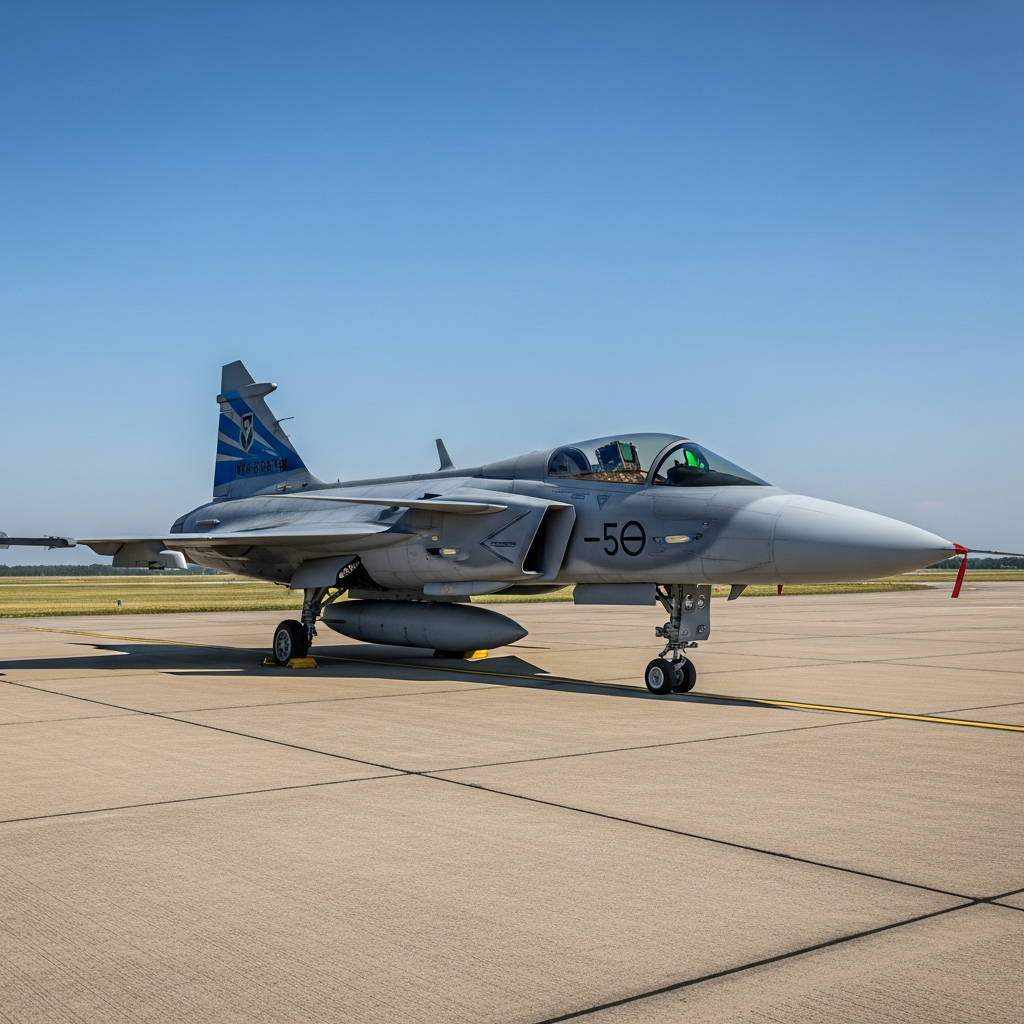
Ukraine has locked in a landmark deal for up to 20 Gripen E/F fighter jets from Sweden, with deliveries starting in 2030. At the same time, Stockholm confirmed it will donate 16 Gripen C/D variants as early as 2027—a two-pronged arrangement that substantially bolsters Kyiv’s modern air power as the conflict enters its fifth year.
Swedish Prime Minister Ulf Kristersson and President Volodymyr Zelenskyy announced the agreement yesterday at Uppsala Air Base in eastern Sweden. The purchased Gripen E/F aircraft will be funded through €2.5 billion ($2.9 billion) from the European Union’s Ukraine Support Loan, approved last month after Hungary’s new government dropped its veto. The 16 donated C/D-model jets—currently flown by the Swedish Air Force—will start moving to Ukraine in early 2027, pending final export clearances.
“The aim is to quickly conclude a final agreement with deliveries as of 2030,” Kristersson said. On the immediate donation, he called it “a historic decision for Sweden” that will “strengthen Ukraine’s air defence significantly.”
Two Aircraft, Different Timelines
The two airframes serve different purposes operationally. The donated Gripen C/D variants are proven 4th-generation multirole fighters already in production, built for rapid deployment. Swedish Defense Minister Pål Jonson said Ukrainian pilot training is already underway and will ramp up this autumn.
The purchased Gripen E/F aircraft represent a significant upgrade in capability. They carry the Raven ES-05 AESA radar, a more powerful General Electric F414 turbofan engine rated at 22,000 pounds of thrust, and Skyward-G infrared search-and-track (IRST) sensors. The E variant can detect targets at ranges far beyond what the earlier models manage. It adds two more hardpoints—totaling ten pylon stations—and can carry nearly 2,000 kilograms more payload than the C/D.
Top speed hits Mach 2 at altitude; low-level dash reaches 1,400 km/h. A pilot can turn around from landing to second sortie in ten minutes for air-to-air configuration, twenty minutes for ground-strike loadouts. For Ukrainian airfields taking constant Russian pounding, the Gripen’s ability to operate from highways and dispersed sites is operational doctrine, not sales pitch.
Weapons and Doctrine Implications
Sweden is shipping advanced air-to-air weapons with the aircraft. The Meteor beyond-visual-range missile travels at Mach 4 with an operational range of approximately 100 kilometers—directly addressing Zelenskyy’s stated goal: stopping Russian glide-bomb attacks. Current Russian aviation operates within Meteor range, forcing bombers either higher (which hurts accuracy) or farther back from the Ukrainian border.
Ukrainian pilot Vadym Voroshylov, call sign “Karaya,” flew the Gripen and didn’t mince words: “For me, the JAS-39 is the only fighter jet in the world I’d be willing to sell my soul for.” He singled out the aircraft’s side-mounted intakes—they reduce foreign object damage risk on damaged airfields—and its ten-minute combat turnaround as game-changers.
Operating costs sweeten the deal. At $5,800 per flight hour versus the F-35’s $35,000, the Gripen lets Ukraine generate sustained sorties at scale. Per-unit flyaway cost runs roughly $85 million.
Long Game
When Kristersson signed a letter of intent on October 22, 2025 on the larger purchase, he described it as “the beginning of a long journey for the next 10–15 years.” Yesterday’s announcement ups the ante. Both nations are now looking at partial localization of Gripen production in Ukraine around 2033, converting the aircraft from a purchase into an industrial partnership.
Saab CEO Micael Johansson saw it strategically: “The more countries that select the Gripen fighter and it starts flying in operations, the more people understand what a fantastic capability this is.”
Donating 16 Swedish Air Force jets signals NATO’s willingness to pull operational aircraft from allied inventories. The purchase timeline—three to four years until first delivery—suggests confidence in Ukrainian victory and reconstruction.
Stay in the loop
Get the latest aircraft insider updates delivered to your inbox.