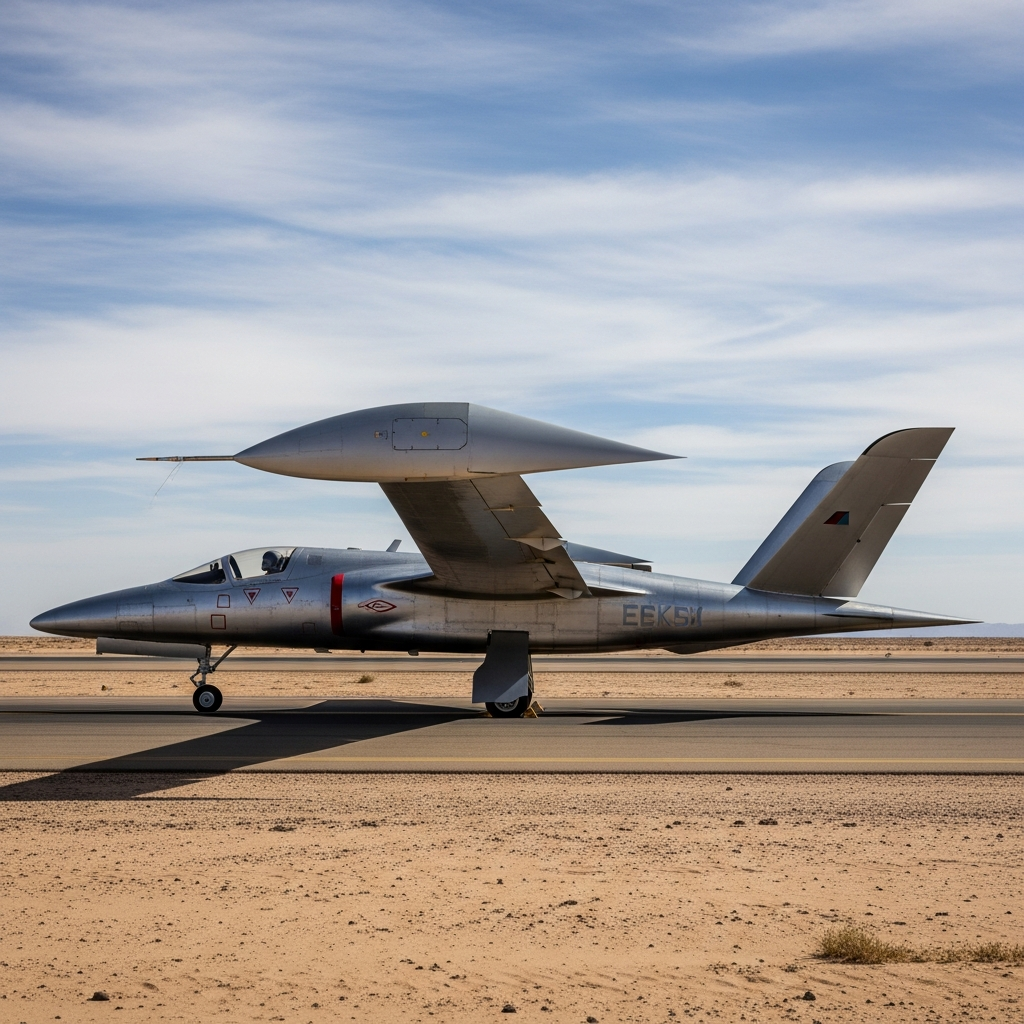
A thermal image captured near Area 51 this week has set off alarm bells in aviation circles. The photo appears to show a previously unreported next-generation aircraft with distinctive cranked-kite wings and canard control surfaces—possibly the first public look at the U.S. Air Force’s classified sixth-generation fighter program.
The image was initially posted by Project Fear on June 2-3, 2026, with YouTuber Anders Otteson of Uncanny Expeditions subsequently analyzing and publicizing the footage. What he captured is striking: an aircraft with geometry markedly different from any operational U.S. military platform. The design combines a pronounced angular break in the leading edge—characteristic of cranked-kite planforms—with forward canard surfaces and what appears to be a sawtooth trailing edge typical of low-observable aircraft. Aviation analysts say the silhouette is a compelling match for speculative renderings of the F-47, the Air Force’s upcoming replacement for the F-22 Raptor.
“This is likely the first public sighting of the 6th Gen NGAD tech demonstrator, a precursor to the production F-47,” Otteson told The Aviationist. Both The War Zone and The Aviationist have vouched for the footage’s provenance, though they note that authenticity of the image’s source speaks only to where it came from, not to identification of what it shows—which remains a matter of speculation. That lends credibility to the sighting, despite the image’s limited resolution and the inherent ambiguities of thermal imaging.
Program Background — What the F-47 Represents
In March 2025, the Air Force selected Boeing’s design as the winning concept for the Next-Generation Air Dominance (NGAD) program, formally designating it the F-47. The contract exceeds $20 billion and covers development of at least 185 aircraft—making it one of the most significant fighter procurement efforts since the F-35 program. The Air Force aims for initial operational capability in the 2030s, with first flight scheduled for 2028.
The F-47 is engineered to deliver a combat radius exceeding 1,000 nautical miles. That’s roughly 25 percent greater than current fighters. The aircraft will fly at speeds above Mach 2 and integrate artificial intelligence systems for autonomous teaming with over 1,000 Collaborative Combat Aircraft (unmanned systems)—a fundamental shift in how air superiority missions get executed.
The Cranked-Kite Design — What It Means
The cranked-kite planform visible in the thermal image represents a sophisticated aerodynamic compromise. The distinctive angular break in the leading edge distributes lift more efficiently across the wingspan while minimizing radar cross-section—a critical advantage in high-threat environments. Unlike conventional delta wings or tailless designs, the cranked-kite geometry optimizes stealth, supersonic stability, and maneuverability without relying on vertical tail surfaces, which are significant sources of radar signature.
The canards—those small foreplanes visible ahead of the main wing—have surprised some observers. Such surfaces introduce complexity for stealth-focused designs. Yet canards provide additional control authority essential for maintaining stability in aircraft optimized for supersonic flight and extreme maneuverability. China’s operational J-20 fighter also employs canards, though experts debate whether the configuration genuinely compromises low-observable characteristics or represents a calculated trade-off.
What This Sighting Reveals—And Doesn’t
The Air Force has declined official comment on this specific image. However, the service confirmed in 2024 that experimental NGAD aircraft have already accumulated “hundreds of hours” of secret test flights. Both Boeing and Lockheed Martin flew risk-reduction demonstrators beginning in 2019, and it remains plausible these earlier technology pathfinders remain active at Groom Lake.
There’s an important caveat: the Air Force has stated that official F-47 renderings do not necessarily reflect the actual aircraft’s appearance—a deliberate operational security measure. This thermal sighting may represent the closest the public has come to authentic imagery of the program.
Expect similar sightings as the F-47 continues ground testing and eventually transitions to flight operations. Area 51’s historical role as the proving ground for the U-2, SR-71, and F-117 suggests this latest mystery aircraft belongs to a lineage of transformative military aviation programs.
Sources
- The Aviationist
- The War Zone
- U.S. Air Force NGAD Program Statements
- Project Fear YouTube Channel
- Uncanny Expeditions — Anders Otteson



Stay in the loop
Get the latest aircraft insider updates delivered to your inbox.