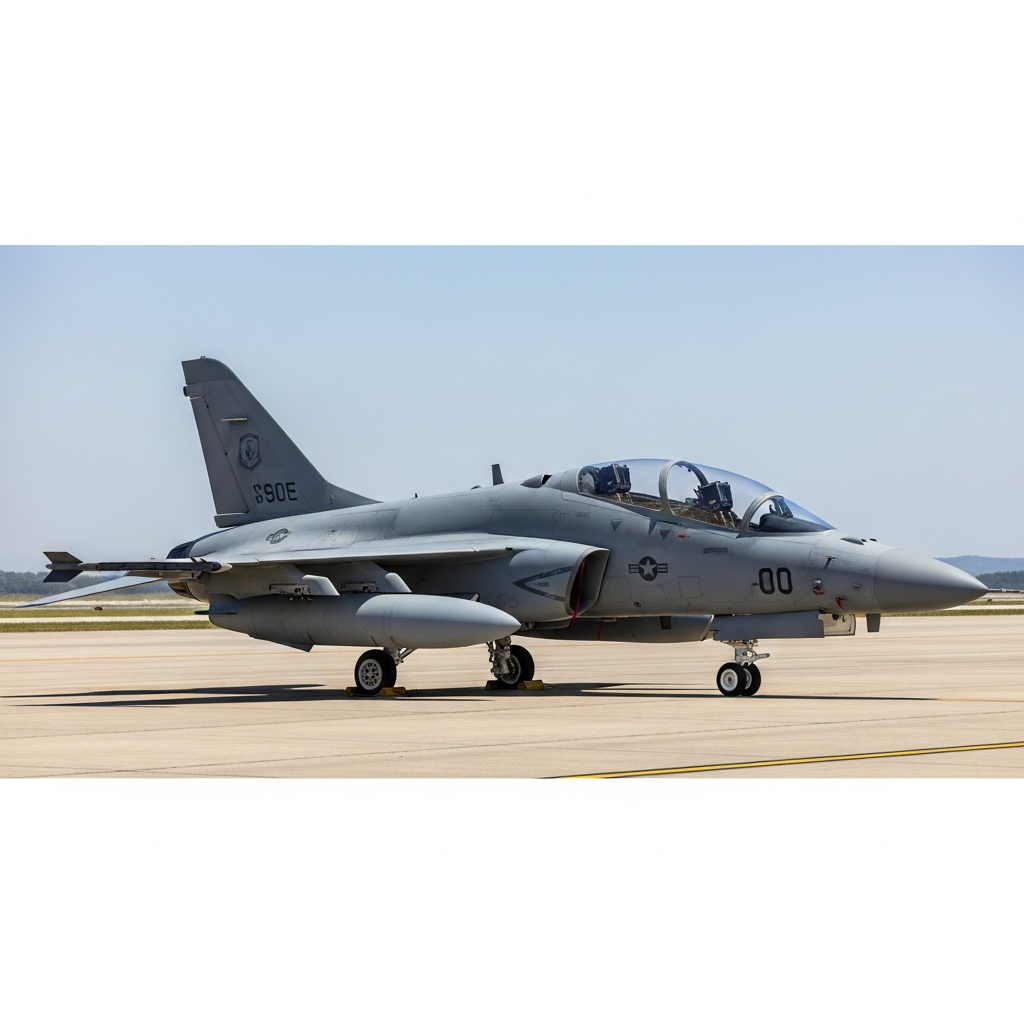
The U.S. Air Force’s Air Education and Training Command has qualified its first two instructor pilots on the T-7A Red Hawk. It’s a watershed moment—one that marks the beginning of operational independence on the advanced trainer and opens the door to a historic transition away from the aging T-38 Talon.
Lt. Col. Michael Trott and Lt. Col. Phillip Bourquin earned their T-7A qualifications through Type-1 sorties. These intensive flights focused on takeoffs, landings, systems familiarization, and aircraft handling. Both officers are stationed at Joint Base San Antonio-Randolph, Texas, home to the 12th Flying Training Wing. Trott commands the 99th Flying Training Squadron; Bourquin serves as the squadron’s director of operations. AETC announced the milestone on June 3, 2026.
“This milestone permits us to fly the aircraft on our own without a T-7 instructor pilot from Boeing or Developmental Test, allowing us to build the instructor cadre vital to producing the highly capable aviators needed for tomorrow’s high-end fight,” Trott said in an official statement.
The first T-7A delivered to AETC—tail number 21-7005—arrived in San Antonio from Boeing’s fighter assembly and delivery center in St. Louis. It’s the fifth production-representative test aircraft built for the Air Force. The previous four remain assigned to Edwards Air Force Base in California, supporting the service’s test and evaluation campaign. The 99th Flying Training Squadron expects to receive its second T-7A in August 2026.
Breaking the Legacy Trainer Stranglehold
The T-38 Talon entered service on March 17, 1961. Over 60 years later, it has trained more than 75,000 Air Force pilots and still remains the backbone of undergraduate pilot training. But the aircraft is ancient. The Air Force’s fleet of 486 T-38s averages nearly 60 years old and suffers from chronic maintenance issues and obsolescence. The core problem? The T-38 was designed to prepare pilots for third-generation fighters—platforms that retired more than 30 years ago.
Maj. Gen. Clark Quinn, the AETC commander, put it bluntly: “All of the aircraft that the T-38 was designed to train for retired 30-plus years ago.”
A T-38 crash at Columbus Air Force Base, Mississippi on May 12, 2026, underscored the urgency. Both pilots safely ejected, but the incident sent a clear signal. An operational pause was announced five days later, further constraining the already shrinking pool of available flying hours. Each crash accelerates the Air Force’s timeline to field a trainer capable of preparing pilots for fifth-generation fighters like the F-35 and future platforms including the B-21 Raider and F-47.
The Red Hawk Advantage
The T-7A shifts the focus from how to fly the aircraft to how to manage the mission. Its design borrows from proven platforms—the F-16’s landing gear, the F/A-18’s General Electric F404 engine, and F-35-style hands-on throttle-and-stick controls. The Red Hawk pulls up to 8 Gs while remaining more forgiving than the T-38.
Large-area touchscreen displays and fully digital avionics give the trainer a modern edge. The cockpit includes onboard simulation of radar, targeting pods, and adversary threats—compressing the learning curve significantly. The layout mirrors operational fighters, eliminating the “relearning” pilots currently experience when transitioning from the Talon to advanced jets.
Maintainability is a game-changer in itself. The F404 engine is replaceable in 90 minutes with basic tools. Ejection seats swap in 15 minutes. Boeing’s digital engineering thread enables predictive maintenance and real-time diagnostics, reducing downtime between sorties.
What Comes Next
Trott and Bourquin will fly “seasoning sorties” before instructing other pilots. A dedicated Pilot Instructor Training syllabus is currently in draft form and is expected to be finalized in fall 2026, requiring approximately four months to complete. AETC targets Initial Operational Capability in August 2027. First student sorties are expected to begin that fall. Production aircraft will then flow directly to Columbus Air Force Base in early 2028, where new pilots will begin instruction on the T-7A.
The Air Force plans to procure 351 T-7As through 2035–36, with annual buys of 40–60 aircraft per year. The 99th FTS—historically linked to the Tuskegee Airmen’s 99th Pursuit Squadron—now leads the charge into the fifth-generation training era.
Stay in the loop
Get the latest aircraft insider updates delivered to your inbox.