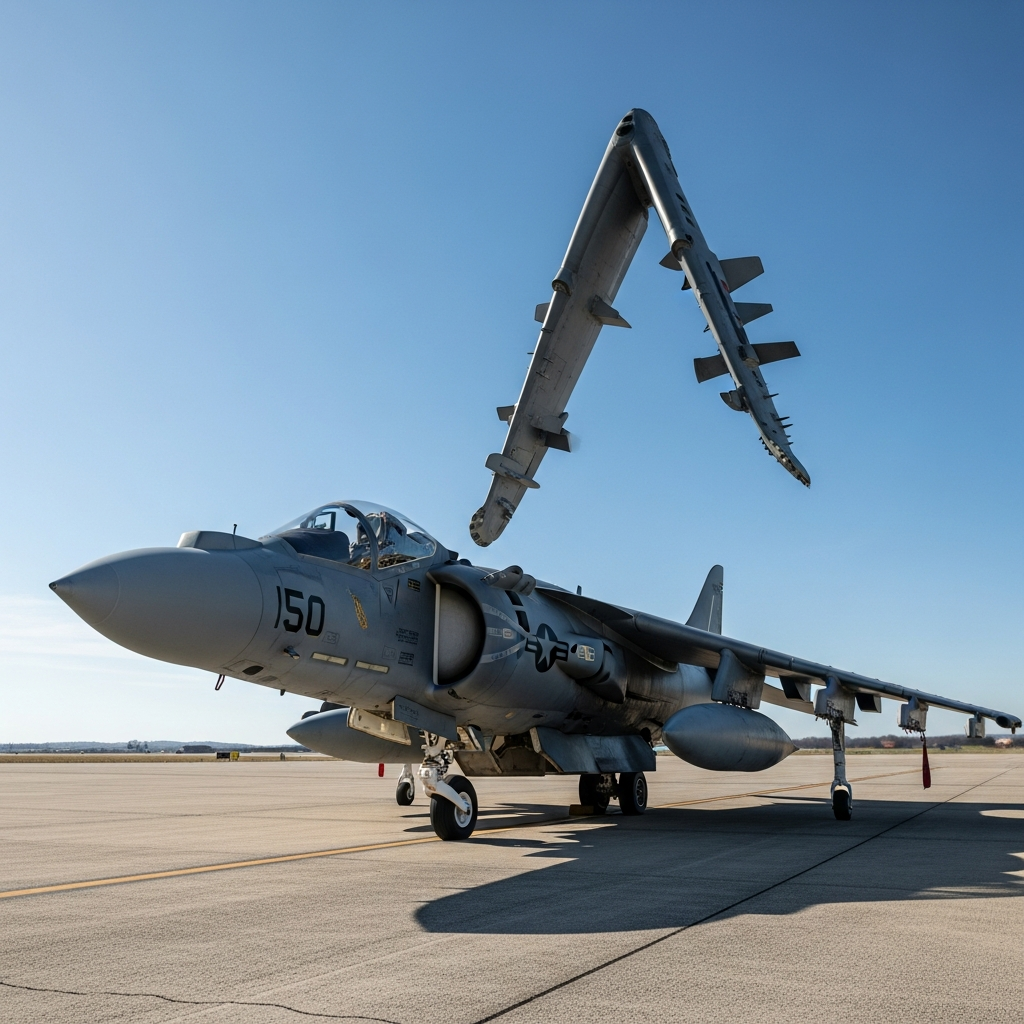
On June 3, 2026, the U.S. Marine Corps officially retired the AV-8B Harrier II. Five jets from Marine Attack Squadron 223—the “Bulldogs,” the last operational Harrier squadron in the world—lifted off at 10:00 Eastern from Marine Corps Air Station Cherry Point, North Carolina, conducted a ceremonial pass over the flightline, and shut down their Rolls-Royce Pegasus engines for the final time. The moment ended more than five decades of vertical-takeoff dominance.
The official “Sundown Ceremony” closed a chapter that opened when the British-designed Harrier first entered USMC service in 1971 as the AV-8A. The redesigned AV-8B arrived in 1985, and over the next four decades, the distinctive jump jet became one of the most recognizable aircraft in military aviation. It was also one of the deadliest to fly.
The Final Flight — And the Road to Retirement
VMA-223 returned from its final deployment on May 20, 2026. The Marine Corps then accelerated the transition. June 1-4 brought community events, static displays, simulator tours, and the sundown ceremony. Squadron leadership made clear this wasn’t a funeral. It was a celebration.
“The Bulldogs are extremely proud to conduct the final Harrier operations for the US Marine Corps,” said Lt. Col. John B. Cumbie, commanding officer of VMA-223. “As a platform that has continuously forward deployed across the globe, the Harrier will be remembered for its distinguished combat legacy, legendary Vertical/Short Take Off and Landing capability, and the Marines and Sailors that made the community special.”
Confidence in the F-35B Lightning II drove the accelerated retirement—the newer jet is already flowing to Marine squadrons. The Harrier, designed in the 1970s, cannot compete with a fifth-generation fighter that achieves twice its maximum speed (1,960 km/h versus 1,070 km/h) and carries precision munitions internally while maintaining a stealth profile. In fiscal 2027, VMA-223 will stand down and redesignate as Marine Fighter Attack Squadron 223, equipped with F-35Bs. The unit is scheduled to return in fiscal year 2028 as fully operational VMFA-223.
The Harrier’s Brutal Legacy
The Harrier’s record was extraordinary but unforgiving. During Operation Desert Storm in 1991, Harriers flew 3,380 sorties from expeditionary airfields as close as 35 nautical miles from the Kuwaiti border. They maintained mission-capable rates above 90% with average turnaround times of just 23 minutes. As recently as December 2023, Harriers from VMA-231 were active against Houthi militants in the Red Sea.
Hovering a fighter jet on a column of hot exhaust demands constant pilot input. There is no margin for error. The aircraft earned the grim nickname “the widowmaker” for its accident rate—among the highest in military aviation. Dozens of pilots lost their lives learning its demands.
In 2024, the final two Marine pilots completed AV-8B qualification training. They became the last aviators ever designated as Harrier pilots by the Corps. That’s when the community truly understood the end was near.
What Comes Next
By fiscal year 2028, the redesignated VMA-223 will be fully operational on the F-35B. The Marine Corps ultimately intends to field 420 F-35 aircraft across the force—205 F-35Bs and 56 F-35Cs have already been received as of end-2026. The Harrier airframes will be donated to museums or placed in long-term storage.
Only Spain now operates the AV-8B operationally. Madrid has 12 jets and committed to flying them into the 2030s aboard its Juan Carlos I carrier. Italy plans to retire its Harriers by 2028, and the UK retired its Harriers years ago. For the world’s most professional air arm, the era of the jump jet has definitively ended. What comes next is all stealth, sensors, and software—a world the Harrier never knew.
Stay in the loop
Get the latest aircraft insider updates delivered to your inbox.