Last fact check: July 30, 2026
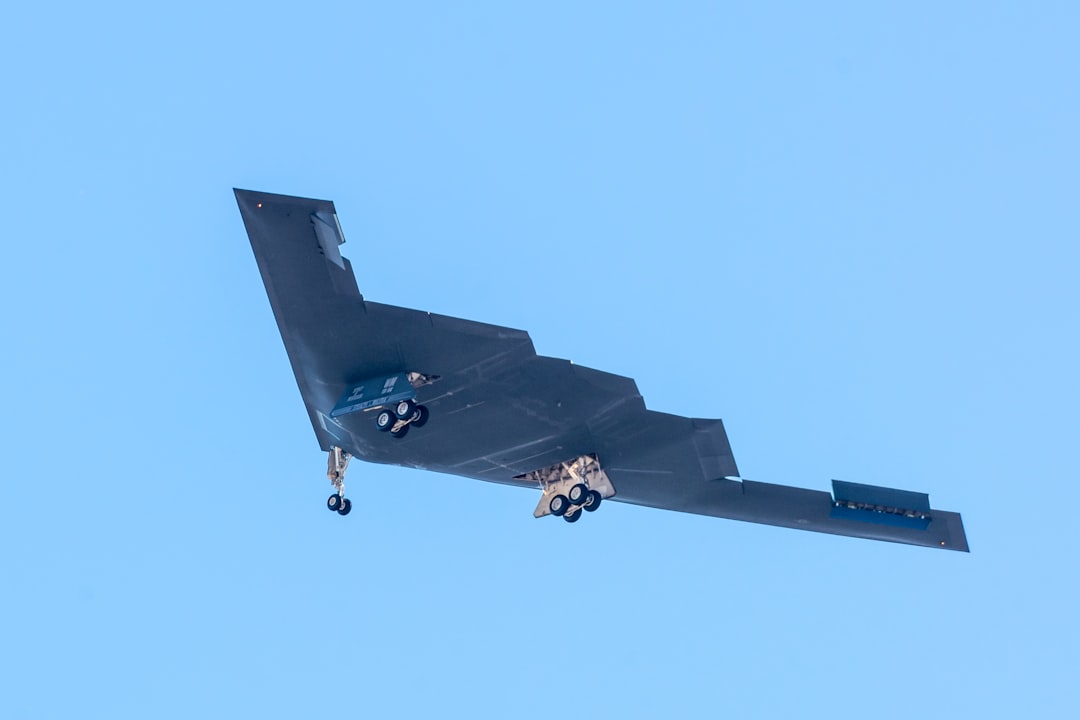
The B-2 Spirit is 172 feet wide, 69 feet long and 17 feet high. Its wingspan is nearly two and a half times its length, which gives the stealth bomber its distinctive flying-wing silhouette.
The current U.S. Air Force fact sheet lists a weight of 160,000 pounds, a maximum takeoff weight of 336,500 pounds, fuel capacity of 167,000 pounds and payload of 60,000 pounds. Northrop Grumman publishes the same external dimensions and maximum gross takeoff weight but describes payload more conservatively as greater than 40,000 pounds.
Those official numbers correct several values repeated in older or unsourced specification tables. The B-2's maximum takeoff weight is not 376,000 pounds, and public sources do not support precise Mach numbers, climb rates, turning radii or minimum-runway claims as universal specifications.
B-2 dimensions and specifications
| Specification | Current official value |
|---|---|
| Wingspan | 172 ft (52.12 m) |
| Length | 69 ft (20.9 m) |
| Height | 17 ft (5.1 m) |
| Weight | 160,000 lb (72,575 kg) |
| Maximum takeoff weight | 336,500 lb (152,634 kg) |
| Fuel capacity | 167,000 lb (75,750 kg) |
| Payload | 60,000 lb in the Air Force fact sheet; Northrop Grumman says more than 40,000 lb |
| Engines | Four General Electric F118-GE-100 turbofans |
| Thrust | 17,300 lb per engine |
| Speed | High subsonic |
| Unrefueled range | Approximately 6,000 nautical miles |
| Ceiling | 50,000 ft |
| Crew | Two: pilot and mission commander |
| Current Air Force inventory | 20, including one test aircraft |
The Air Force fact sheet was current as of May 2026. Dimensions are public, but many details related to low observability, mission systems and actual operational performance remain classified.
Why the B-2 looks wider than its weight suggests
The bomber does not have the long cylindrical fuselage and separate tail found on a conventional aircraft. Its crew compartment, engines, fuel and weapons bays are integrated into a broad flying wing.
That layout explains the unusual proportions:
- a 172-foot span approaching the B-52H's 185 feet
- a length of only 69 feet, compared with the B-52H's 159 feet 4 inches
- a height of 17 feet, compared with the B-52H's 40 feet 8 inches
From above, the B-2 occupies a large footprint. From the side, it has a shallow profile without a vertical tail. The geometry contributes to aerodynamic efficiency and is one element of its low-observable design.
The Air Force says the B-2 combines the flying-wing shape with composite materials, special coatings and reductions in radar, infrared, acoustic, electromagnetic and visual signatures. The exact radar cross section and many design details are not public.
How wide is a 172-foot wingspan?
The B-2's wingspan is:
- 13 feet narrower than a B-52H
- 35 feet wider than a B-1B with its wings extended
- about 2.49 times the B-2's own length
- slightly wider than a C-17 Globemaster III, whose span is 169 feet 10 inches
A National Basketball Association court is 94 feet long, so the B-2's span is about 1.83 basketball-court lengths. An American football field is 160 feet wide, so the B-2 extends about 12 feet beyond the field's sideline-to-sideline width.
These comparisons describe wingspan only. Perspective in photographs can make the aircraft look smaller when its swept leading edge is viewed from the front or rear.
B-2 weight: correcting the 376,000-pound claim
The current U.S. Air Force and Northrop Grumman specifications both give 336,500 pounds as the B-2's maximum takeoff or maximum gross takeoff weight.
The Air Force separately lists “weight” as 160,000 pounds and fuel capacity as 167,000 pounds. The fact sheet does not label the 160,000-pound value with the more technical term “operating empty weight,” so it is safest to preserve the source's wording.
Maximum takeoff weight is an operating limit, not the weight of every departure. Actual takeoff weight varies with fuel, weapons, crew, mission equipment and other load. Fuel capacity plus the published base weight and maximum payload should not be added mechanically to infer a normal mission load; payload and fuel trade against the maximum weight and mission requirements.
Why official payload figures differ
The Air Force's May 2026 fact sheet gives a payload of 60,000 pounds. Northrop Grumman's current technical page states more than 40,000 pounds. The National Museum of the U.S. Air Force says typical combat missions delivered up to 40,000 pounds of precision weapons.
These statements are not necessarily contradictory:
- 60,000 pounds can describe a maximum published capacity.
- More than 40,000 pounds is a manufacturer capability statement.
- Up to 40,000 pounds can describe a documented mission load rather than the structural maximum.
Loadout depends on weapon dimensions, carriage hardware, mission range, fuel and authorized integration. A table of every historical weapon should not be treated as a current loadout menu. Some weapons associated with older B-2 articles have been retired or are not useful examples of present capability.
The durable specification is that the B-2 has internal weapons carriage and supports conventional and nuclear missions. Exact mission configurations should come from current Air Force releases.
Range and speed: use the public wording
The Air Force describes B-2 speed as high subsonic, not as a precise public maximum Mach number. Northrop Grumman uses the same wording.
The Air Force gives an unrefueled range of approximately 6,000 nautical miles. Northrop Grumman says the aircraft can travel 10,000 nautical miles with one aerial refueling. Additional refueling gives the B-2 global mission reach, with crew endurance and tanker support becoming important planning factors.
Avoid converting “high subsonic” into an asserted Mach 0.95 maximum or Mach 0.85 cruise speed unless a current authoritative source provides those numbers. Public marketing language does not establish a certified operating limit, and actual mission profiles are not public.
The published ceiling is 50,000 feet. The rate of climb is not included in the current Air Force fact sheet.
Crew and cockpit
The B-2 has a crew of two:
- the pilot sits in the left seat
- the mission commander sits in the right seat
That is a small crew for an intercontinental heavy bomber. The B-1B has four crew members, and the B-52H has five according to their Air Force fact sheets.
Public Air Force material documents very long B-2 missions and aerial refueling, but detailed claims about bunks, galley dimensions, toilet facilities or crew-station layouts should be sourced before publication. They are not necessary to answer a dimensions query.
Engines and thrust
Four General Electric F118-GE-100 non-afterburning turbofan engines power the B-2. The Air Force lists 17,300 pounds of thrust for each engine, for a simple nominal total of 69,200 pounds.
The engines are integrated into the flying-wing structure rather than hung in external pods. Intake and exhaust treatment contributes to the aircraft's reduced signatures. Public descriptions can explain that principle without claiming classified infrared or radar performance.
The absence of afterburners aligns with a high-subsonic, long-range design. The B-1B, by contrast, uses four afterburning F101 engines and can reach Mach 1.2 according to the Air Force.
B-2 vs. B-1B vs. B-52H dimensions
| Specification | B-2 Spirit | B-1B Lancer | B-52H Stratofortress |
|---|---|---|---|
| Wingspan | 172 ft | 137 ft extended; 79 ft swept | 185 ft |
| Length | 69 ft | 146 ft | 159 ft 4 in |
| Height | 17 ft | 34 ft | 40 ft 8 in |
| Maximum takeoff weight | 336,500 lb | 477,000 lb | 488,000 lb |
| Published payload | 60,000 lb | 75,000 lb | 70,000 lb |
| Crew | 2 | 4 | 5 |
| Published speed | High subsonic | Mach 1.2 at sea level | High subsonic |
The comparison reveals the B-2's defining characteristic. It is almost as wide as the B-52H but only 43% as long and 42% as tall. The B-1B is more than twice the B-2's length even before considering its variable-sweep wings.
The B-2 is not the heaviest or highest-payload U.S. bomber. Its importance comes from combining a heavy internal payload, intercontinental range and low observability in one platform.
Maintenance footprint and deployment
Whiteman Air Force Base in Missouri is the B-2's only operational base. The Air Force has also built permanent or transportable climate-controlled shelters to support deployments at selected locations.
Climate control matters because maintaining low-observable surfaces requires specialized inspection and repair conditions. That does not mean the aircraft cannot be exposed to rain or operate away from Whiteman. Air Force reporting documents deployments and specialized shelters at locations including RAF Fairford.
Public sources do not establish a universal:
- 200-by-80-foot minimum hangar
- 30-foot door-clearance rule
- 90-foot turning radius
- 10,000-foot minimum runway for every normal operation
Airport and basing requirements depend on mission weight, weather, configuration, pavement, support equipment and approved operating data. Those numbers should not appear as fixed specifications without authoritative documentation.
How many B-2 bombers are there?
The Air Force's May 2026 fact sheet lists 20 aircraft in the active force, including one test aircraft.
Twenty-one flying B-2s were originally produced. One aircraft, Spirit of Kansas, was destroyed in a 2008 takeoff accident at Andersen Air Force Base. The current inventory figure therefore aligns with the remaining fleet, though not every aircraft is necessarily mission-capable on a given day.
Inventory is different from availability. Aircraft can be in depot maintenance, modification, testing or repair. Public daily mission-capable counts are not provided in the fact sheet.
Is the B-2 larger than the B-21 Raider?
The Air Force and Northrop Grumman have not published an official B-21 wingspan, length, height, maximum takeoff weight or payload.
Photographs show another flying-wing bomber, and public officials describe the B-21 as the future backbone of a bomber force that will also include the B-52. Image-based estimates of a 140-to-150-foot wingspan are not verified specifications and should not be presented as fact.
Until the Air Force releases dimensions, the accurate comparison is limited: both use a flying-wing form and support conventional and nuclear missions, but the B-21's exact size and many capabilities remain undisclosed.
Why sources report different B-2 numbers
Conflicting B-2 tables usually result from one of four problems:
- a typo repeated across derivative websites
- confusion between empty, operating, mission and maximum takeoff weight
- mixing maximum structural payload with a typical weapon load
- converting qualitative terms such as “high subsonic” into invented precision
Use the source date and definition, not just the number. For this guide, the current Air Force fact sheet controls the baseline, while Northrop Grumman and Air Force museum material provide clearly attributed context.
Bottom line
The verified B-2 dimensions are straightforward:
- 172-foot wingspan
- 69-foot length
- 17-foot height
- 336,500-pound maximum takeoff weight
- 167,000-pound fuel capacity
- 60,000-pound Air Force payload figure
- two-person crew
Its 172-foot wing is nearly as wide as the B-52H's, but the aircraft is less than half as long. That extreme flying-wing geometry—not speculative speed, classified stealth figures or unsupported hangar measurements—is the clearest way to understand the B-2's scale.
Related Aircraft Insider guides
Primary sources used
- U.S. Air Force B-2 fact sheet, current May 2026: https://www.af.mil/About-Us/Fact-Sheets/Display/Article/104482/b-2-spirit/
- Northrop Grumman B-2 technical details: https://www.northropgrumman.com/what-we-do/aircraft/b-2-stealth-bomber/technical-details
- National Museum of the U.S. Air Force B-2 fact sheet: https://www.nationalmuseum.af.mil/Visit/Museum-Exhibits/Fact-Sheets/Display/Article/195832/AFmuseum/northrop-b-2-spirit/
- U.S. Air Force B-1B fact sheet: https://www.af.mil/About-Us/Fact-Sheets/Display/Article/104500/b-1b-lancer/
- U.S. Air Force B-52H fact sheet: https://www.af.mil/About-Us/Fact-Sheets/Display/Article/104465/b-52-stratofortress/
- U.S. Air Force C-17 fact sheet: https://www.af.mil/About-Us/Fact-Sheets/Display/Article/977489/c-17-globemaster-iii/
- U.S. Air Force reporting on B-2 forward shelters: https://www.af.mil/News/Article-Display/Article/135377/new-hangars-establish-bomber-deployment-option/
- U.S. Air Force B-21 fact sheet: https://www.af.mil/About-Us/Fact-Sheets/Display/Article/2682973/b-21-raider/
Stay in the loop
Get the latest aircraft insider updates delivered to your inbox.