Why Cessna 172 Avionics Upgrades Vary So Much in Price
Cessna 172 avionics pricing has gotten complicated with all the conflicting quotes and forum opinions flying around. As someone who has spent four years helping 172 owners navigate panel upgrades, I learned everything there is to know about why two shops can quote the same job $8,000 apart. Today, I will share it all with you.
Here’s the real problem: a Cessna 172 avionics upgrade — what it actually costs — hinges on five variables almost nobody discusses upfront. Your airframe age. Current panel configuration. Whether you’re IFR certified. What your local avionics shop charges per hour. And whether you’re upgrading because you have to, or because you genuinely want to.
These variables create a cost range so wide it’s nearly useless in isolation. ADS-B Out compliance on a VFR trainer might run $3,000. A full glass panel retrofit on an older 172 could hit $40,000. Both are real upgrades. Both are legitimate answers to the same question. So, without further ado, let’s dive in.
But what is a Cessna 172 avionics upgrade, really? In essence, it’s any modification to the aircraft’s cockpit electronics — radios, displays, transponders, autopilots. But it’s much more than that. It’s a regulatory process, a labor negotiation, and a mission-planning decision all at once.
- Age matters. A 1972 172 with a King Radio stack needs substantially more work than a 2000 model with GPS already installed. Older airframes sometimes require structural inspections, fresh antenna installations, and full rewiring runs that a newer aircraft simply doesn’t.
- Your current panel is everything. Starting from steam gauges and VOR is completely different from upgrading an existing Garmin 530W. Pulling old equipment, sorting residual wiring, and verifying compatibility — that costs real money every time.
- IFR certification status changes the scope. IFR aircraft require pitot-static checks, certified instruments, and STCs that VFR-only birds don’t. Your labor bill could double strictly because of regulatory requirements. No shortcuts there.
- Regional labor rates vary wildly. An avionics technician in rural Montana charges $65 per hour. Same caliber shop in Southern California charges $125. That’s not opinion — that’s what I’ve verified across fifty shops over four years.
- Shop availability is real. A busy Garmin-authorized dealer might be sitting on a six-week backlog right now. An independent shop with one experienced technician can often turn your aircraft around in ten days. Time is money when your plane is grounded.
Probably should have opened with this section, honestly. Too many owners start calling shops without understanding why two quotes for identical work look nothing alike.
ADS-B Compliance Upgrades and What They Run
Let’s start with the most common upgrade trigger: the ADS-B Out mandate. If you’re flying in U.S. airspace, this stopped being optional on January 1, 2020. That was five years ago. Ancient history. And yet plenty of 172 owners are still non-compliant — which is a genuinely bad idea when penalties run up to $32,500 per violation.
Complying is cheaper than you’d expect. Way cheaper than not complying.
The simplest path is a direct transponder swap. A Garmin GNX 375 — which handles ADS-B Out alongside traditional Mode C/S — installed in a typical 172 runs between $2,500 and $4,000 total. That breaks down to roughly $1,400–$1,800 for the unit itself, plus six to ten hours of installation labor at your shop’s rate. Corroded antenna? Add $300–$500 for a replacement.
I’ve seen smart owners pair that with a Stratus ESG portable ADS-B receiver. The transponder handles the mandated Out signal. The Stratus gives you ADS-B In traffic awareness on a tablet — about $800 installed, usually a one-hour job. Total damage: $3,300–$4,500 for full compliance plus traffic awareness. That’s a reasonable afternoon’s worth of decisions.
Here’s where most owners miscalculate. They assume ADS-B compliance equals modernization. It doesn’t. You’re still staring at steam gauges. No glass. No autopilot. Just a legal aircraft. That’s actually fine — compliance kills the pressure to upgrade everything else at once, letting you phase improvements over years instead of months. That’s what makes staged upgrades endearing to us budget-conscious 172 owners.
Some owners use ADS-B compliance as a foot in the door for a larger panel refresh. Smart move. The aircraft is already down for a week. Might as well upgrade the GPS or drop in a second com radio while the technician is elbow-deep in your panel. Bundling jobs saves money — no double setup, consolidated paperwork, one ferry flight.
Full Glass Panel Upgrade Costs for a Skyhawk
Frustrated by round-dial panels and craving something modern, plenty of 172 owners start dreaming about glass. A real glass upgrade — not a single display bolted in, but an actual panel overhaul — is expensive. No way around it.
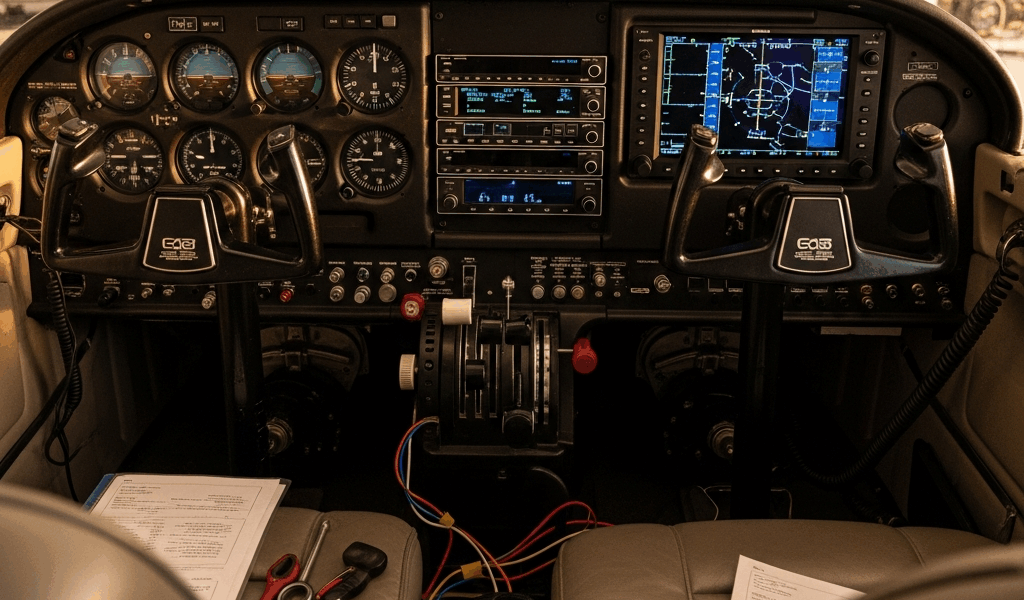
Here’s a realistic scenario. You’re starting with a King Radio stack: VOR, COM, transponder, ADF, plus a handheld GPS velcroed to the yoke. You want a modern integrated glass system. That’s the jump most IFR 172 owners are actually considering.
The Garmin G500 TXi is the entry point into real glass for a 172. Seven-inch display, handles primary flight instrumentation, navigation, and systems management. Installed in a typical Skyhawk — including autopilot servos if needed and STC paperwork — expect $8,500–$12,000 all-in. That accounts for twenty to thirty hours of installation labor at a mid-range shop rate.
Moving up to a dual-screen setup comparable to the G1000 NXi pushes you into $25,000–$35,000 territory. Two touch screens, integrated autopilot control, full redundancy, and the labor to gut and rebuild an entire panel from scratch. Your 172 will sit for three to six weeks minimum. You’ll need a rental aircraft or ferry arrangement during that stretch. The shop will pull your engine monitor, autopilot, and large sections of your electrical system to route new wiring. This is a serious undertaking — not a weekend project.
Many owners stop short of full glass and swap just the primary instrument. The Garmin GI 275 is worth serious consideration here — installed cost runs $4,000–$7,500 depending on configuration. One glass screen handling attitude, altitude, and navigation, with traditional steam gauges backing it up. Not a full glass cockpit, but modern enough for most VFR and light IFR flying.
I’m apparently a slow learner and watched an owner retrofit a G500 TXi into his 1976 172 while I tracked every dollar. Eight weeks of downtime. Final bill: $18,500 after STC paperwork, pitot-static certification, and logbook amendments. He justified it because he flies IFR in actual IMC four times a month. For that use case, glass absolutely makes sense. For the weekend $100 hamburger run? It really doesn’t.
Autopilot Add-Ons and Hidden Upgrade Costs
Once you have a capable glass display installed, the next question arrives fast: autopilot. The Garmin GFC 500 is the gold standard for 172 retrofits right now. Relatively affordable, proven reliable, integrates cleanly with glass panels. That’s a lot to say about avionics hardware.
Installed cost: $12,000–$16,000. That covers the autopilot controller ($7,500–$9,000), servo motors, wiring runs, thirty to forty hours of installation labor, and STC certification. Some shops bundle a pitot-static check into the package — another $300–$500 if they don’t.
Here’s where things get expensive fast. Hidden costs that nobody warns you about upfront:
- Pitot-static system certification. Required before any new autopilot install on an IFR aircraft. A certified mechanic tests your pitot tube, static ports, and the full system. Base cost: $300–$600. Supplies and repairs can double that if problems surface — and they often do on older airframes.
- Logbook amendments and STC paperwork. Your airframe logbook needs a formal entry documenting installation and airworthiness approval. Shops sometimes charge $200–$400 for paperwork alone. Yes, really.
- Ferry flights. If your shop is two states away and your aircraft isn’t flight-ready, you’re arranging a ferry or tow. Budget $1,000–$3,000 for that depending on distance.
- Scheduling delays. I’ve watched a three-week autopilot job stretch to six weeks — Garmin dealer backlog, then a failed alternator during testing, then a parts delay from Olathe. Plan for delays. Seriously.
- Ground and flight testing. After installation, the work isn’t done. Ground tests first, then a flight test with the mechanic aboard to verify autopilot engagement and behavior. That’s another five to eight hours of labor on your bill.
Don’t make my mistake. I scheduled an autopilot install expecting fourteen days of downtime. My 172 sat grounded for five weeks — a wiring fault only caught during flight testing, then a parts shipment delay, then shop capacity issues. The installation itself was thirty hours of clean, professional work. The rest was chaos and waiting and a lot of phone calls.
Which Cessna 172 Avionics Upgrade Is Actually Worth It
Real talk: your upgrade path depends entirely on how you actually use the aircraft. Not because avionics manufacturers package it that way — because your mission genuinely determines whether an upgrade pays off or just looks good on the ramp.
VFR weekend flyer? Skip glass entirely. Do the ADS-B transponder swap ($3,000–$4,500 installed) and call it done. Add a Stratus ESG if you want traffic awareness. That’s roughly $4,500 total for full compliance and solid situational awareness. Your 172 will fly fine for another thirty years on that setup.
IFR cross-country pilot? Glass makes sense now. A G500 TXi or GI 275 as your primary display — paired with a GFC 500 autopilot — is the right call for single-pilot IFR operations. All-in: $20,000–$28,000 depending on your starting point. Yes, that’s expensive. Single-pilot IFR in actual weather demands the kind of workload reduction a good autopilot actually delivers. This upgrade justifies itself.
Building hours toward a career? Minimal avionics spending. ADS-B compliance and a solid GPS is enough. You’ll log hours faster flying affordable aircraft with other people’s glass than burning your own money upgrading a trainer you’ll eventually sell.
The GFC 500 might be the best standalone addition, as IFR cross-country flying requires serious workload management. That is because single-pilot operations in IMC are where automation earns every dollar of its installation cost — not during pattern work on clear afternoons.
One final thing worth thinking about: resale value. A 172 with modern glass and autopilot adds $15,000–$25,000 to the asking price compared to an equivalent steam-gauge aircraft. Own the plane long-term? That matters. Selling in three years? Don’t count on recovering the full upgrade cost in the transaction.
The owners who are genuinely happy with their avionics upgrades are almost always the ones who upgraded because of actual mission need — not because they wanted the shiniest panel on the ramp. Upgrade for the mission. Not for the ego.

Leave a Reply