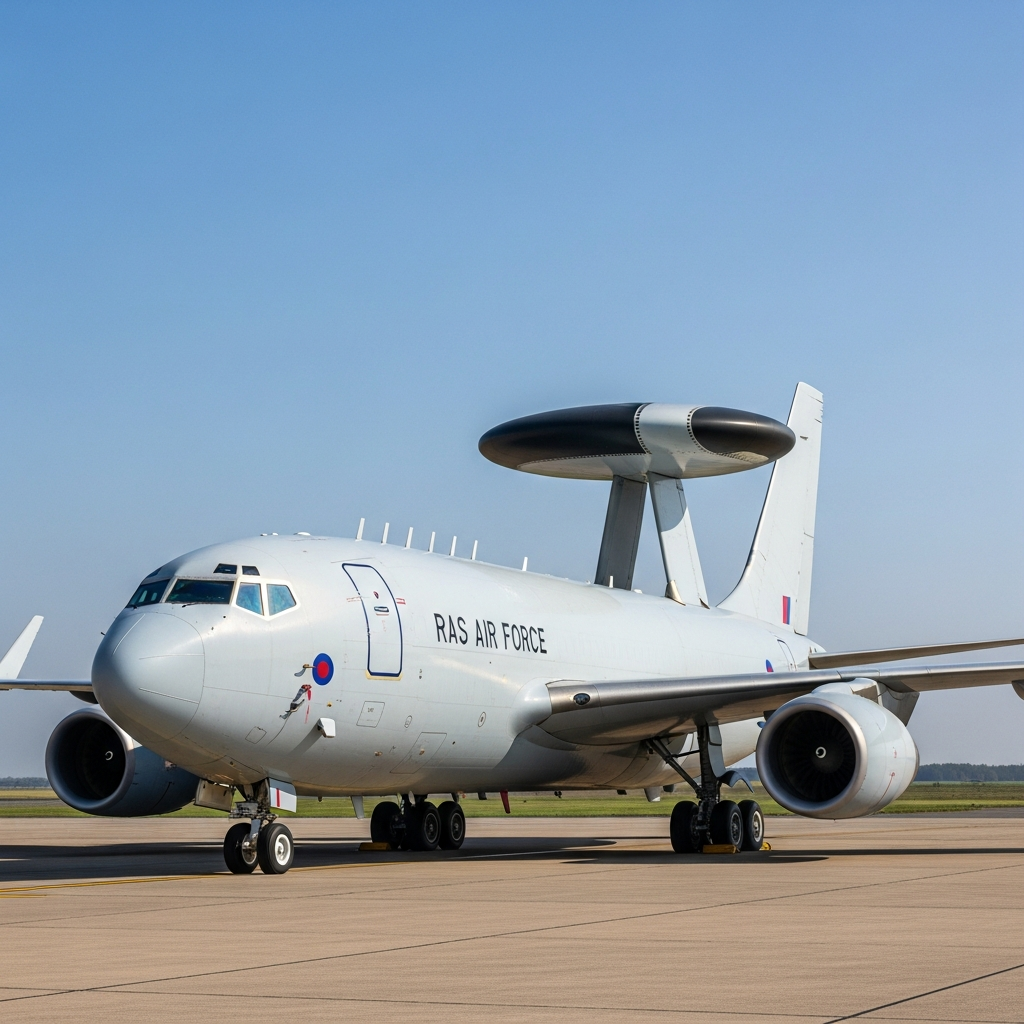
RAF Lossiemouth in Scotland just took delivery of its first Boeing E-7 Wedgetail airborne early warning aircraft to continue its Test and Evaluation phase. The moment marks a significant milestone: Britain’s sovereign air surveillance capacity is finally restored after a five-year gap that began when the older E-3D Sentry fleet retired in 2021.
The aircraft, designated WT001, arrived on 21 May 2026 at RAF Lossiemouth after being returned from Birmingham for additional integration and testing work. The aircraft had initially been received by the RAF on 18 October 2024 with No. 8 Squadron markings before being sent back for further preparation. It had been flown from STS Aviation Services in Birmingham by a joint crew of Boeing and RAF personnel. For the first time since the Sentry’s final operational sortie in July 2021, the UK has the tangible beginnings of a replacement for this critical capability.
Beginning the Test Gauntlet
WT001 is now settling into the Test and Evaluation phase at RAF Lossiemouth, its future main operating base. Ground trials start immediately, with live flying trials to follow. MOD Boscombe Down in Wiltshire—the UK’s primary military aircraft test facility—will also conduct testing. The focus is straightforward: validate radar performance, mission system interoperability, tactical communications, and integration with Britain’s air defence and command networks before formal transfer to RAF operational control later in 2026.
Group Captain Sarah Brewin, Station Commander RAF Lossiemouth, said it plainly: “We are delighted to welcome the arrival of the first Wedgetail aircraft to RAF Lossiemouth to continue its Test and Evaluation phase. This marks a significant step in delivering the Royal Air Force’s next generation of airborne surveillance and control capabilities that will support the defence of the UK for the years to come.”
Technical Superiority Over the Sentry
The E-7 is a generational leap forward. Unlike the Boeing 707-based Sentry it replaces, the Wedgetail sits on the modern Boeing 737 Next Generation airframe. Northrop Grumman’s electronically scanned Multi-role Electronically Scanned Array (MESA) radar mounts in a distinctive dorsal fin—a design that ditches the rotating dome of earlier systems and reduces aerodynamic drag. The payoff is substantial: 360-degree coverage with a maximum detection range exceeding 600 kilometres. The MESA system can simultaneously conduct air search, sea search, and fighter control missions via integrated tactical data networks including Link-11, Link-16, and SATCOM.
The RAF ordered five E-7 aircraft in 2019. That number was reduced to three as part of wider defence cost-saving measures—and those three will be flown by No. 8 Squadron, which previously operated the Sentry from Lossiemouth before disbandment. WT001 and WT002 started life as Boeing Business Jets previously operated by Chinese company Deer Jet, with WT001 delivered in 2010 and WT002 in 2011. WT003 is different—a new-build 737 delivered in 2022 for conversion work.
The Five-Year Void
The gap was real. Britain’s air surveillance capacity simply vanished between the Sentry’s retirement and today. The RAF had operated E-3D aircraft for over three decades. During the Balkans conflict, those aircraft flew 248 sorties. During Kosovo operations, they provided 25 per cent of NATO’s standing AWACS coverage. Since 2021, though, the UK has depended on allied aircraft from France, NATO, and the United States—supplemented only by short-range Crowsnest-equipped Merlin helicopters.
This gap occurred as NATO’s focus sharpened on the North Atlantic and northern Europe. Russian long-range aviation activity near alliance airspace drove the heightened attention. RAF Lossiemouth’s position in northeastern Scotland positions the Wedgetail fleet to monitor these critical approaches—and that geography matters.
Funding and Future Fleet
The 2021 Integrated Defence Review reduced the planned Wedgetail fleet to three aircraft as part of wider defence cost-saving measures. It did, however, retain five Northrop Grumman MESA radars—two as operational spares. Three aircraft presents a tough reality: maintaining continuous operational availability while managing maintenance, training, and deep servicing cycles could realistically leave just one aircraft ready for tasking at any given time.
But there’s potential for expansion. The 2025 Strategic Defence Review recommends procuring additional Wedgetails “when funding allows.” The review also floated cost-sharing arrangements with NATO allies to offset operating expenses.
WT001’s arrival signals the beginning of the end of Britain’s air surveillance void. The journey from test aircraft to operational squadron, though, isn’t finished yet.

Stay in the loop
Get the latest aircraft insider updates delivered to your inbox.