GCAP Awards First $905M Design Contract — Sixth-Generation Stealth Fighter Takes Shape
The Global Combat Air Programme agency awarded a £686 million ($905 million) contract to the Edgewing joint venture on April 1 — formally unifying UK, Italian, and Japanese funding under a single prime contractor for the first time and triggering the start of full design and engineering work on what aims to be the West’s most capable crewed fighter aircraft.
Edgewing is incorporated in Reading, UK, and owned equally by BAE Systems, Leonardo, and Japan Aircraft Industrial Enhancement Co. Ltd. (JAIEC). The venture was publicly announced as the programme’s industrial lead in June 2025. Wednesday’s contract announcement, made April 2, ends a period of national parallel contracts and places Edgewing at the center of configuration control, airworthiness certification, and schedule authority for the entire programme.
“This contract is an important moment for GCAP, as activities previously conducted under three nations’ contracts will now be carried out as part of a fully fledged international program.” — Masami Oka, GCAP Agency Chief Executive
What Edgewing Is Building
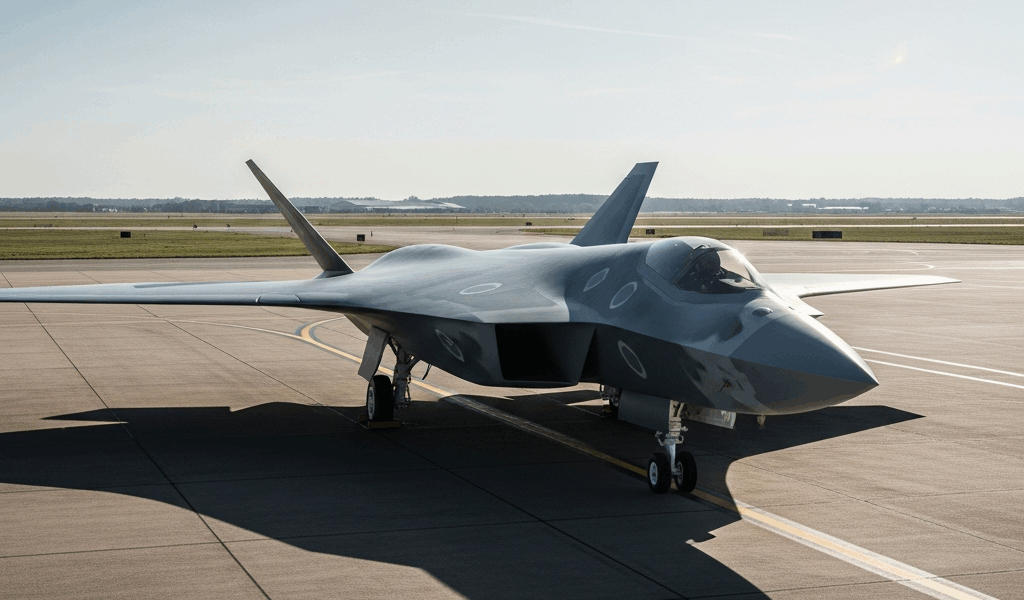
The target aircraft is a twin-engine, broad-delta stealth fighter with canted tails — a configuration optimised for low observable signature, large-aperture sensors, and generous internal volume. Based on visible engine duct proportions from BAE Systems’ publicly released demonstrator imagery, the aircraft is estimated to be roughly a third larger than a Eurofighter Typhoon. Capability goals are ambitious: supersonic cruise without afterburner, approximately double the internal weapons payload of an F-35A, triple the F-35’s range, and the ability to command loyal wingman drones as a crewed command node across air, land, sea, space, and cyber domains.
Engine development is split across Rolls-Royce, Italy’s Avio Aero, and Japan’s IHI Corporation. MBDA holds the weapons integration role. Sensors and mission systems fall under the GCAP Electronics Evolution (G2E) consortium — stood up in September 2025 — comprising Leonardo UK, Leonardo Italy, ELT Group, and Mitsubishi Electric, developing the Integrated Sensing and Non-Kinetic Effects (ISANKE) and Integrated Communications Systems (ICS) architecture.
Manufacturing will be subcontracted to BAE Systems in the UK, Leonardo in Italy, and Mitsubishi Heavy Industries in Japan. Italy’s primary assembly work will flow through Torino Caselle — already home to the Eurofighter production line — with electronics work spread across Leonardo facilities in Rome, Pomezia, Florence, and Nerviano. Of the approximately 9,000 people currently working on GCAP, 3,000 are Italian.
Schedule and Near-Term Milestones
The current contract funds work through June 30, 2026. At that point, GCAP Agency and Edgewing intend to sign a full long-term international contract in due course. The 2035 in-service date remains the programme’s stated target — the aircraft replacing the Eurofighter Typhoon in the UK and Italy and Japan’s Mitsubishi F-2. Edgewing will hold design authority for an airframe expected to remain in service beyond 2070.
Near-term demonstrators are already underway. BAE Systems, Rolls-Royce, and MBDA are developing the Combat Air Flying Demonstrator (CAFD) — a crewed, supersonic, low-observable aircraft — on a two-year build timeline. The Excalibur flight-test aircraft, a modified Boeing 757 operated jointly by Leonardo UK and 2Excel under a £115 million contract, completed its first phase of modification and flight testing in December 2024 and is expected to receive a fighter-nose radar integration fit next.
Canada Watching Closely
The contract award comes as Canada’s potential participation in GCAP moves from speculation toward formal process. Canadian Defence Minister David McGuinty told The Logic on March 13 that full membership is “something that we’re examining.” Then on March 31, the Asahi Shimbun reported that the UK, Italy, and Japan are coordinating observer status for Ottawa, with a trilateral defence ministers’ meeting reportedly planned for the UK as early as July to formalise the announcement.
“Together with Japan and Italy, we remain open to other partners joining the Global Combat Air Programme, while keeping on track with the programme schedule and delivering our future military capabilities.” — British High Commission spokesperson, Ottawa
India’s Ministry of Defence separately told parliament on March 18 that the Indian Air Force is evaluating both GCAP and FCAS as potential sixth-generation partnerships — a signal of how much diplomatic weight this programme now carries.
The contrast with GCAP’s closest rival is worth noting. The Franco-German-Spanish FCAS programme continues to stall over intellectual property disputes and industrial workshare disagreements. GCAP’s centralised Edgewing structure is a deliberate architectural choice designed to avoid exactly that fate — and the full long-term contract, to be signed in due course, will be the first real test of whether that model holds.


Leave a Reply