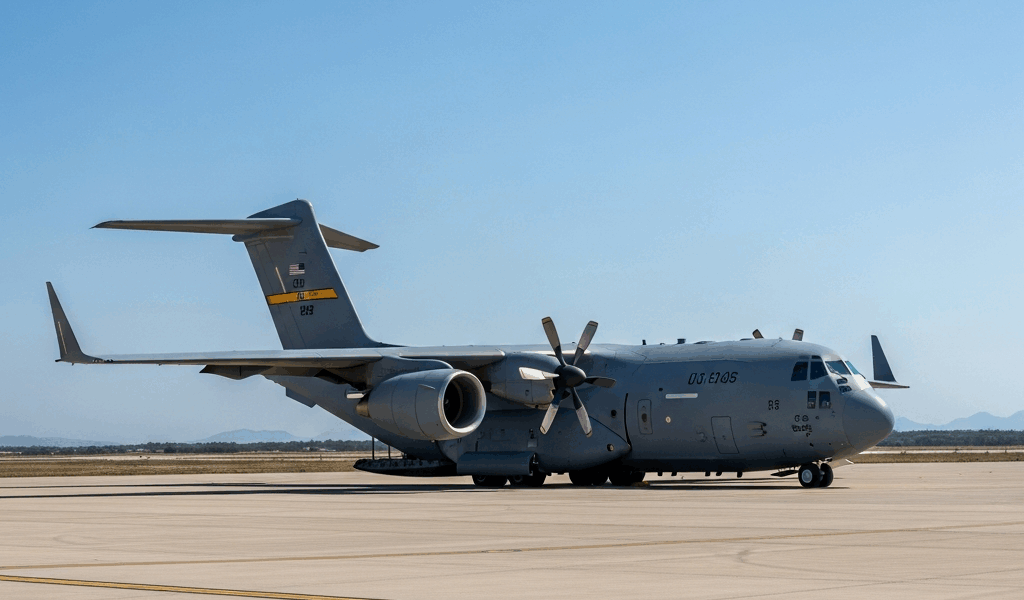
Italy Blocks U.S. Military Aircraft at Sigonella — Defense Minister Addresses Parliament Over NATO Rift
SIGONELLA AIR BASE, SICILY — April 7, 2026 — Italy refused U.S. military aircraft permission to land at Naval Air Station Sigonella overnight on March 27, delivering one of the most consequential alliance ruptures since the 1985 Achille Lauro crisis. Defense Minister Guido Crosetto was summoned before the Chamber of Deputies to explain the decision.
What Happened
The aircraft were already airborne — en route from the continental United States — when Italian Air Force General Staff received their filed flight plans. Pentagon operational documents for Operation Epic Fury confirm the broader campaign involved B-1Bs, B-2 Spirit stealth bombers, and B-52Hs. The flight plans showed a scheduled stop at Sigonella before continuing toward the Middle East. No prior authorization had been sought. No Italian military leadership had been consulted.
Italy’s Chief of Defence Staff, General Luciano Portolano, escalated the request immediately to Crosetto, who called Prime Minister Giorgia Meloni. The two made the call: deny the request. It was formally communicated to the U.S. Ambassador to Italy before the aircraft could land.
Sigonella sits roughly 15 kilometers west of Catania and 40 kilometers south of Mount Etna. It operates under Italian Air Force control while hosting more than 40 subordinate U.S. commands. Its two runways — measuring 2,462 and 2,442 meters respectively — routinely handle C-17s, KC-135s, P-8A Poseidons, and rotational MQ-4C Tritons from VUP-19 “Big Red.” The base logged 2,919 landings in 2022 alone, making it one of the busiest U.S. military transit hubs in the Mediterranean. This was not a close call over airfield capacity. It was a deliberate political and legal decision.
The Legal Argument
Crosetto framed the denial in procedural terms during his April 7 parliamentary briefing — not confrontational ones. Italy’s bilateral defense arrangements with Washington date to 1954 and are grounded in agreements including the Status of Forces Agreement of 1951, updated further by the Italy-U.S. Memorandum of Understanding in 1995. Those agreements draw a sharp distinction between routine logistics, which are automatically authorized, and missions that could constitute participation in combat operations, which require explicit Italian government and parliamentary approval.
“The application of the agreements on the use of U.S. military bases in Italy has always been characterized by absolute, coherent continuity from over 75 years. No government, of any political color, has ever questioned these agreements. Respecting agreements does not mean being involved in a war. We are not at war with Iran. We know how to enforce treaties.”
— Defense Minister Guido Crosetto, Chamber of Deputies, April 7, 2026
On X, Crosetto went further: “There is no cooling or tension with the U.S., because they know the rules that have governed their presence in Italy since 1954 just as well as we do.”
Washington’s Reaction
U.S. Secretary of State Marco Rubio did not soften his response, speaking on Al Jazeera.
“If NATO is just about us defending Europe if they’re attacked but then denying us basing rights when we need them, that’s not a very good arrangement.”
— Secretary of State Marco Rubio, Al Jazeera
Rubio stated that U.S. involvement in NATO would need to be “reexamined.” That language landed hard in European capitals already rattled by President Trump’s public threats to withdraw from the alliance entirely.
Italy Is Not Alone
Spain went further. On March 30 — before Italy’s denial had become public news — Madrid announced it would deny U.S. military aircraft access to its bases and airspace entirely if those aircraft were involved in strikes on Iran. Spanish Defense Minister Margarita Robles called the war “profoundly illegal and profoundly unjust.” France, separately, was accused by Trump of blocking military supply flights to Israel through its airspace. The pattern — coordinated, or at minimum convergent — points to a shared posture emerging among key European NATO members.
Italy’s position remains technically distinct. Airspace was not closed, and Meloni’s office described the partnership with Washington as “solid.” But turning away aircraft at a staging stop, mid-mission — the specific type denied at Sigonella was never officially confirmed, though Pentagon documents place strategic bombers including B-1Bs, B-2 Spirits, and B-52Hs within the broader operation — is not a minor procedural footnote.
Historical Echo
The 1985 Sigonella standoff casts a long shadow here. Carabinieri and VAM troops physically blocked Delta Force and SEAL Team Six operators on the tarmac in a dispute over the Achille Lauro hijackers — a confrontation that nearly turned kinetic. The 2026 refusal was cleaner, faster, and handled through proper channels. That arguably makes it more durable as a precedent.
What to Watch
Operation Epic Fury officially concluded April 8. The White House declared its objectives met after 38 days of strikes, with Iran agreeing to a ceasefire and reopening of the Strait of Hormuz. The operation is over. The alliance friction it generated is not. Formal NATO consultations on basing rights and the legal thresholds for access approvals are now inevitable — and how Washington and Rome manage the post-conflict accounting will be worth watching closely.



Leave a Reply