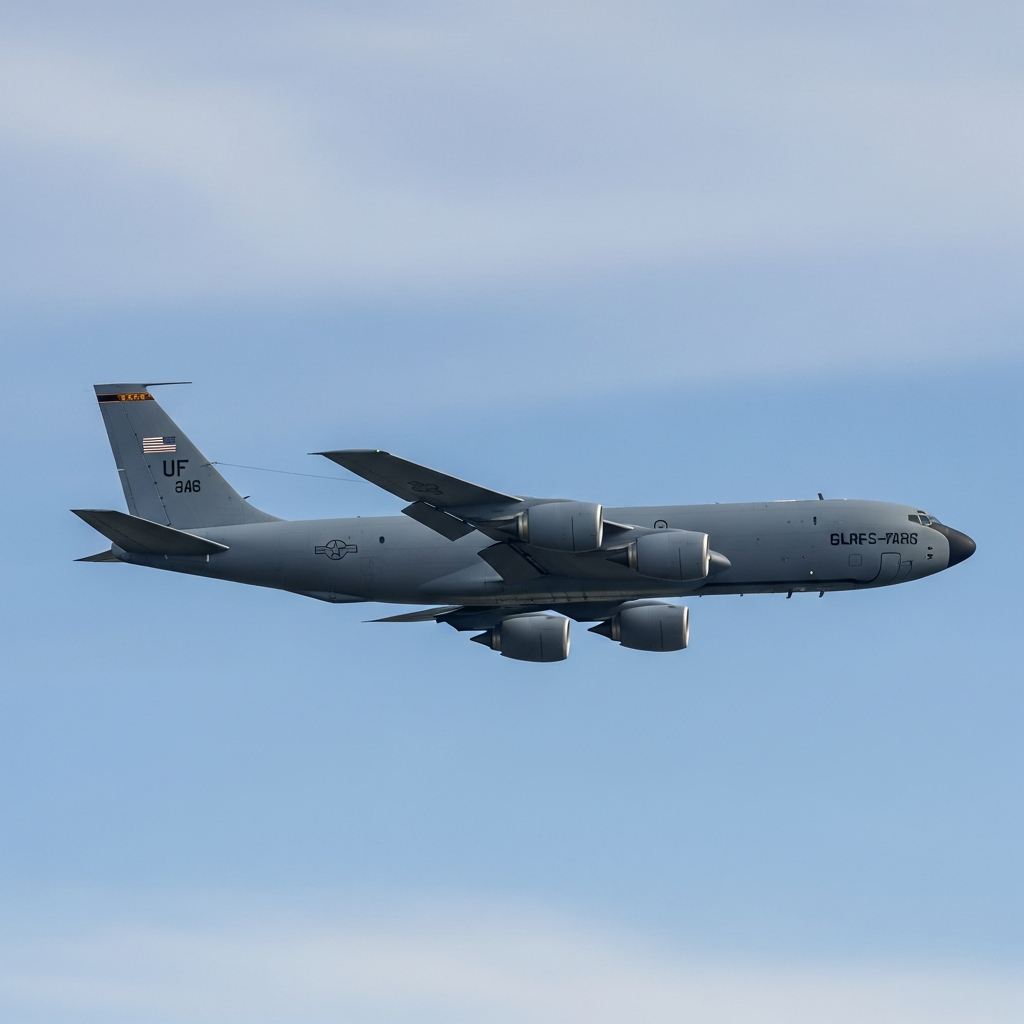
A U.S. Air Force KC-135R Stratotanker squawked 7700 — the universal in-flight distress code — over the Persian Gulf near Qatar on Tuesday, May 5, 2026, then vanished from civilian flight tracking screens. The signal loss was captured in Flightradar24 data cited by Iran’s semi-official Fars News Agency.
The aircraft had departed Al Dhafra Air Base in the United Arab Emirates and was conducting aerial refueling operations over the Arabian Gulf when it issued the distress squawk. Flight tracking data showed the KC-135R circling the airspace for a period before beginning a descent toward Al Udeid Air Base in Qatar — the U.S. military’s primary air hub in the region, roughly 500 kilometers northwest of the Strait of Hormuz. About an hour after the 7700 code appeared, the aircraft’s ADS-B transponder signal dropped off tracking screens entirely.
A U.S. defense official confirmed to Newsweek that the Stratotanker landed safely. No further details were offered on the nature of the emergency or the aircraft’s condition. CENTCOM has not issued a formal statement.
A Second Emergency on the Same Morning
It wasn’t an isolated event. A second U.S. Air Force aerial refueling aircraft — a KC-46A Pegasus, tail number 18-46048 — also transmitted a 7700 squawk over the Persian Gulf the same morning. The Pegasus was subsequently tracked descending toward Al Udeid, where it landed without reported incident. Two H125 helicopters lifted off from Al Udeid following the KC-135 emergency, consistent with standard search-and-rescue alert posture.
Back-to-back tanker emergencies in a single morning underscore the operational tempo and hazard environment facing U.S. aerial refueling assets in the Gulf theater. Heavy tanker activity over the Persian Gulf has surged in recent days as the Air Force sustains fighter and strike missions tied to Project Freedom — President Trump’s May 4 initiative to push commercial vessels through the Strait of Hormuz under U.S. naval escort.
Technical Context — Why Signal Loss Isn’t Automatically Catastrophic
The loss of ADS-B telemetry does not confirm a crash. Military aircraft routinely disable transponders in contested airspace for operational security reasons. As the KC-135 descended toward Qatar, it also likely dropped below the line-of-sight threshold required for ground-based ADS-B receivers — a phenomenon known as terrain masking. The picture is further complicated by what regional monitors have documented: extensive GPS spoofing and AIS jamming across the Persian Gulf during the current conflict, which can corrupt or suppress tracking data entirely.
The KC-135R typically operates with a crew of three — pilot, copilot, and boom operator — and can carry up to 200,000 pounds of transferable fuel. With 376 airframes on active duty, the Stratotanker fleet is the backbone of U.S. air power projection in the region, enabling the long-endurance sorties of F-15Es and F-16s enforcing the Hormuz passage. The Air Force has flagged the KC-135’s limited secure beyond-line-of-sight communications as a persistent liability in exactly this kind of contested environment.
The Broader Context — A Fragile Ceasefire and a Dangerous Strait
Tuesday’s incident unfolded against one of the most volatile backdrops in the Gulf in decades. A ceasefire between the U.S. and Iran took effect on April 7, following the U.S. launch of Operation Epic Fury on February 28. Renewed hostilities flared after Project Freedom began on May 4 — the same day the HMM Namu, a Panamanian-flagged cargo vessel, was struck by an explosion off the UAE coast. Trump attributed the attack to Iran.
On Tuesday evening, Trump paused Project Freedom at the request of Pakistan and other nations, while the U.S. Navy blockade of the Strait remained in place. Secretary of State Marco Rubio declared that Operation Epic Fury had “effectively ended,” framing the U.S. posture as defensive. Iranian Foreign Minister Abbas Araghchi was sharply dismissive, writing:
“Events in Hormuz make clear that there’s no military solution to a political crisis. Project Freedom is Project Deadlock.”
Tuesday’s emergency also follows the deadliest KC-135 loss in more than a decade — a March 12 crash in western Iraq during Operation Epic Fury that killed all six crew members aboard, including Maj. John A. Klinner, Capt. Ariana G. Savino, and Tech. Sgt. Ashley B. Pruitt of the 6th Air Refueling Wing at MacDill Air Force Base.
What to Watch
Two tanker emergencies in a single morning, no official explanation from CENTCOM or the Pentagon. The pressure on the KC-135 fleet operating out of Al Dhafra and Al Udeid is evident. Any official determination of cause, crew status details, and whether Tuesday’s incidents prompt changes to U.S. tanker operations over the Gulf remain to be seen.


Stay in the loop
Get the latest aircraft insider updates delivered to your inbox.