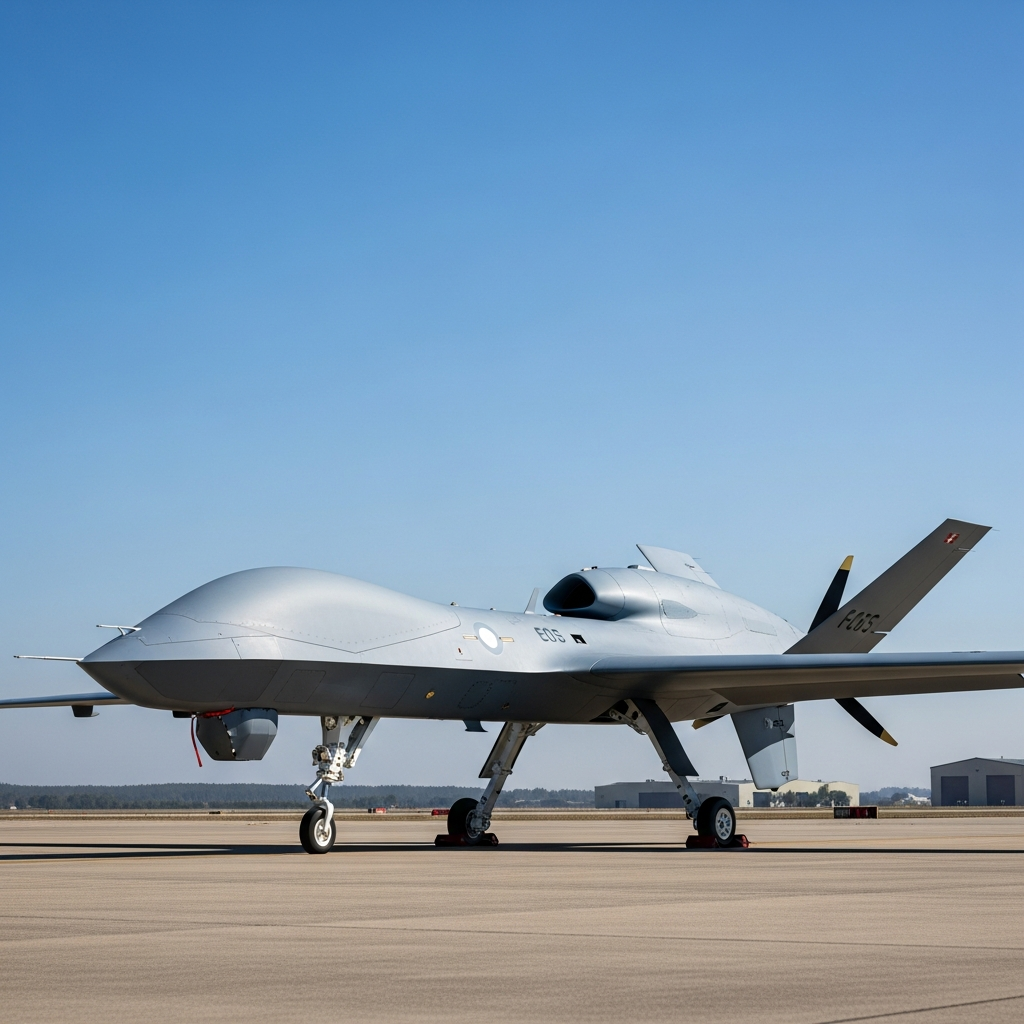
The United States Air Force and the Netherlands Ministry of Defence have formalized a partnership to acquire prototype Collaborative Combat Aircraft — making the Netherlands the first NATO ally to officially buy into America’s autonomous wingman program. The agreement, sealed this week following a Letter of Acceptance signed ahead of an April 8 deadline, gives the Dutch military unprecedented access to the CCA development program, including technical data, operational concepts, and experimentation environments alongside U.S. forces.
The road to formalization began last October 16, when Dutch State Secretary for Defence Gijs Tuinman signed a Letter of Intent at the Dutch embassy in Washington ahead of Defence Industry Days. State Secretary Derk Boswijk informed parliament on March 19 that the follow-on Letter of Acceptance would be signed before the April 8 cutoff. The ministry confirmed that intent publicly on March 21.
Two Contenders — YFQ-42A and YFQ-44A
The Netherlands will acquire prototype CCA aircraft feeding directly into U.S. development work. Two platforms are currently in active flight testing. General Atomics Aeronautical Systems’ YFQ-42A — derived from the experimental XQ-67A and optimized for endurance — completed its maiden flight in August 2025. Anduril Industries’ YFQ-44A flew for the first time in October 2025. Both prototypes carry the “YFQ-” prefix, and the production winner will become the first aircraft to formally introduce the new “FQ” designation into the U.S. inventory. The Air Force plans to select one design as the production winner in late 2026.
The cost logic is stark. An F-35A runs roughly $78 million per airframe. The forthcoming F-47 Next Generation Air Dominance fighter is expected to approach $200 million. A CCA designed to fly as an expendable or attritable wingman changes the economics of a contested-airspace fight entirely — which is why the USAF intends to spend more than $8.9 billion on CCA programs between fiscal years 2025 and 2029.
What the Dutch Get — and Why It Matters
Tuinman was direct about the scope of access the Netherlands has secured. The agreement unlocks what he described as “total access” “on all levels” into the USAF CCA program, allowing Dutch officials to submit requirements tailored specifically to the European theater. He projected a potential need for over 1,000 CCAs across NATO if the standard two-drone-per-fighter ratio is applied to allied fleets.
“We think that this is a unique point in time and it reinforces the partnership we have with the U.S. I think it also makes the world a lot safer if in the near future we can actually also operate CCA type of aircraft in the European theater.” — State Secretary Gijs Tuinman, October 2025
“The future fight will be fought with allies and partners. By aligning our approaches early, we ensure interoperability and shared advantage in the era of human-machine teaming.” — Secretary of the Air Force Troy Meink
The Netherlands’ 46 F-35As form the natural pairing platform. Those jets recently received initial certification for NATO’s nuclear sharing mission at Volkel Air Base, where 11 of 33 hardened aircraft shelters are now qualified to house nuclear weapons. That detail raises the strategic stakes of adding autonomous wingmen to that force well above a typical procurement announcement.
Strategic Backdrop — Drones Over Europe, Mass Over the Pacific
The urgency behind the deal isn’t abstract. Russian drones disrupted communications during a Dutch military exercise in Poland, and Russian unmanned platforms have repeatedly violated NATO airspace in what European officials characterize as deliberate provocations. China, meanwhile, is producing approximately 400 advanced combat aircraft annually — J-20s, J-35s, and J-16s — mirroring the mass-production naval strategy that has reshaped Pacific force calculations. CCAs are the Western answer to both threat vectors: affordable mass that doesn’t require a pilot in every cockpit.
Tuinman also flagged the Netherlands’ potential role as a commercial gateway. “The Netherlands is like the jumping pad for the United States to get into Europe,” he said — a credible pitch given the country’s existing F-35 logistics footprint and its established relationships with U.S. defense primes.
Separately, back in October 2025 — concurrent with the signing of the CCA Letter of Intent — the Dutch Ministry of Defence signed an agreement with GA-ASI and local partner VDL Defentec to co-develop a small UAS for ISR missions, with low-rate production scheduled to begin in 2026 in both countries.
What to Watch Next
The USAF’s CCA downselect decision — expected in late 2026 — will determine whether the Netherlands ends up operating a YFQ-42A or YFQ-44A derivative. Denmark, which announced plans to acquire CCAs in October 2025, is also pursuing the capability to complement its own F-35 fleet. Australia and Japan announced joint MQ-28A Ghost Bat activities on April 18. The allied CCA ecosystem is assembling faster than most analysts expected two years ago. Prototype flight testing at Edwards AFB and the Experimental Operations Unit at Nellis continues to push toward that downselect — and the Dutch program will be worth watching closely as it does.
Stay in the loop
Get the latest aircraft insider updates delivered to your inbox.