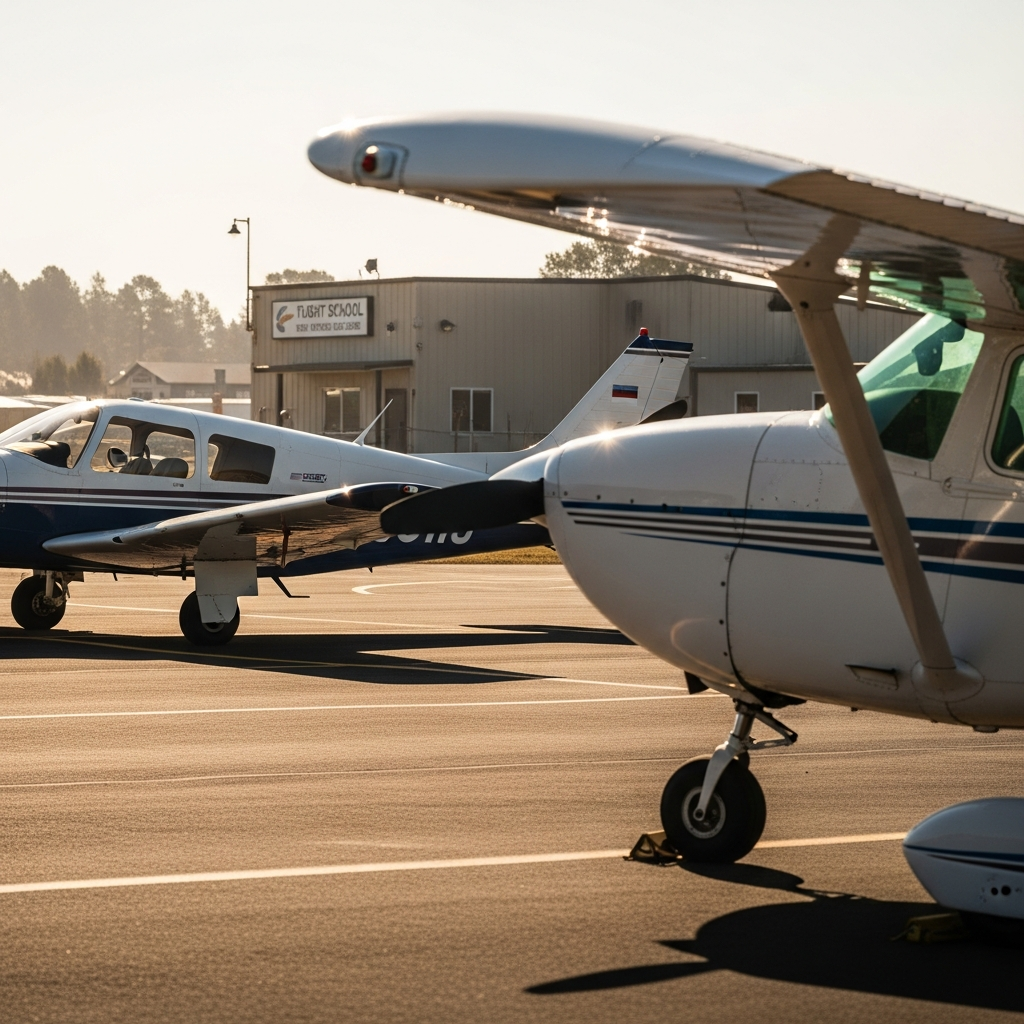
Why This Comparison Gets Messier Than It Should
The Piper Warrior vs Cessna 172 debate has gotten complicated with all the noise flying around — forum arguments, flight school sales pitches, that one CFI who swears by whatever he learned in. As someone who’s logged time in both left seats and spent years watching students struggle with this exact choice, I learned everything there is to know about what actually separates these two airplanes in practice. Today, I’ll share it all with you.
I’ve been that person in the FBO lounge, watching someone else fly the 172 I just reserved, squinting through scratched plexiglass at a ramp full of blue-and-white Skyhawks and wondering if the Warrior school across the field was the smarter call. It’s not some abstract Reddit argument. It touches your wallet, your progress rate, and whether you’re white-knuckling every crosswind approach for the first 20 hours or actually learning something.
Both planes own the training market. Walk into almost any Part 61 or Part 141 school and you’ll find one or the other — sometimes both sitting on the same ramp. But picking between them isn’t a spec sheet exercise. It’s about how a nervous 15-hour student handles a gusty afternoon, how the plane behaves on short final, and whether your instructor is fighting the aircraft instead of teaching you. That stuff matters more than a two-knot cruise difference.
The Specs That Actually Show Up in Your Logbook
But what is the real difference between these two aircraft? In essence, it’s a handful of numbers that look significant on paper but mostly disappear in the pattern. But it’s much more than that — the numbers only tell part of the story.
Skip the 12-row table with maximum zero-fuel weight and service ceiling. Here’s what you’ll actually feel.
- Useful load — The Piper Warrior III (PA-28-161) hauls roughly 840 lbs in a typical configuration. A standard Cessna 172S comes in around 878 lbs. Minor gap — until you’re doing dual cross-countries with bags and a full fuel stop.
- Fuel burn — Both aircraft drink approximately 8–9 gallons per hour at normal training power settings. Budget $45–$55 in 100LL per flight hour depending on your airport’s current pricing.
- Cruise speed — Warriors cruise around 108–110 knots. The 172S sits at 122–124 knots. After ATC vectors and climb segments? The real-world gap almost disappears.
- Stall speed — The Warrior stalls clean around 57 knots. The 172 is lower — about 48 knots clean. You’ll be doing power-off stalls every single lesson for months, so that margin is worth noting.
- Visibility — This is where the two planes genuinely part ways. More on that below.
Nothing in that list should be your deciding factor alone. These planes are far closer than the marketing suggests.
How Each One Actually Flies the Pattern
I trained first in a 172, then transitioned to Warriors for a hundred-plus hours of right-seat instructing. The pattern difference is real enough to be honest about.
The Cessna 172 is forgiving in a way that feels almost deliberate. High-wing configuration means a clear view of the runway on base and final — no neck-craning required. The flare is intuitive. There’s a reason generations of instructors call it the “flying forklift” — not as an insult, but as genuine acknowledgment that it’s stable, honest, and recovers well from sloppy student inputs. Early solo students build confidence fast in this airplane. Sometimes maybe a little too fast, honestly.
The Warrior flies differently. That low wing changes traffic pattern visibility in ways that genuinely take adjustment. On left base you’re looking over the wing at the runway. On right base, the wing is sitting right between you and where you’re pointed. Students who start in Warriors often develop stronger scanning habits — leaning, checking, actively working the cockpit. Not a bad outcome. The controls feel lighter, more responsive. Some students love it immediately. Others spend their first five hours trying to stop porpoising on final.
The rudder coordination demands are slightly more pronounced in the Warrior. That’s actually useful — it accelerates habit development if your instructor stays on it.
Crosswinds. I’d give the 172 the edge here for early students. The high wing creates a mild weathervane effect, but the ground handling stays predictable. Warriors handle crosswinds just fine — it’s a different feel on the mains at touchdown, not a worse one. Just different.
Don’t make my mistake. I assumed the Warrior’s lighter feel meant it was easier to fly precisely. Wrong. Lighter controls mean small corrections carry more consequence. My approaches looked like a sine wave on final for several hours before I figured that out.
What Flight Schools Pay — and What You Pay to Rent
Probably should have opened with this section, honestly. For most student pilots it’s the actual deciding factor, not cruise speed.
Wet rental rates in 2024 run roughly $155–$185 per hour for a Cessna 172S at mid-sized market flight schools. Warriors tend to land at $140–$165 per hour wet. That $15–$20 gap per hour doesn’t sound dramatic — until you multiply it across a 60–70 hour private pilot course. We’re talking $900–$1,400 in potential savings reaching checkride minimums in the Warrior. That’s real money.
The cost difference isn’t mysterious. Parts for the 172 run higher. Newer 172S models carry expensive avionics packages that cost serious money to maintain. Insurance at high-utilization schools carries a premium on Skyhawks. The Warrior’s Lycoming O-320 engine — the same basic powerplant living in thousands of aircraft worldwide — makes maintenance predictable and parts cheap. I’m apparently an O-320 convert at this point, and that engine works for me while some of the newer Lycoming variants never seemed as foolproof in a training environment.
Flight schools stock 172s in larger numbers for one reason: brand recognition. Cessna built over 44,000 of them. Parents of student pilots know the name. There’s an implied safety in familiarity that genuinely drives enrollment decisions — even when the Warrior sitting next door is equally capable. Schools running Warriors often acquired them through a previous owner donation, or because they serve a cost-conscious student base that did the math.
That’s what makes the 172 endearing to flight schools as a business. It sells itself before the tour even starts.
So Which One Should You Train In
So, without further ado, let’s dive in — and I’ll give you direct answers for the situations that actually come up, not the hedged non-answers you’ll find on aviation forums.
If your school has both: Start in the 172. Get your solo in it. Then transition to the Warrior for cross-countries and hood work. Flying both makes you a sharper stick — and the Warrior’s lighter controls will feel like a reward instead of a surprise somewhere around hour 25.
If your school only has Warriors: Train in the Warrior without hesitation. The adjustment period is real but short. By hour 15 you’ll feel at home, and the handling characteristics will make you a more active, engaged pilot from early on. Don’t let anyone talk you into driving 45 minutes to the Cessna school just because the 172 is the “standard.” That logic costs time and money.
If ownership is somewhere in your plan: The used Warrior market is deep. PA-28s hold value well, and training in one makes your transition to ownership almost seamless. A used 1977 Warrior II — PA-28-161, mid-time engine, basic but functional panel — runs $55,000–$75,000 right now. A comparable 172 from the same era costs $30,000–$50,000 more. That gap matters. Train in what you plan to own.
If you want maximum checkout flexibility post-PPL: The 172 ecosystem is simply larger. More rental fleets, more insurance approvals, more flying club aircraft. If you’re planning to join a local club or hop on a platform like JustAircraft after your certificate, 172 checkouts exist in more places.
Long-term — and this matters — neither aircraft puts you at a disadvantage transitioning into complex or high-performance training. Both are docile enough that your first Archer or Cirrus checkout will feel like the real jump. Not whatever you soloed at 30 hours.
Stay in the loop
Get the latest aircraft insider updates delivered to your inbox.