Last fact check: July 30, 2026
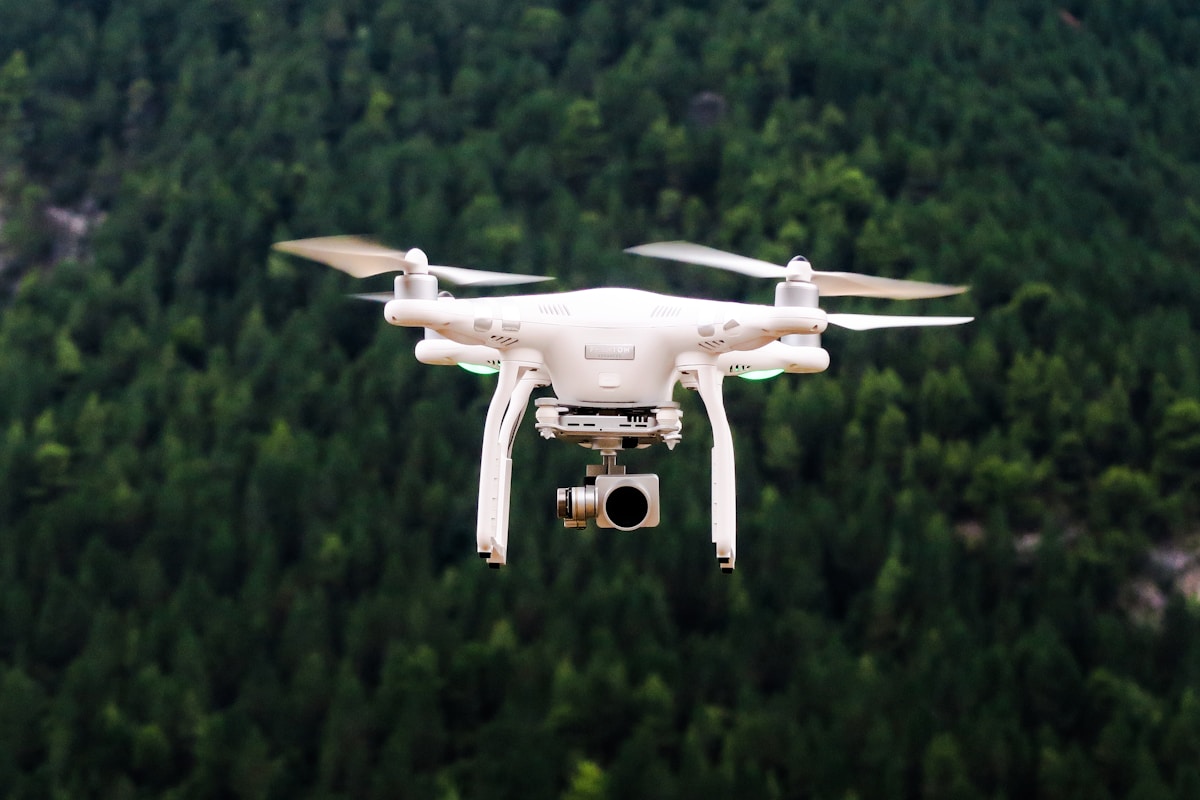
Private citizens in the United States generally should not attempt to disable, jam, hack, capture or shoot down a drone—even when it is flying over their property. A drone is an aircraft under federal aviation rules, signal jammers have no lawful consumer use, and forcing an aircraft down can injure people or damage property.
The lawful response is to protect people from any immediate hazard, document the flight from a safe location, preserve available Remote ID information and contact the authority appropriate to the problem. Call local emergency services first when the drone appears to pose an immediate threat or is being used in a suspected crime. Report aviation-rule violations to the FAA.
This guide addresses the United States. Privacy, trespass, nuisance, stalking and surveillance laws differ by state and locality, so a local attorney or law enforcement agency is the right source for a specific dispute.
Quick answer: what should you do about an unwanted drone?
- Do not shoot, throw objects, launch another drone, use a laser, jam the signal or try to take control.
- Move people away from the area directly under the aircraft if it appears unstable, damaged or threatening.
- From a safe location, record the time, place, direction of travel, behavior and any identifying details.
- Capture Remote ID information with a compatible receiver or app if it is readily available and can be done without confrontation.
- Call local law enforcement for an immediate safety threat, suspected crime, stalking or serious privacy concern.
- Report an apparent FAA-rule violation to the local FAA Flight Standards District Office or FAA aviation-safety reporting channel.
- Preserve original photos, videos, app screenshots and incident notes.
Do not approach or pursue a suspected operator. Remote ID control-station location data may place you near another person's home, vehicle or worksite, and a confrontation can make a manageable incident dangerous.
Can you shoot down a drone over your property?
No. The FAA expressly tells private citizens not to shoot at drones. Federal law prohibits shooting at an aircraft, and the FAA warns that gunfire can cause an unmanned aircraft to crash into people, property or other aircraft. The shooter may face FAA civil penalties and federal, state or local criminal charges.
Property ownership does not create an unlimited private right to use weapons in the airspace above it. It also does not eliminate local rules governing firearms, reckless endangerment or property damage.
The FAA's current public guidance states: “Can you shoot down drones above your property?”.
Are drone jammers legal for private citizens?
No. Signal jammers intentionally interfere with authorized radio communications. The FCC has repeatedly stated that jammers have no lawful consumer use in the United States. They can disrupt cellular, Wi-Fi, GPS, public-safety, aviation or other communications beyond the intended drone.
Labeling a product a “drone jammer,” “GPS blocker” or “privacy device” does not make it lawful. Importing, marketing, selling or operating jamming equipment can trigger federal enforcement.
The 2026 SAFER SKIES framework does not give the general public permission to jam drones. It provides a legal structure for specified government and authorized public-safety operations under defined conditions and oversight. An ordinary property owner, business or security guard should not infer counter-drone authority from an agency's authorized program.
Can you hack or take control of a drone?
Private citizens should not attempt it. Intercepting communications, accessing a computer system without authorization, spoofing navigation or taking control of an aircraft can implicate federal computer, communications, interception, aircraft-piracy and aircraft-sabotage laws as well as civil liability.
A product vendor's claim that a device “detects,” “identifies,” “spoofs” or “takes over” drones does not establish that buying or using it is legal. A joint DOJ, FAA, DHS and FCC advisory recommends that non-federal entities obtain legal and technical review rather than relying on vendor representations.
Passive observation and mitigation are not automatically interchangeable. Even a detection system can raise communications or privacy issues depending on what it captures and how it operates.
Why lasers, nets and physical interception are poor choices
Pointing a laser toward an aircraft is dangerous and can violate federal and state law. A laser intended for a drone can miss, reflect or affect a piloted aircraft elsewhere in the line of sight.
Throwing objects, launching nets or flying another drone into the target can send batteries, propellers and airframe parts falling unpredictably. It can also damage someone else's property or cause a second aircraft to lose control.
Commercial counter-UAS systems are designed for authorized security or public safety programs with site assessment, trained personnel, legal authority and controlled operating procedures. They are not do-it-yourself solutions for a residential complaint.
A drone over a house is not automatically illegal
Seeing a drone above a home can feel invasive, but location alone does not prove an FAA violation or criminal intent. The FAA regulates aviation safety and airspace; it does not regulate privacy. State and local laws may address surveillance, voyeurism, harassment, stalking, nuisance or recording.
Drone pilots still must follow applicable operating rules. Depending on the operation, those may include:
- avoiding careless or reckless operation
- not creating a hazard to people or property
- complying with controlled-airspace authorization requirements
- obeying temporary flight restrictions and security restrictions
- following operations-over-people rules
- maintaining Remote ID compliance when required
- remaining within visual line of sight unless authorized otherwise
A drone may be conducting legitimate photography, inspection, mapping, public-safety, utility or real-estate work. Document conduct rather than assuming purpose. Repeated low hovering aimed at windows is different evidence from a drone briefly crossing overhead on an authorized mapping route.
When to call 911 or local law enforcement
Use emergency services when the drone appears connected to an immediate threat to life, an active crime, critical infrastructure, wildfire response or an ongoing emergency. Examples include a drone:
- carrying an apparent weapon or hazardous payload
- repeatedly approaching emergency aircraft or responders
- interfering with a police, fire or medical operation
- striking or attempting to strike people or vehicles
- dropping dangerous objects
- stalking a person in a way that creates immediate fear or danger
- operating close to an airport in a manner that creates an immediate hazard
Tell the dispatcher what you observed, not what you assume. Give the exact location, time, direction, estimated altitude, description and whether you can see an operator. Follow dispatcher instructions and stay out of the response area.
For a non-emergency suspected crime or recurring privacy issue, use the local agency's non-emergency number.
How to report an unsafe drone flight to the FAA
The FAA says dangerous drone operations or suspected crimes should go to local law enforcement first. For an apparent violation of FAA operating rules, a witness may also contact the local Flight Standards District Office.
The FAA investigates reports of unsafe operations, but a useful report needs specific facts. Include:
- date and exact local time
- street address, coordinates or a precise landmark
- direction of flight and observed altitude
- duration and repeated pattern
- drone color, size, lights and identifying markings
- photos or video from the original device
- Remote ID serial number or app screenshot, if available
- description and location of the suspected operator, without confrontation
- nearby aircraft, airport, emergency response or crowd
- names and contact details of independent witnesses
- local police incident number, when applicable
Use the FAA's drone-sighting reporting guidance and FAA contact page to reach the appropriate aviation-safety channel.
What Remote ID can and cannot tell you
Remote ID allows a compliant drone to broadcast identification and location information that nearby parties can receive. A Standard Remote ID drone broadcasts a unique identifier plus drone and control-station location data. A broadcast module sends its identifier, the drone's position and the takeoff location.
Remote ID is often compared with a digital license plate. The public may receive the broadcast identifier, but the FAA's registration lookup associated with that identifier is for authorized agencies. An identification app does not give a private person permission to identify, follow, confront or publish personal information about the operator.
Remote ID also has limitations:
- some drones can lawfully operate without broadcasting inside an FAA-Recognized Identification Area
- certain operators may have an FAA authorization to deviate
- very small recreational drones may not require registration
- hardware failure or reception range can prevent a reading
- an absent reading does not prove malicious intent
- a received serial number does not prove who controlled the aircraft at that moment
Use Remote ID as evidence for authorities, not as a vigilante-tracking tool. See the FAA's Remote ID overview.
How to document the incident safely
Stand in a safe place and avoid walking backward into traffic or onto a runway, roof or restricted property while filming the sky.
Capture:
- a wide view showing the drone's relationship to buildings, people or airspace
- a closer view if the device can obtain it safely
- the original audio and metadata
- screenshots of Remote ID or relevant flight-restriction information
- a written timeline made while details are fresh
Keep the original files. Editing, cropping or repeatedly exporting video can remove metadata and make it harder to establish timing or authenticity. Share evidence directly with investigators rather than posting accusations or a suspected operator's location publicly.
What if the drone is interfering with an airport or aircraft?
Pilots who encounter a drone during flight should prioritize aircraft control, avoidance and communication with air traffic control. Provide the location, altitude, direction and description when workload permits. File the appropriate safety report after landing.
People on the ground should not enter airport property, aim lights or launch another aircraft. Notify airport operations, local law enforcement or 911 according to the immediacy of the threat.
A drone near an airport is not automatically unauthorized; controlled-airspace operations may have FAA authorization. Unsafe proximity to an aircraft, runway or emergency operation is the important observable fact to report.
What businesses and property managers can do
A business facing repeated drone activity should develop a response plan before purchasing detection or mitigation equipment:
- Assign an incident contact and escalation chain.
- Coordinate with local law enforcement and, where relevant, airport or critical-infrastructure authorities.
- Establish safe observation and evidence-preservation procedures.
- Review applicable privacy, labor, communications and aviation law with qualified counsel.
- Evaluate passive detection technology for its actual data collection and legal implications.
- Do not acquire mitigation capability based solely on a vendor's assertion that it is “FCC compliant” or “law-enforcement grade.”
- Train staff not to confront pilots or attempt a takedown.
Even state and local police agencies do not automatically possess federal counter-UAS authority. Any mitigation program must operate under the specific authorization, training, oversight and coordination applicable to that agency and location.
Authorized counter-UAS action is different from private self-help
Federal law permits certain agencies to detect, track and mitigate drones that pose credible threats to covered facilities, assets or operations. The 2026 SAFER SKIES Act also created a pathway for designated state, local, tribal and territorial personnel to perform specified counter-UAS functions under federal rules and oversight.
These are limited public-safety authorities—not a general defense-of-property exception. They may depend on agency designation, training, approved equipment, covered events or facilities, coordination and other safeguards.
The DOJ counter-UAS legal advisory explains why aircraft, communications, computer-access and interception laws must be evaluated together.
Bottom line
For a private citizen, the legal way to “disable” a drone problem is usually to stop the unsafe situation through distance, documentation and authorized response—not to bring the aircraft down.
- Do not shoot, jam, hack, laser or physically intercept it.
- Protect people from the immediate hazard.
- Record objective facts from a safe location.
- Save Remote ID information without pursuing the operator.
- Contact local law enforcement first for a threat or suspected crime.
- Report apparent aviation-rule violations to the FAA.
- Use local legal advice for recurring privacy or property disputes.
This approach preserves evidence, avoids creating a falling-object hazard and gives the agencies with actual legal authority the best chance to identify the operator and respond appropriately.
Related Aircraft Insider guides
- Are drones legal in residential neighborhoods?
- FAA drone flight restrictions over New York and New Jersey
Primary sources used
- FAA, what to know about drones: https://www.faa.gov/newsroom/what-know-about-drones
- FAA, reporting a drone sighting: https://www.faa.gov/uas/contact_us/report_uas_sighting
- FAA, Remote ID: https://www.faa.gov/uas/getting_started/remote_id
- FAA, public-safety toolkit: https://www.faa.gov/uas/public_safety_gov/public_safety_toolkit
- FAA, Drone Identification and Security Compliance Verification Tool: https://www.faa.gov/uas/public_safety_gov/discvr_tool
- DOJ Justice Manual, counter-UAS authorities: https://www.justice.gov/jm/9-95000-unmanned-aircraft-systems-uas
- DOJ/FAA/DHS/FCC interagency legal advisory: https://www.justice.gov/media/1084061/dl?inline=
- FCC jammer enforcement decision: https://docs.fcc.gov/public/attachments/FCC-16-67A1_Rcd.pdf
- FCC July 2026 counter-UAS declaratory ruling: https://docs.fcc.gov/public/attachments/DA-26-654A1.pdf
Stay in the loop
Get the latest aircraft insider updates delivered to your inbox.