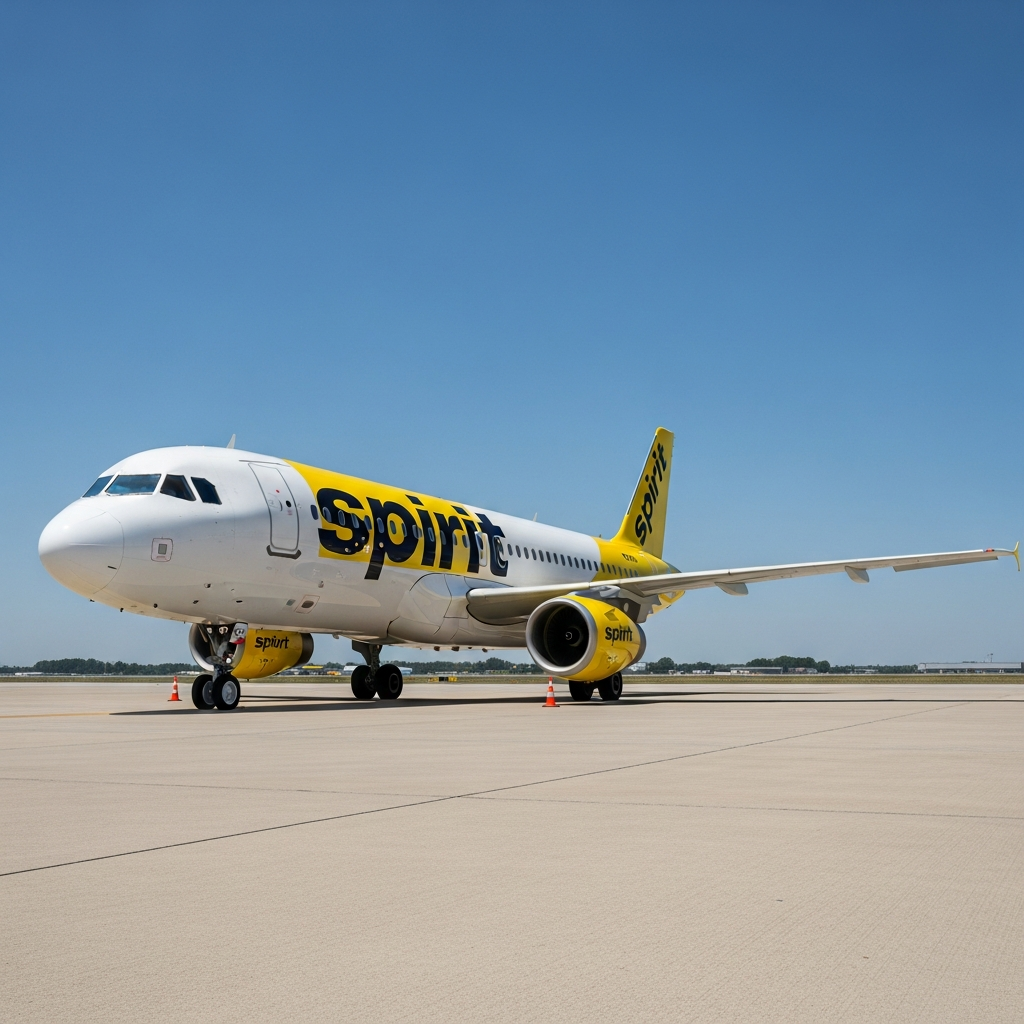
Spirit Airlines is gone. At 3:00 a.m. Eastern Time on Saturday, May 2, 2026, the Dania Beach-based ultra-low-cost carrier ceased all operations after the U.S. government and Spirit’s bondholders failed to reach agreement on a last-ditch bailout — ending 33 years of flight operations and stranding hundreds of thousands of passengers overnight.
The airline’s website and app went dark before dawn. In their place: a blunt final message. “To our Guests: all flights have been cancelled, and customer service is no longer available.” Spirit had been operating 96 Airbus A320-family jets at the time of shutdown. According to aviation analytics firm Cirium, 4,119 domestic flights were scheduled between May 1 and May 15, representing 809,638 seats. Every one of those seats is now empty.
The Final Flight
Spirit’s last revenue flight touched down at Dallas Fort Worth International Airport shortly after midnight local time Saturday. Flight NK1833 — a two-hour, 39-minute Airbus narrowbody hop — had originated from Detroit Metropolitan Wayne County Airport, the same city where the airline launched its first scheduled routes. Flightradar24 confirmed the landing. The day before, Spirit’s final full day of operations, the carrier had flown more than 50,000 passengers.
The Iran War Killed the Numbers
Spirit had already filed for Chapter 11 bankruptcy twice in less than 12 months — first in November 2024, then again in August 2025, entering that second filing carrying $8.1 billion in debts against $8.6 billion in assets. February 2026 brought what finally looked like a lifeline: a creditor-backed restructuring deal that had real legs. Then, three days later, the war with Iran started.
The conflict choked off roughly 20 percent of the world’s oil supply and sent jet fuel prices into freefall — upward. Spirit’s restructuring plan had been built on projected jet fuel costs of $2.24 per gallon in 2026. By the end of April, the price had climbed to $4.51 per gallon. That 70 percent surge rendered the entire financial model worthless.
“The sudden and sustained rise in fuel prices in recent weeks ultimately has left us with no alternative but to pursue an orderly wind-down of the Company. Sustaining the business required hundreds of millions of additional dollars of liquidity that Spirit simply does not have and could not procure.” — Dave Davis, Spirit Airlines President and CEO
The Government Tried — and Failed
Commerce Secretary Howard Lutnick called Spirit CEO Dave Davis Friday evening to deliver the final word: no deal. Bondholders confirmed it in writing to Spirit’s board the same night. President Trump had told reporters earlier that Friday his administration submitted a “final” bailout proposal — the sticking point, he acknowledged, was creditor priority disputes. Transportation Secretary Sean Duffy confirmed Saturday that Trump “was like a dog on a bone” pursuing every avenue to keep Spirit flying, including multiple Oval Office sessions in the days prior.
“If you have a flight scheduled with Spirit Airlines, don’t show up at the airport. There will be no one here to assist you.” — Transportation Secretary Sean Duffy
Staff received no formal company-wide notice. A Spirit pilot who had been laid off prior to the shutdown told CNN the only communication came via an email from the chief pilot, sent somewhere between 6:00 and 7:00 p.m. Friday. International flights had been quietly cancelled Thursday — a move designed to prevent aircraft and crews from being stranded abroad.
What This Means for Passengers and Fares
American, Delta, United, and Southwest moved quickly, offering capped “rescue fares” — most around $200 — to help stranded Spirit passengers rebook. The FAA was notified before operations halted, a Spirit spokesperson confirmed.
The broader market impact is real and likely lasting. Spirit was founded in 1983 as Charter One Airlines by Ned Homfeld in Macomb County, Michigan, and spent decades functioning as a pure price-suppressor — its presence on any route historically forced legacy carriers to compete on cost. Consumer advocates are already warning that fares on Spirit’s former routes will climb without it.
“You do not have to fly a small carrier in order to benefit from its presence, because they will bring down the big guys’ fares. Everyone will be paying more.” — William McGee, American Economic Liberties Project
The Association of Flight Attendants, representing 5,500 Spirit cabin crew members, has called on federal officials to deploy worker support resources immediately. ALPA President Jason Ambrosi echoed that concern — warning that the consequences will fall hardest on frontline aviation workers and their families, not executives.
Bankruptcy court proceedings in New York will determine how Spirit’s assets are disposed of and whether creditors recover anything meaningful. With 96 Airbus narrowbodies now sitting idle, fleet liquidation activity is expected to begin within weeks.
Stay in the loop
Get the latest aircraft insider updates delivered to your inbox.