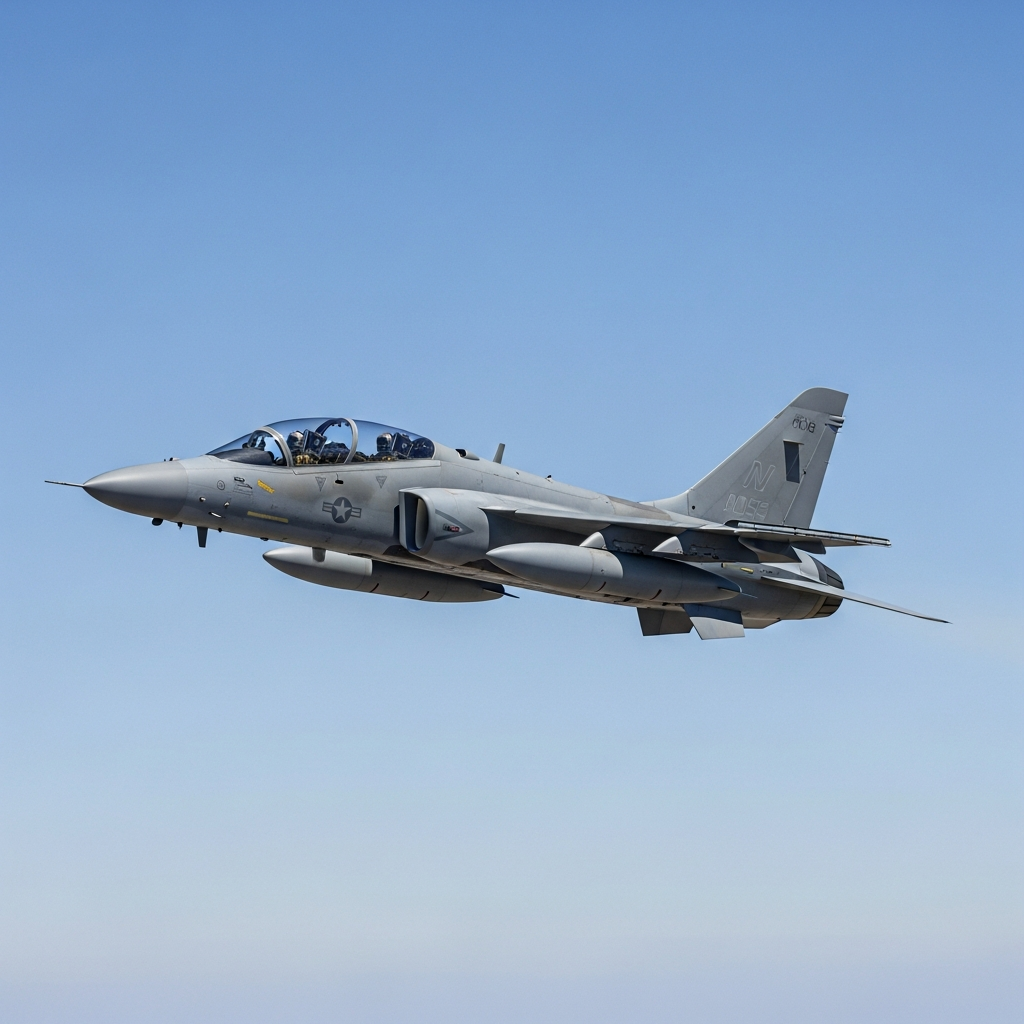
The U.S. Air Force formally cleared the Boeing T-7A Red Hawk for low-rate initial production on April 23, awarding a $219 million contract covering the first 14 aircraft, spares, support equipment, and training. The decision — publicly announced May 5 — ends years of costly development turbulence for the service’s next advanced jet trainer.
Milestone C approval, granted by the Air Force acquisition office, authorizes Boeing Defense, Space & Security to begin serial manufacturing at its St. Louis facility. The contract is modest in scope. But it signals the program’s formal pivot from engineering to the production floor after a development phase that inflicted more than $1.8 billion in losses on Boeing under a fixed-price structure.
A Long-Delayed Green Light
This program has been a case study in fixed-price development risk. Boeing won the original $9.2 billion contract in September 2018 — a deal with options for up to 475 aircraft — and then absorbed charge after charge tied to ejection seat deficiencies, flight control software instability, and chronic supply chain friction. The Government Accountability Office flagged in May 2023 that Boeing’s own schedule projections were built on optimistic assumptions. A single quarter, Q3 2024, produced $900 million in program-related charges alone.
The ejection seat issue was among the most technically consequential. Engineers ultimately redesigned the canopy to fragment safely on egress — preventing glass injury — and added a new seat sequencer that extends parachute deployment duration to reduce the risk of neck and spine injuries during descent. A successful ejection seat test in May 2025 cleared the path for Milestone C to proceed.
“Reaching Milestone C is a testament to the dedicated government and industry teams who have worked diligently to overcome complex technical hurdles. The T-7A is a pivotal program for the future of our combat air forces, and entering production brings us one step closer to putting this essential capability into the hands of our instructor pilots and students.”
— William Bailey, Performing the Duties of the Assistant Secretary of the Air Force for Acquisition, Technology, and Logistics
Where the Aircraft Stands Today
Two Red Hawks are already on the flightline at Joint Base San Antonio-Randolph. Tail number 21-7005 arrived at the 12th Flying Training Wing on December 5, 2025, followed by a second airframe in early January 2026. The 99th Flying Training Squadron — a unit with direct historical ties to the Tuskegee Airmen, who painted their airplanes’ tails bright red, and to the Curtiss P-40 Warhawk, both of which the aircraft’s name was chosen to honor — became the first operational Air Force unit to receive the Red Hawk. APT-5 is supporting familiarization flights with instructor pilots, while APT-3 is being used to train maintainers on a platform designed from the outset for reduced lifecycle cost.
On April 23, the same day Milestone C was approved, Air Force Chief of Staff Gen. Ken Wilsbach walked the JBSA-Randolph flightline alongside Lt. Col. Jonathan Aronoff, 416th Flight Test Squadron director of operations, in preparation for a flight in the Red Hawk.
“Boeing is honored to work with our U.S. Air Force partner in achieving this historic milestone in the T-7A Red Hawk’s journey. Getting this pathfinding digitally designed, built and tested advanced trainer into the hands of Air Force instructors and students remains our focus, and Milestone C positions us to start low-rate initial production this year.”
— Andy Adams, Vice President and Program Manager, Boeing T-7 Programs
The Aircraft Itself
The T-7A is powered by a single General Electric F404-GE-103 turbofan, delivering roughly three times the total thrust of the aging T-38 Talon twin it replaces. The aircraft spans 30.6 feet and stretches 46.9 feet in length. It was the first Air Force jet designed and built entirely through model-based digital engineering, cutting assembly time dramatically. The tandem cockpit features three reconfigurable multifunction displays, a wide-angle HUD, full HOTAS integration, and an embedded training system capable of simulating radar, EW, and weapons employment — mirroring the interface logic of operational fighters. Saab manufactures the aft fuselage section at its West Lafayette, Indiana facility.
“Our mission is to train the next generation of combat aviators, and the T-7A Red Hawk is the tool we need to do it. Replacing our 60-plus-year-old T-38s is a top priority. The T-7A’s advanced systems will give our students a far more realistic training environment, ensuring they are prepared for the cockpits of the future.”
— Brig. Gen. Matthew Leard, Director of Plans, Programs, Requirements, and International Affairs, AETC
What Comes Next
Initial operational capability remains targeted for August 2027, when 14 aircraft are expected to be assigned to the 99th Flying Training Squadron at JBSA-Randolph. Annual procurement is projected at 40 to 60 aircraft per year through the early 2030s as the T-38 fleet phases out. Boeing is simultaneously pursuing international sales — Australia’s RAAF LIFT program and a potential Japanese Air Self-Defense Force variant, informally dubbed the T-7AJ, are among the most closely watched prospects in a global market Boeing estimates at more than 2,700 aircraft.
Stay in the loop
Get the latest aircraft insider updates delivered to your inbox.