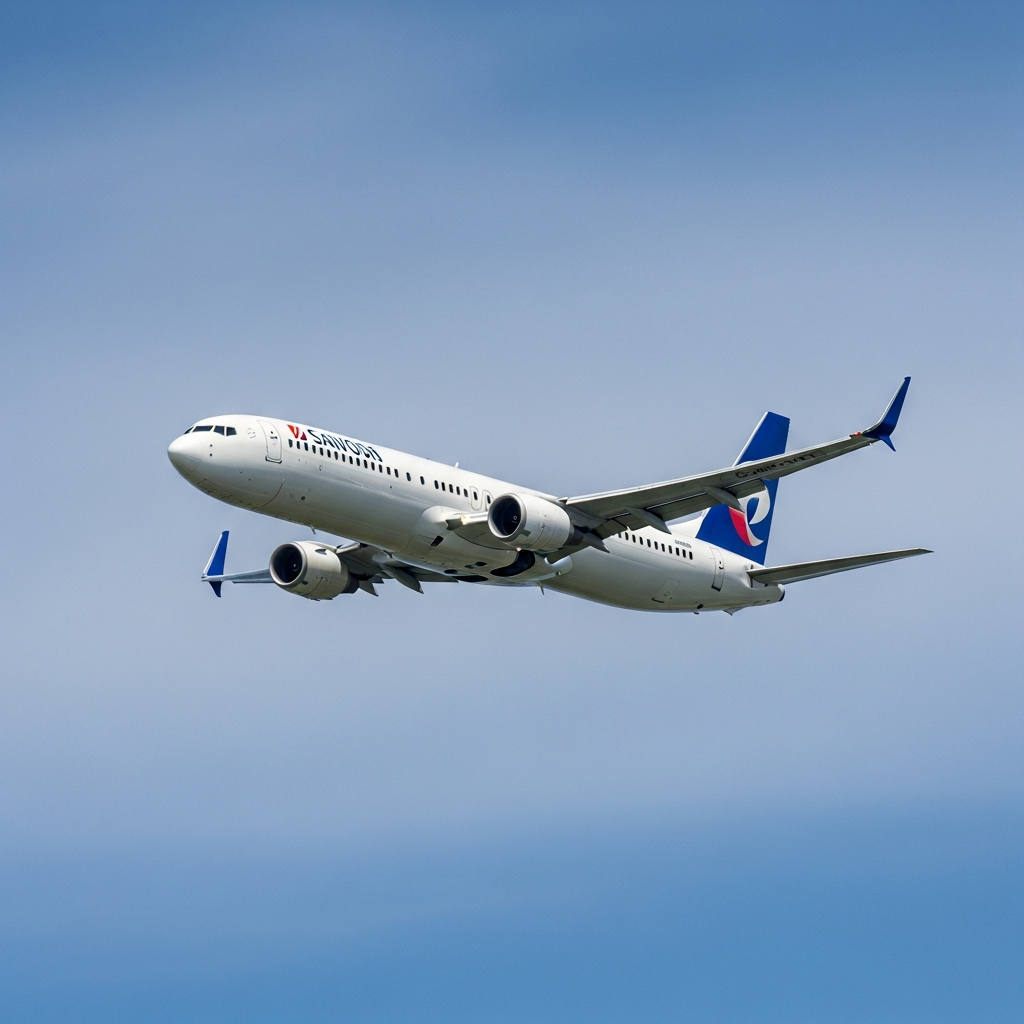
President Trump announced May 14, 2026, that China has agreed to purchase 200 Boeing commercial jets — the first major state-linked Chinese aircraft order since 2017, and a potential turning point after nearly a decade of Boeing being effectively frozen out of the world’s second-largest aviation market.
Trump made the announcement during a Fox News interview following his summit with President Xi Jinping in Beijing, framing it as a diplomatic win that exceeded what Boeing itself had sought.
“One thing [Xi] agreed to today: he’s going to order 200 jets. That’s a big thing. Boeing — 200 big ones. That’s a lot of jobs. It’s a lot. Boeing wanted 150, he got 200.” — President Trump, Fox News, May 14, 2026
The market was unimpressed. Boeing shares fell 4.8% to $229.13 by midday Thursday — their steepest single-day drop in roughly seven months — as investors processed a deal that arrived without formal confirmation from Boeing, any named Chinese carrier, or the Civil Aviation Administration of China.
What We Know — and What We Don’t
Trump did not specify aircraft type, airline recipients, delivery timelines, or contract value. That ambiguity matters enormously in aviation terms. Pre-summit reporting indicated China was weighing a package of roughly 500 Boeing 737 MAX narrowbodies and approximately 100 widebody jets — 787 Dreamliners and 777Xs — though widebody discussions were on a separate, slower track. Whether Trump’s 200-jet figure represents a narrowed version of that package, or simply the narrowbody component, is unconfirmed.
Trump’s own language didn’t help. “I think it was a commitment, sort of […] a statement,” he said. “But I think it was a commitment.” That’s not how a signed purchase agreement sounds.
Bloomberg Intelligence analyst George Ferguson put the number in blunt context:
“An order for 200 jets is a disappointment for a market looking for 300 or more, and details around type [are missing]. Until the order is confirmed by an airline, it won’t go into the firm backlog — and in years past, agreements by the Chinese government for plane sales haven’t been consummated.” — George Ferguson, Bloomberg Intelligence
A Decade of Market Share Lost to Airbus
The numbers tell a stark story. This decade, Chinese carriers have placed orders for just 39 Boeing aircraft. Over that same period, they committed to approximately 700 Airbus jets since July 2022 alone — including a 137-aircraft A320neo deal with China Southern Airlines and its subsidiary Xiamen Airlines, announced April 29, 2026, less than three weeks before the Beijing summit.
Airbus has also built structural advantages Boeing can’t quickly replicate. Its A320 family final assembly line in Tianjin — expanded with a second line last year — gives Airbus an embedded industrial footprint in China. Boeing has no equivalent presence on the ground.
The freeze accelerated after the 737 MAX’s twin fatal crashes in 2018 and 2019. China was the first country to ground the MAX following the Ethiopian Airlines disaster in March 2019 and didn’t allow it to resume flying until 2023, years after the FAA restored its airworthiness certificate.
Boeing’s Pipeline Problem
Even if the deal formalizes, Boeing faces a delivery math challenge. The company was targeting roughly 52 737 MAX deliveries per month by end of 2025 while managing a backlog of approximately 6,100 aircraft — representing six to seven years of production at current output rates. A new 200-jet Chinese order would join that queue. Meaningful deliveries, under the most optimistic scenarios, are likely 12 to 24 months away at minimum.
Boeing CEO Kelly Ortberg traveled with Trump’s delegation to Beijing and had signaled cautious optimism before the summit — telling analysts he was “highly confident” any Trump-Xi agreement would “include some aircraft orders,” while adding the outcome was “100% dependent on U.S.-China negotiations and relations.”
What to Watch Next
The deal’s credibility hinges entirely on what comes next. A formal announcement from Boeing naming specific Chinese airline customers, confirmed aircraft types, and a delivery schedule would signal this is real. A government-to-government statement is not a purchase agreement. Worth noting: China’s 2017 Boeing deal — also announced during a Trump visit — resulted in a 300-aircraft framework that was subsequently disrupted by trade tensions and the MAX crisis.
The COMAC C919 adds long-term pressure, too. Beijing’s domestically built narrowbody — a direct competitor to the 737 MAX and A320neo — has active regulatory backing, with Chinese authorities encouraging domestic airlines to support local aerospace production. Boeing’s path back into China is narrower than the headline number suggests.
We’ll continue tracking confirmation from Boeing, CAAC, and Chinese airline sources as this develops.
Stay in the loop
Get the latest aircraft insider updates delivered to your inbox.