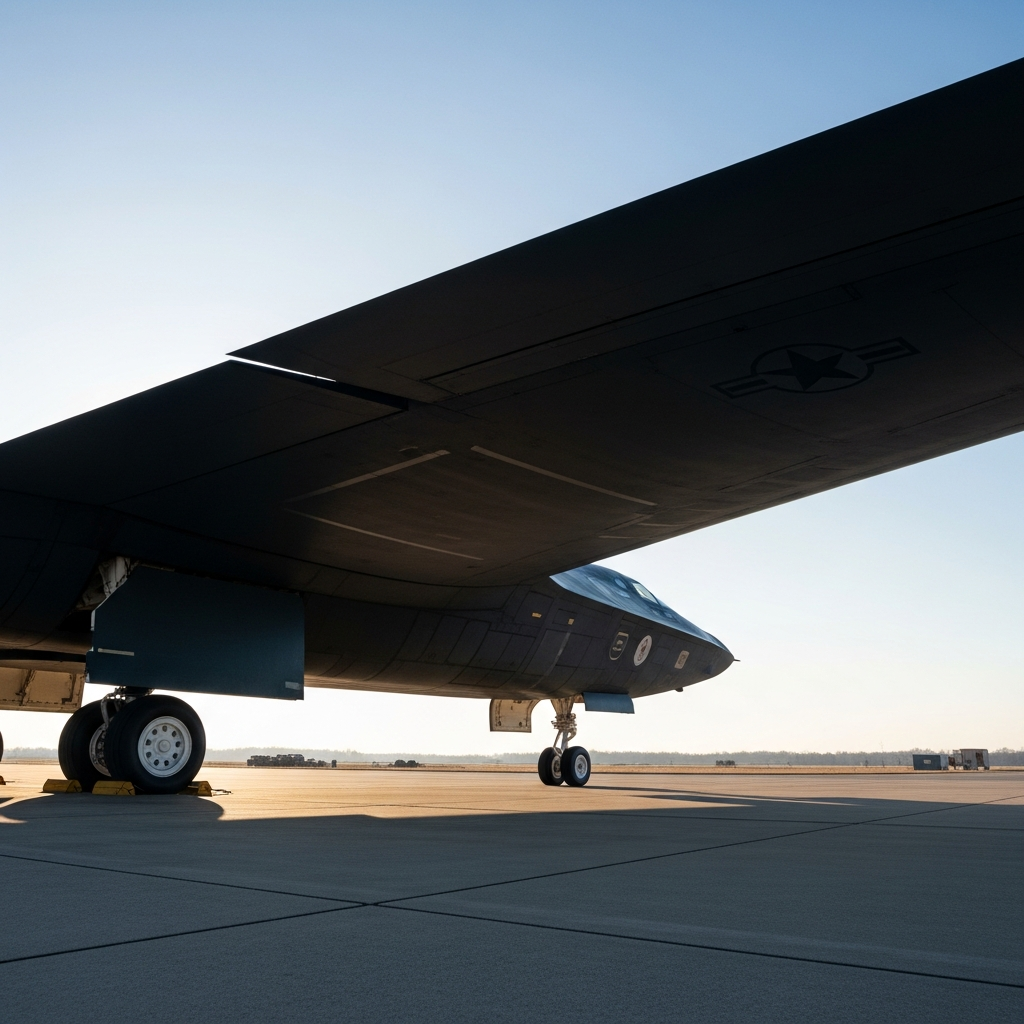
The U.S. Air Force has officially confirmed that the B-21 Raider stealth bomber will operate with a two-pilot crew. The announcement, made July 9, 2026, settles months of speculation about single-pilot or autonomous configurations that had circulated through defense circles since late 2025.
The decision ends a debate that gained real momentum when Gen. Thomas A. Bussiere, then commander of Air Force Global Strike Command, reportedly recommended a one-pilot-and-one-weapons-system-officer configuration. It carries substantial implications for crew training pipelines, pilot career progression, and operational doctrine as the aircraft moves toward deployment in 2027.
“Following careful analysis of the B-21’s advanced capabilities, Air Force leadership determined that a two-pilot configuration optimally supports the aircraft’s mission profile,” the Air Force stated. The service emphasized that keeping the two-crew model “maximizes the lethality and survivability of the Raider” by preserving “deep tactical and combat experience currently residing within the WSO and CSO communities.”
The Crew Roles — Pilot and Mission Commander
The B-21 will maintain the operational structure established by the B-2 Spirit: a pilot and a mission commander responsible for weapons employment and countermeasures. The mission commander retains the capability to fly the aircraft if needed—a redundancy that became standard on the B-2.
B-21 pilots will carry the 11B bomber pilot Air Force Specialty Code, the baseline designation for all Air Force bomber pilots. The Air Force is still working through the exact number of B-21 pilots required, but preliminary pilot-to-airframe ratios suggest the service will need approximately 350 pilots once the full fleet reaches operational strength.
Automation Handles What Extra Crew Once Did
The two-person crew works because the B-21 consolidates mission management functions into an advanced cockpit supported by integrated software systems. Automation handles sensor fusion, threat detection, and weapons integration tasks that previously required additional crew members on legacy bombers like the B-52H (five-crew) or B-1B Lancer (four-crew).
The aircraft is engineered for extended-duration missions lasting several days. It includes sleeping accommodations, restroom facilities, and food preparation equipment—a necessity given that B-2 sorties routinely exceed 20 hours, with the longest reaching 44 hours.
What This Means for Weapons System Officers
The formal crew confirmation opens a career pathway for experienced weapons system officers and combat systems officers facing fleet drawdowns. As the B-1B and B-2 inventories eventually retire, the Air Force can transition WSOs and CSOs into B-21 pilot pipelines rather than losing that institutional knowledge.
This mirrors the B-2 era, when navigator and WSO experience was initially required for pilot candidates. That restriction was relaxed over time, but the talent pool exists today—497 personnel held the bomber pilot AFSC at the end of 2025, serving a fleet of 141 bombers.
Testing Momentum Continues
The crew confirmation comes as the B-21 program enters the operational preparation phase at Ellsworth Air Force Base, North Dakota. The Air Force formally accepted two critical facilities on June 30: the $161 million Low Observable Restoration Facility and the $81 million Wash Rack and General Maintenance Hangar. Both are specifically designed to preserve the bomber’s radar-absorbent coatings.
Test aircraft are performing above expectations. One test cycle was completed ahead of schedule in May 2026. The first operational aircraft will arrive at Ellsworth in 2027, with additional aircraft planned for Whiteman Air Force Base, Missouri, and Dyess Air Force Base, Texas.
The two-pilot crew decision doesn’t preclude future single-pilot or optional-crewing configurations, but it removes that option from near-term operational planning. With the first production aircraft years away and the training infrastructure just coming online, the Air Force has prioritized the proven crew model while leveraging automation to reduce manning requirements compared to the legacy bomber fleet.
Sources
- Aviation Week
- U.S. Department of the Air Force Official Statement, July 9, 2026
- Air Force Global Strike Command public affairs

Stay in the loop
Get the latest aircraft insider updates delivered to your inbox.