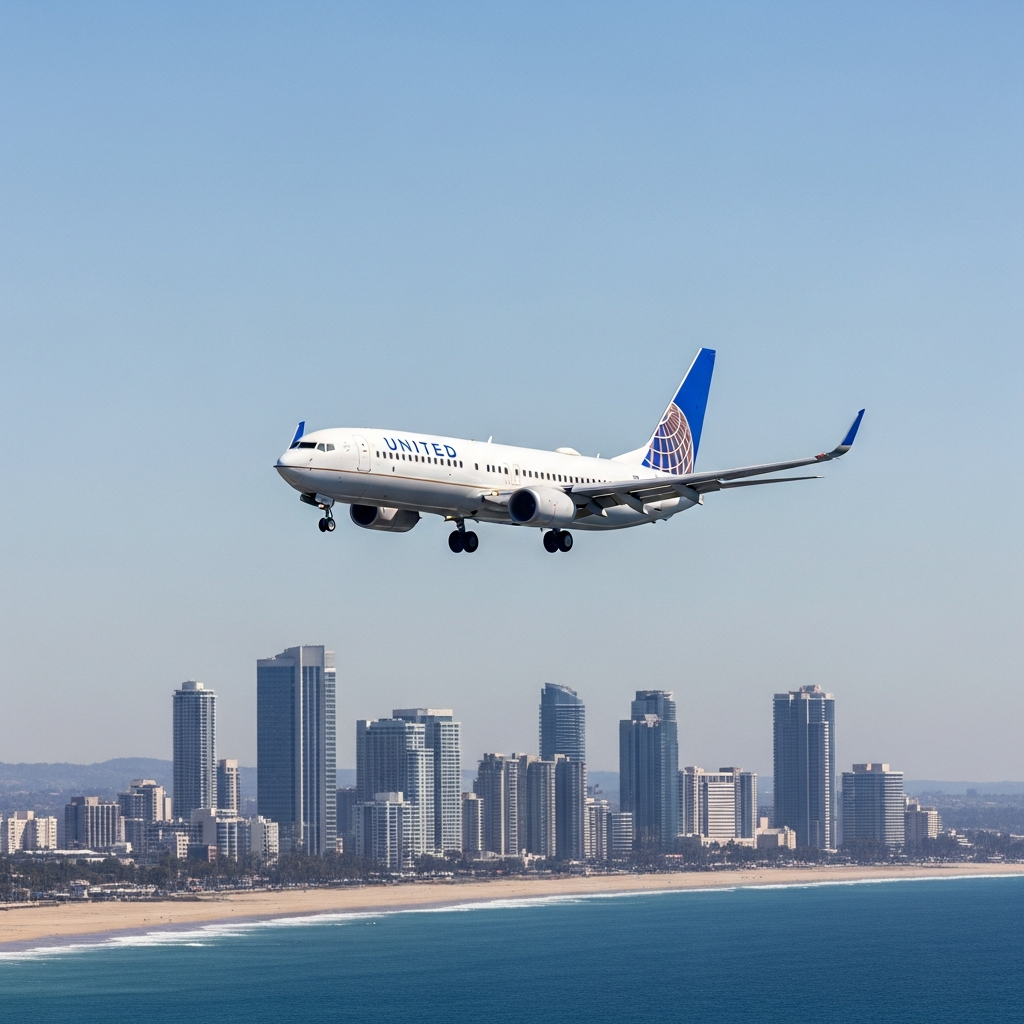
A United Airlines Boeing 737-800 approaching San Diego International Airport reported a close encounter with a small red drone at approximately 3,000 to 4,000 feet on the morning of April 29, 2026 — an altitude that places the object far outside legal airspace for unmanned systems and well above the ceiling of any standard consumer drone.
United Flight 1980, registration N14219, departed San Francisco International Airport (SFO) at approximately 6:53 a.m. PDT. Forty-eight passengers and six crew members were aboard. The 737-800 touched down at San Diego at approximately 8:28 a.m., roughly 90 minutes after departure.
The encounter happened during the jet’s base leg — the segment of the approach where the aircraft flies perpendicular to the runway before turning onto final — between waypoints KEEDG and SAIEE. On the way down, the crew first reported seeing “a red small object” approximately 1,000 feet below them. After landing, the captain got on with ground control and gave a more direct account.
“Okay over to spot 1 and contact ramp. And we hit a drone probably at around 3,000 feet. About uh… Yeah around on our base leg between KEEDG and SAIEE. Red drone heading west.”
The controller asked for more detail — size, number of engines. The pilot’s answer made clear just how fast it all happened: “It was so small I couldn’t tell. It was red, shiny. I couldn’t tell.”
United Walked Back “Strike” Language — FAA Investigation Underway
United’s initial statement used the word “strike.” By that afternoon, the airline had quietly revised its language. “United Flight 1980 reported a potential drone prior to arriving in San Diego,” the company told Fox Business, adding it could not confirm whether the aircraft had actually made contact with the object. United also issued a further clarification: “There’s no indication that the aircraft struck the drone or vice-versa.”
FAA spokesman Ian Gregor offered a more conservative read of the geometry:
“While approaching San Diego International Airport at about 4,000 feet altitude, the crew of United Airlines Flight 1980 told air traffic control they believed they saw a drone 1,000 feet below them. Air traffic control alerted other pilots but did not receive any additional drone-sighting reports.”
A maintenance team met the aircraft on arrival and went through a thorough inspection of the fuselage and engines. No damage was found. The plane departed San Diego again at 10:16 a.m., continuing to Houston on its next scheduled leg.
The Altitude Problem — No Consumer Drone Should Be There
FAA spokesperson Cassandra Nolan has noted that the FAA caps recreational drone operations at 400 feet above ground level. In Class B airspace surrounding San Diego International, the effective ceiling for unauthorized drone flight is zero — all operations require a federal waiver. Three thousand feet is simply not achievable by standard off-the-shelf consumer hardware under normal conditions, a detail that touched off immediate debate on X and Reddit’s r/aviation community, where ATC audio sourced from theATCapp spread rapidly after the incident.
FAA Chief Counsel Liam McKenna has been direct about where the agency stands on enforcement: “The FAA will take decisive action against drone operators who ignore safety rules or operate without authorization. These unsafe operations create serious risks, and the FAA will hold operators fully accountable for any violations.” Under a 2026 policy update, FAA enforcement personnel are now required to pursue legal action — rather than issue a compliance warning — for violations that endanger the public or breach restricted airspace. Fines can reach $75,000 per violation.
The broader trend isn’t reassuring. An Associated Press analysis of NASA’s Aviation Safety Reporting System found drones accounted for nearly two-thirds of all reported near-midair collisions involving commercial aircraft at the 30 busiest U.S. airports in 2024 — a notable spike from the roughly half recorded over the previous decade. The FAA logged more than 1,850 drone sightings near airports in 2025 alone, averaging over 150 per month.
What Happens Next
The FAA investigation remains open. Critical questions are still unresolved: whether physical contact occurred, what platform could sustain flight at 3,000 feet over Class B airspace, and whether the drone was equipped with Remote ID — the digital transponder system the FAA now requires on most unmanned aircraft. If investigators trace the operator, mandatory enforcement under the 2026 policy framework would follow.
This story will be updated as the FAA releases findings.
Stay in the loop
Get the latest aircraft insider updates delivered to your inbox.