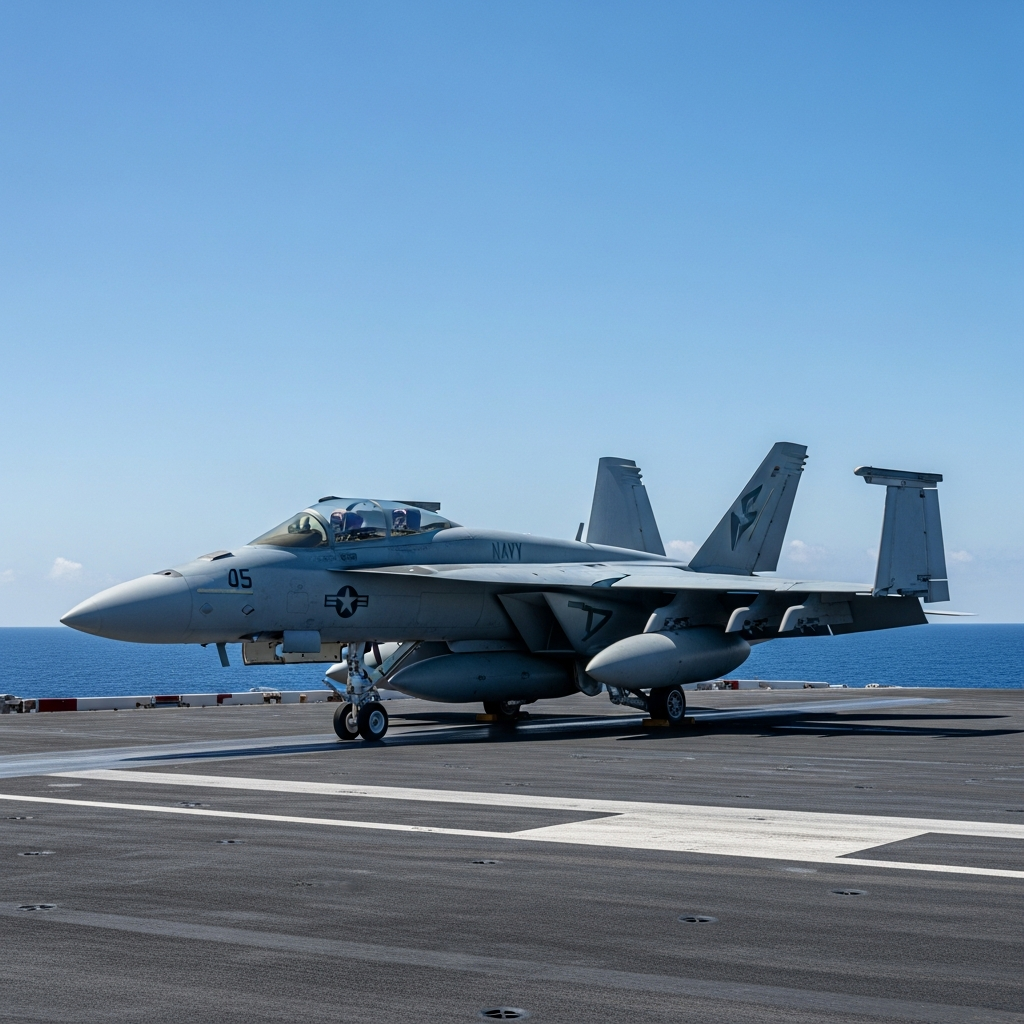
The USS Gerald R. Ford is closing in on the longest U.S. aircraft carrier deployment since the Vietnam War. It’s a milestone arriving not with fanfare, but with fire damage, displaced sailors, and mounting questions about American naval readiness.
As of April 12, 2026, the Ford — CVN-78, the Navy’s most advanced and expensive warship at $13 billion — has been underway for more than 290 days since departing Naval Station Norfolk, Virginia on June 24, 2025. On Wednesday, April 15, the ship will cross the 295-day mark, surpassing the USS Abraham Lincoln’s 294-day deployment and closing in on Vietnam-era records. Chief of Naval Operations Adm. Daryl Caudle confirmed last week that the deployment will likely stretch into its eleventh month, calling it “record-breaking” by any measure.
A Deployment Without Pause
The Ford has not slowed down. After departing Norfolk, the carrier initially headed to the Mediterranean and up to Norway before being redirected to the Caribbean — where operations resulted in the capture of Venezuelan President Nicolás Maduro in January 2026. By mid-February, the ship had been repositioned to the eastern Mediterranean as the Trump administration ramped up military pressure on Iran.
Operation Epic Fury began with a presidential go order on February 27, 2026, followed by a combined strike wave of more than 100 aircraft from land and sea on February 28, including F/A-18E/F Super Hornets from Strike Fighter Squadron 213 (VFA-213) and F-35Cs operating from the Ford’s flight deck. The carrier transited the Suez Canal on March 5 and began sustained strike sorties into Iran shortly after.
Carrier Air Wing 8 provides the Ford’s striking power — a layered mix of Super Hornets for precision strike, EA-18G Growlers for electronic attack and SEAD, E-2D Hawkeyes from Airborne Command and Control Squadron 124 (VAW-124) for battle management, and MH-60R Seahawks for anti-submarine warfare. The ship’s Electromagnetic Aircraft Launch System, or EMALS — which replaces legacy steam catapults with a linear synchronous motor capable of handling everything from lightweight drones to heavy strike aircraft — allows the air wing to sustain up to 160 sorties per day, outpacing the roughly 140 achievable from older Nimitz-class carriers.
The Fire — and What Came After
On March 12, a fire ignited inside the Ford’s aft laundry facility while the carrier was operating in the northern Red Sea near Al Wajh, Saudi Arabia. It spread fast. The blaze moved through ventilation ducting into adjacent berthing compartments, destroying more than 100 racks and displacing approximately 600 sailors. More than 200 crew members were treated for smoke inhalation; one was medically evacuated ashore. Full response — firefighting, water damage remediation, and hot-spot clearance — took more than 30 hours.
To replace the destroyed bedding, the Navy stripped roughly 1,000 mattresses from the still-under-construction USS John F. Kennedy at Newport News Shipbuilding in Virginia and airlifted them overseas.
Adm. Caudle addressed the incident publicly at a Center for Strategic and International Studies event on April 1, framing it as a testament to crew resilience.
“They fought that, put it out, and started flying sorties two days after that, so I’m very proud of that crew.” — Adm. Daryl Caudle, Chief of Naval Operations
The Ford first stopped at Naval Support Activity Souda Bay on the Greek island of Crete on March 23 for initial assessment and repairs related to the fire, then spent five days in Split, Croatia for further assessment and limited repairs before departing April 2. The Navy declared the ship combat-ready, and it returned to operations immediately.
Readiness Questions the Navy Can’t Dodge
The fire is one thing. What comes next is another. Nuclear-powered carriers typically require six to twelve months of post-deployment maintenance following high-tempo operations. The Ford got five days in Croatia.
The ship’s EMALS system, designed for 4,000 cycles between failures, averaged just 181 during 2019 operational testing and 600 during 2022 trials. Its vacuum collection holding and transfer plumbing system required maintenance assistance calls 32 times in 2025 alone. Nine months of near-continuous combat operations have deferred problems that drydock time will eventually have to address — and there’s no shortcut around that math.
Rear Adm. Paul Lanzilotta, Commander of Carrier Strike Group 12, acknowledged the human toll plainly.
“Long deployments are challenging. Fatigue accumulates and time away from home weighs on Sailors. Our responsibility as leaders is to ensure they are supported.” — Rear Adm. Paul Lanzilotta, Commander, Carrier Strike Group 12
A ceasefire with Iran was announced earlier this week. Ford’s leadership has told sailors the ship expects to return to the United States in May 2026. But with a record deployment, deferred maintenance, and a hull that has barely stopped moving in nearly a year, how long before the Ford is genuinely ready for the Pacific fight defense analysts keep warning about — that’s the question Washington should be asking right now.
Stay in the loop
Get the latest aircraft insider updates delivered to your inbox.