B-2 Bomber vs Football Field Size Comparison
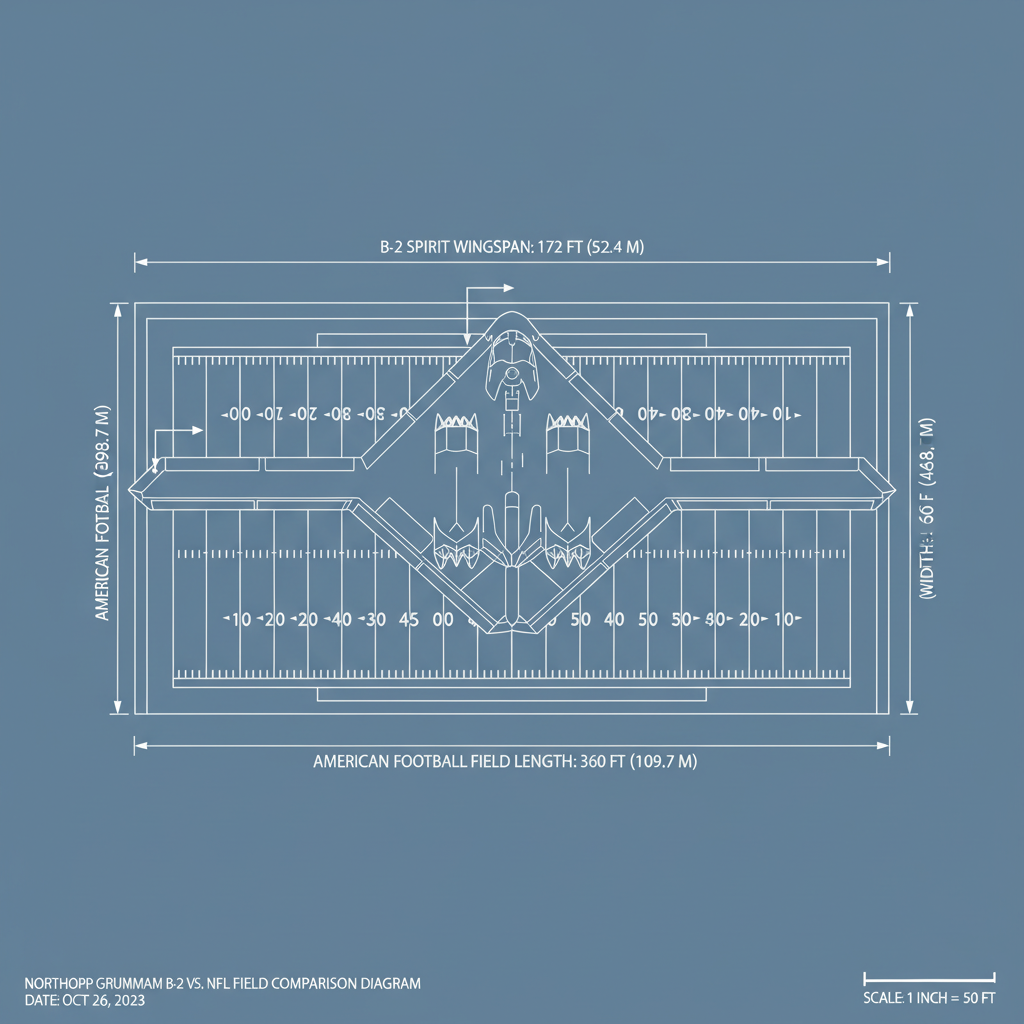
The B-2 Spirit stealth bomber is one of the largest military aircraft ever built, but just how big is it? The best way to visualize the B-2’s massive size is by comparing it to something familiar: an American football field. This visual comparison reveals the true scale of this $2 billion flying wing.

Quick Answer
The B-2 bomber’s wingspan of 172 feet covers approximately half of a football field. A standard football field is 360 feet long (including end zones), making the B-2’s wingspan nearly 48% of the field’s total length.
B-2 Bomber Dimensions
- Wingspan: 172 feet (52.4 meters)
- Length: 69 feet (21 meters)
- Height: 17 feet (5.18 meters)
- Wing Area: 5,140 square feet
- Empty Weight: 158,000 pounds
- Max Takeoff Weight: 336,500 pounds
Visual Comparison to Football Field
Wingspan vs Field Length
A regulation football field measures:
- Playing field: 300 feet (100 yards)
- With end zones: 360 feet (120 yards)
- Width: 160 feet (53.3 yards)
B-2 Wingspan Comparison:
- 172 feet = 57% of the playing field length
- 172 feet = 48% of total field length (with end zones)
- 172 feet = 107% of the field width (wider than the field!)
If the B-2 Landed on a Football Field
Imagine a B-2 Spirit positioned lengthwise down a football field:
- The wingtips would stretch from the 14-yard line to the opposite 43-yard line
- That’s nearly 5 first downs worth of distance
- The wings would extend 6 feet beyond each sideline if positioned crossways
Length Comparison
At 69 feet long, the B-2’s fuselage would:
- Cover about 23 yards of the field
- Equal the length of three school buses parked end-to-end
- Span from goal line to the 23-yard line
Other Size Comparisons
B-2 vs Common Objects
| Object | Dimension | B-2 Equivalent |
|---|---|---|
| School bus | 40 feet | 4.3 buses wingspan |
| Semi-truck trailer | 53 feet | 3.2 trailers wingspan |
| NBA basketball court | 94 feet | 1.8 courts wingspan |
| Tennis court | 78 feet | 2.2 courts wingspan |
| Olympic swimming pool | 164 feet | Slightly wider than pool |
B-2 vs Other Aircraft
| Aircraft | Wingspan | Comparison to B-2 |
|---|---|---|
| B-2 Spirit | 172 feet | – |
| Boeing 747 | 211 feet | 23% larger |
| C-5 Galaxy | 223 feet | 30% larger |
| B-52 Stratofortress | 185 feet | 8% larger |
| F-22 Raptor | 44.5 feet | B-2 is 4x wider |
| F-35 Lightning II | 35 feet | B-2 is 5x wider |
Why Is the B-2 So Large?
Flying Wing Design
The B-2’s massive wingspan serves several purposes:
- Stealth efficiency: The flying wing design eliminates vertical surfaces that reflect radar
- Fuel capacity: The wide wings house enormous fuel tanks for 6,000-mile range
- Payload bay: Can carry 40,000 pounds of ordnance internally
- Aerodynamic efficiency: The wing shape provides exceptional lift-to-drag ratio
No Fuselage or Tail
Unlike conventional aircraft, the B-2 has no separate fuselage or tail section. Everything—cockpit, engines, weapons bay, fuel, and crew—is integrated into the wing structure. This makes the aircraft appear wider and flatter than traditional bombers.
 >
>
Parking and Hangar Requirements
Special Facilities Needed
The B-2’s size requires custom infrastructure:
- Climate-controlled hangars: 210 feet wide to accommodate wingspan plus clearance
- Cost per hangar: $100+ million for B-2-specific facilities
- Runway requirements: Minimum 11,000-foot runways for takeoff with full load
- Taxiway width: Extra-wide taxiways to prevent wingtip damage
Home Base
All 20 operational B-2 bombers are based at Whiteman Air Force Base in Missouri, which has specialized facilities designed specifically for the aircraft’s unique requirements.

Weight Comparison
How Heavy Is the B-2?
At maximum takeoff weight (336,500 pounds), the B-2 weighs:
- Equal to 168 tons
- The weight of 24 full-size pickup trucks
- Heavier than 67 Honda Civics
- About 3 times the weight of a fully loaded semi-truck
Empty vs Loaded
- Empty weight: 158,000 pounds (79 tons)
- Fuel capacity: 167,000 pounds when fully loaded
- Payload capacity: 40,000 pounds of weapons
Scale Model Perspective
If you scaled a B-2 down to toy size:
- A 1:72 scale model would have a 29-inch wingspan
- A 1:144 scale model would have a 14.5-inch wingspan
- A 1:200 scale model would have a 10-inch wingspan
Even at model scale, the B-2’s proportions remain impressive compared to other aircraft models.
Operational Implications of Size
Advantages
- Long range: Large fuel capacity enables 6,000+ mile missions
- Heavy payload: Can carry nuclear or conventional weapons
- High altitude: Large wings provide lift at 50,000 feet
- Stability: Size provides stable bombing platform
Challenges
- Limited bases: Only a few airfields can accommodate B-2 operations
- Expensive maintenance: Requires specialized facilities and equipment
- Difficult to conceal: Large size makes ground operations complex
- Parking limitations: Cannot use standard military hangars
Historical Context
Largest Flying Wing Ever Built
The B-2 is the largest operational flying wing aircraft in history. Previous flying wings were smaller:
- Northrop YB-49: 172-foot wingspan (same as B-2, but 1940s prototype)
- Northrop YB-35: 172-foot wingspan (B-49 predecessor)
- Horten Ho 229: 55-foot wingspan (WWII German prototype)
The B-2 represents the culmination of 50+ years of flying wing development.
Cost Per Square Foot
With a price tag of approximately $2.2 billion per aircraft (including development costs) and a wing area of 5,140 square feet:
- Cost per square foot: ~$428,000
- More expensive than: The most luxurious penthouses in Manhattan
- Gold comparison: About 200 ounces of gold per square foot
Viewing the B-2 in Person
Where to See a B-2
- Whiteman Air Force Base, Missouri: Occasional public tours
- Air shows: B-2 appearances at major airshows nationwide
- Rose Parade: B-2 often performs flyover in Pasadena, California
- Sporting events: Occasional flyovers at major games
What to Expect
When seeing a B-2 in flight:
- Eerily quiet: Despite size, engines are muffled for stealth
- Distinctive shape: The flying wing profile is unmistakable
- Slow appearance: Large size makes it appear to move slower than it actually is
- Low altitude: Flyovers typically occur at 1,000-2,000 feet for visibility
Fun Facts About B-2 Size
- The B-2’s wingspan is longer than the Wright Brothers’ first flight distance (120 feet)
- You could park 8 school buses wingtip-to-wingtip under the B-2’s wingspan
- The cockpit is only 2% of the total aircraft volume
- Each wing measures over 8,000 square feet—larger than most family homes
- The weapons bay is large enough to fit a small school bus
Conclusion
The B-2 Spirit stealth bomber’s 172-foot wingspan—roughly half a football field—makes it one of the most impressive aircraft ever built. While smaller than jumbo jets like the Boeing 747, the B-2’s unique flying wing design and stealth capabilities make it appear even more massive and imposing.
Next time you’re at a football game, imagine a B-2 spanning from the 14-yard line to the opposite 43-yard line, and you’ll appreciate the true scale of this incredible aircraft. Its size isn’t just for show—every foot of wingspan serves a purpose in making the B-2 the world’s most capable stealth bomber.
Stay in the loop
Get the latest aircraft insider updates delivered to your inbox.