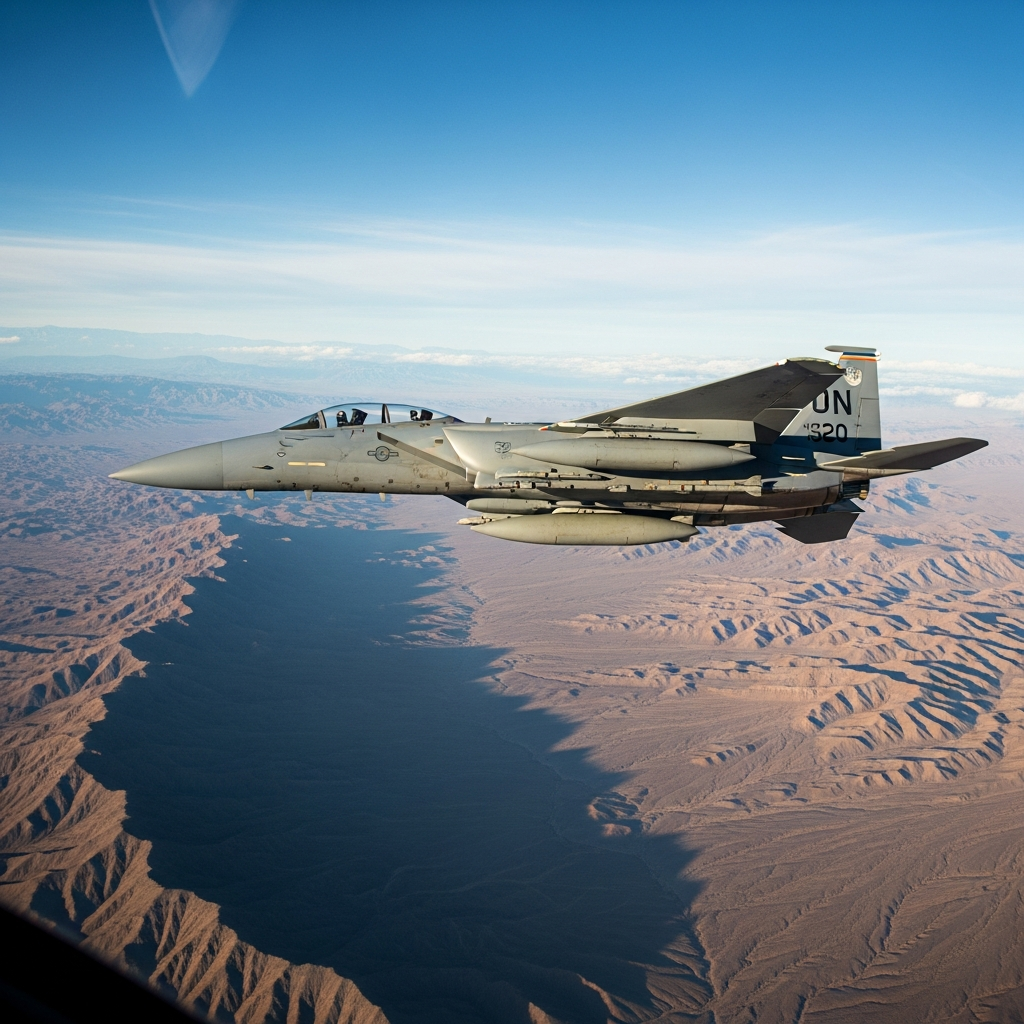
An American F-15E Strike Eagle was shot down over Iran on April 2, 2026. U.S. forces recovered its two crew members in separate search-and-rescue missions completed on April 4, according to U.S. Central Command.
That is the core event the U.S. government has confirmed. A later New Mexico Air National Guard account identified the aircraft's call sign as Dude 44, placed it in Iran's Zagros Mountains and said more than 150 aircraft and scores of special operators were mobilized for the recovery.
The public record does not support many of the precise details circulated immediately after the rescue. CENTCOM has not publicly identified the weapon, the unit that fired it, the exact crash coordinates, the crew members or a complete order of battle for either recovery.
Confirmed facts versus unverified claims
| Claim | Public status |
|---|---|
| An F-15E was shot down over Iran | Confirmed by CENTCOM |
| Shootdown date | April 2, 2026 |
| Number of crew members | Two |
| Both crew members survived and were recovered | Confirmed |
| Recoveries were separate missions | Confirmed |
| Recovery completed | April 4, 2026 |
| Aircraft call sign was Dude 44 | Confirmed in a later official Guard history |
| General location was the Zagros Mountains | Confirmed in the Guard history |
| More than 150 aircraft and scores of special operators mobilized | Confirmed in the Guard history |
| Exact missile or air-defense system | Not publicly confirmed |
| Exact crash time and coordinates | Not publicly confirmed |
| Detailed aircraft-by-aircraft rescue package | Not publicly confirmed |
| CIA disinformation and civilian-assistance story | Not confirmed in the cited official releases |
| SEAL Team Six, disabled C-130s and exact bomb totals | Not confirmed in the cited official releases |
This distinction matters because an official confirmation of a broad event does not validate every anonymously sourced or social-media detail attached to it.
What CENTCOM said
CENTCOM's April 5 release was short. It stated that:
- the F-15E was shot down April 2 during a combat mission
- U.S. forces recovered two American service members from Iran
- the recoveries were completed April 4
- the service members were recovered in separate search-and-rescue missions
- U.S. strikes into Iran continued
CENTCOM did not say whether the aircraft was hit by a surface-to-air missile, an air-to-air weapon, antiaircraft fire or another system. It did not name an Iranian organization or identify the crew.
The proper wording is therefore “shot down over Iran,” not “shot down by a specific Iranian missile.” Attribution may be established in a classified investigation without being released publicly.
Correcting the timeline
The live Aircraft Insider article dates the shootdown to Friday, April 3. The official CENTCOM release says it occurred April 2.
It also describes the event as a “24-hour operation.” The public dates span April 2 through April 4, and CENTCOM says there were separate rescue missions. That does not establish that each crew member was isolated for the same amount of time or that the entire operation lasted exactly 24 hours.
A durable timeline is:
| Date | Confirmed event |
|---|---|
| April 2, 2026 | F-15E shot down during a combat mission over Iran |
| April 4, 2026 | U.S. forces completed separate recoveries of both crew members |
| April 5, 2026 | CENTCOM publicly announced the successful recoveries |
| June 26, 2026 | New Mexico Air National Guard history identified Dude 44, the Zagros Mountains and the scale of mobilization |
Later official histories can add information, but they should not be backfilled with unsupported detail from early reports.
What the later Air National Guard account adds
The June 26 history from the 150th Special Operations Wing focuses on the training system behind combat search and rescue rather than giving a tactical play-by-play.
It states that:
- the downed F-15E used call sign Dude 44
- the aircraft was in the hostile Zagros Mountains
- the recovery was among the most complex combat search-and-rescue missions in history
- more than 150 aircraft and scores of special operators were mobilized
- recovery crews depended on intelligence preparation and specialized personnel-recovery training
The account credits the Total Force training partnership at Kirtland Air Force Base, including the 188th Rescue Squadron and 512th Rescue Squadron. It says the training enterprise supports HC-130J Combat King II and HH-60W Jolly Green II crews.
It does not publish the exact tactical package, routes, weapons, ground-force identity or rescue coordinates. “More than 150 aircraft” should not be converted into a fabricated breakdown that appears more authoritative than the source.
Why separate recoveries matter
The F-15E has a crew of two:
- a pilot
- a weapons systems officer
Both use ejection seats. After ejection, wind, aircraft attitude, terrain and the timing of seat separation can place the two survivors far apart. Rescue forces then have to authenticate, locate and recover each isolated person while managing threats and airspace.
CENTCOM's wording confirms that the two service members were not simply picked up together. Separate recoveries increase coordination demands and can require different timing, routes or recovery assets.
The public release does not establish which crew member was recovered first, their injuries or how either person moved on the ground. Those details should remain omitted until an official history releases them.
What combat search and rescue involves
Combat search and rescue is more than sending a helicopter to a beacon. A recovery force may require:
- personnel-recovery intelligence
- survivor authentication and communications
- threat analysis
- fighter or attack-aircraft protection
- aerial refueling
- command and control
- rescue helicopters or other extraction aircraft
- medical support
- suppression or avoidance of hostile air defenses
The >150-aircraft figure describes a large mobilization, not necessarily 150 aircraft crossing the same point or directly surrounding one survivor. Tankers, command-and-control aircraft, defensive counterair, strike aircraft, rescue assets and reserves can contribute at different locations and times.
The Guard history emphasizes that specialized training precedes the crisis. Personnel-recovery intelligence analysts learn to map threats and develop recovery corridors, while aircrews practice the coordination and procedures needed under time pressure.
Was an HH-60W involved?
The live article gives a detailed HH-60W extraction narrative. Public Air Force material connects HH-60W training to the rescue enterprise and the Dude 44 mission, but the CENTCOM release does not identify the extraction aircraft.
It is reasonable to explain that the HH-60W is the Air Force's current combat-rescue helicopter and that the Kirtland training partnership prepares HH-60W crews. It is not responsible to state as fact that a particular HH-60W took ground fire, carried a named survivor or suffered specific crew injuries without a supporting release.
Readers seeking the aircraft's verified capabilities should use the separate HH-60W Jolly Green II guide rather than treating an unconfirmed incident narrative as a specifications source.
What shot down Dude 44?
The public answer is unknown.
Iran operates multiple short-, medium- and long-range air-defense systems, and portable infrared missiles are one possible category in any low-altitude threat environment. That inventory does not identify the weapon used in this event.
The live article lists Bavar-373, S-300 and Verba as candidates and refers to a passive infrared system. These systems use different sensors, engagement methods and ranges. Listing them together without official evidence invites readers to mistake speculation for an investigation result.
Until the Air Force or CENTCOM releases findings, the accurate statement is that the F-15E was shot down and the responsible weapon has not been publicly identified.
Was this the first recent U.S. F-15E loss?
The April incident must be distinguished from a separate March 1 event. CENTCOM said three F-15E Strike Eagles went down over Kuwait in an apparent friendly-fire incident involving Kuwaiti air defenses. All six aircrew ejected, were recovered and were stable.
The April 2 aircraft was shot down over Iran, and its crew required separate recoveries from Iranian territory. The two events have different locations, causes and rescue circumstances.
Claims that Dude 44 was the first American fighter lost in combat in a precise number of years require a defined standard. “Combat loss” can exclude or include accidents in a combat theater, friendly fire, remotely piloted aircraft and aircraft that reach friendly territory before being abandoned. This article does not need that superlative to explain the event.
Operational lessons that can be stated safely
The incident demonstrates several points without pretending to know classified details:
- modern strike aircraft remain vulnerable in a dense threat environment
- ejection survival does not end the danger for an isolated crew
- rescue forces need intelligence, communications, protection and refueling
- separate survivors can drive separate recovery missions
- years of training support a mission executed with little warning
- a large rescue mobilization does not reveal its full tactical order of battle
It is too early to claim that a particular weapon will force a particular electronic-warfare or routing change. Those decisions depend on the classified investigation and wider campaign assessment.
Bottom line
CENTCOM confirmed that an F-15E was shot down over Iran on April 2, 2026 and that both crew members were safely recovered in separate missions completed April 4. A later Guard history identified the jet as Dude 44, placed the event in the Zagros Mountains and said more than 150 aircraft and scores of special operators were mobilized.
The weapon, exact crash location, crew identities and detailed rescue package remain outside the confirmed public record used here. Keeping that boundary produces a more reliable account than repeating dramatic details that cannot be traced to an official source.
Frequently asked questions
When was the F-15E shot down over Iran?
CENTCOM says the aircraft was shot down April 2, 2026 during a combat mission.
Did both crew members survive?
Yes. U.S. forces recovered both service members safely in separate missions completed April 4.
What was the F-15E's call sign?
A June 2026 New Mexico Air National Guard history identifies it as Dude 44.
What weapon shot down the F-15E?
CENTCOM has not publicly identified the weapon or attributed the shootdown to a specific air-defense unit.
How large was the rescue operation?
The official Guard history says more than 150 aircraft and scores of special operators were mobilized. It does not provide a complete aircraft-by-aircraft breakdown.
Was this the same as the Kuwait friendly-fire incident?
No. Three F-15Es went down over Kuwait March 1 in an apparent friendly-fire incident. Dude 44 was shot down over Iran April 2.
Primary sources
- U.S. Central Command, April 5 rescue announcement: https://www.centcom.mil/MEDIA/PUBLIC-RELEASES/Article/4451965/us-continues-strikes-into-iran-after-successful-rescue-of-f-15e-aircrew/
- New Mexico Air National Guard/150th Special Operations Wing, Dude 44 rescue training history: https://www.dvidshub.net/news/568713/rescue-starts-here-150sow-impact-on-dude-44
- U.S. Central Command, March 1 Kuwait friendly-fire incident: https://www.centcom.mil/MEDIA/PRESS-RELEASES/Press-Release-View/Article/4418568/three-us-f-15s-involved-in-friendly-fire-incident-in-kuwait-pilots-safe/
- U.S. Central Command, Operation Epic Fury first-24-days fact sheet: https://media.defense.gov/2026/Mar/23/2003902061/-1/-1/1/OPERATION-EPIC-FURY-FACT-SHEET-THE-FIRST-24-DAYS.PDF
Stay in the loop
Get the latest aircraft insider updates delivered to your inbox.