Update — July 30, 2026: This report describes the former company’s March closure announcement. Sonex has since reopened under new ownership. Read the verified Sonex closure-and-relaunch timeline for the current factory, kit and builder-support status.
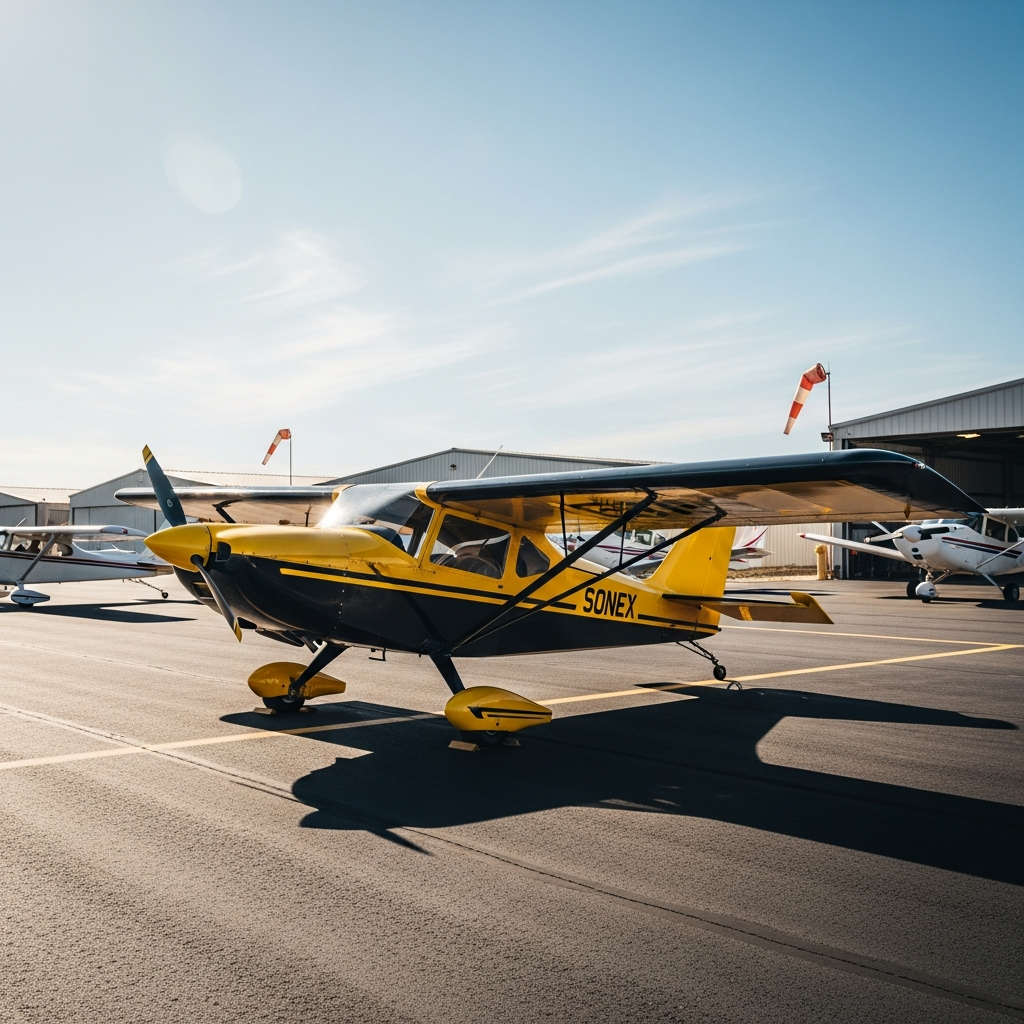
Sonex, LLC announced on March 27, 2026 that it is ceasing operations immediately and filing for bankruptcy. The Oshkosh, Wisconsin-based kit aircraft manufacturer — which put all-metal homebuilts within reach of thousands of amateur builders — is closing after nearly three decades of production that began with the first flight of serial number one on February 28, 1998.
Owner and president Mark Schaible broke the news in a video posted to the company’s website and YouTube channel. He described a compounding financial collapse that left no path forward.
“This decision is necessitated by a severe drop-off in sales and our bank’s unwillingness to carry-forward our debts given some unprofitable years. We’ve had to make this decision very suddenly as a perfect storm of bank pressure, lack of sales, increasing costs, competition from our own aircraft in the used market, and cashflow realities are not allowing us to continue our work.”
Schaible purchased the company from founder John Monnett in January 2022. He confirmed that he and his wife are filing personal bankruptcy alongside the business. His nine-person team, he said, “fought tooth and nail” to keep Sonex alive.
What Sonex Built
At closure, roughly 700 Sonex aircraft had been completed and registered. More than 2,100 kits were listed as under construction in the company’s records. The lineup covered a lot of ground — the two-seat low-wing Sonex, the Y-tail Waiex, the single-seat Onex, the motor-glider Xenos, and the SubSonex JSX-2 personal jet, which became a fixture on the airshow circuit. That last one was powered by a PBS TJ-100 turbojet and capable of 232 mph.
Company subsidiary AeroConversions produced the AeroVee engine series, an aviation adaptation of the Volkswagen air-cooled flat-four. It came in 80-hp normally aspirated and 100-hp turbocharged configurations, with complete engine core overhaul costs ranging from as little as $100 to $500 depending on what needs to be replaced.
The timing is especially hard for builders waiting on the Sonex Highwing. It made its first flight on June 30, 2025, and had been introduced at EAA AirVenture Oshkosh 2024 — where it generated significant excitement and preorders, and customers could sit in the aircraft at the exhibit booth. Tail kits had already begun shipping. Pre-orders were strong. The Highwing was supposed to be the company’s next chapter — instead, it may turn out to be its last.
Why It Failed — A Self-Inflicted Headwind
Schaible was candid about one factor that sets this collapse apart from a simple market downturn. The used market had been flooded with the company’s own product. Completed Sonex airframes built over 25-plus years were trading for prices that undercut new kit pricing by a wide margin — why buy a new kit for $50,000 when you could buy a completed, flown-in Sonex for $35,000? Sonex had spent decades putting aircraft into the market, and those aircraft were now competing directly against it.
Industry observers have pointed to a possible Osborne Effect as well — the phenomenon where announcing a compelling future product suppresses sales of current inventory. Excitement over the Highwing and the two-seat SubSonex JSX-2T may have caused prospective buyers to hold off on existing kits, draining cash flow at precisely the wrong moment.
Not a Van’s Aircraft Situation
Schaible was explicit on one point: this will not follow the path of Van’s Aircraft, which filed Chapter 11 reorganization on December 4, 2023. That filing allowed the kitmaker to keep operating and fulfill orders during restructuring. Sonex’s filing is expected to be a liquidation — a harder outcome for the more than 2,100 builders mid-project and any customers holding deposits on Highwing kits.
By March 31, though, Schaible reported an “overwhelming number of inquiries” covering the full range of options, from direct investment to outright purchase of manufacturing rights. AOPA reported on April 2 that a last-minute rescue remained possible. Schaible and John Monnett are working with attorneys to evaluate each inquiry. For AeroVee owners, community members note that most engine parts remain available through third-party vendors.
“This is not how I wanted my EAA story to end.”
Any acquisition or rescue developments will be updated as they emerge. For the 700-aircraft fleet already flying, the most urgent open question heading into AirVenture season is support continuity — parts, drawings, and technical knowledge.
Stay in the loop
Get the latest aircraft insider updates delivered to your inbox.