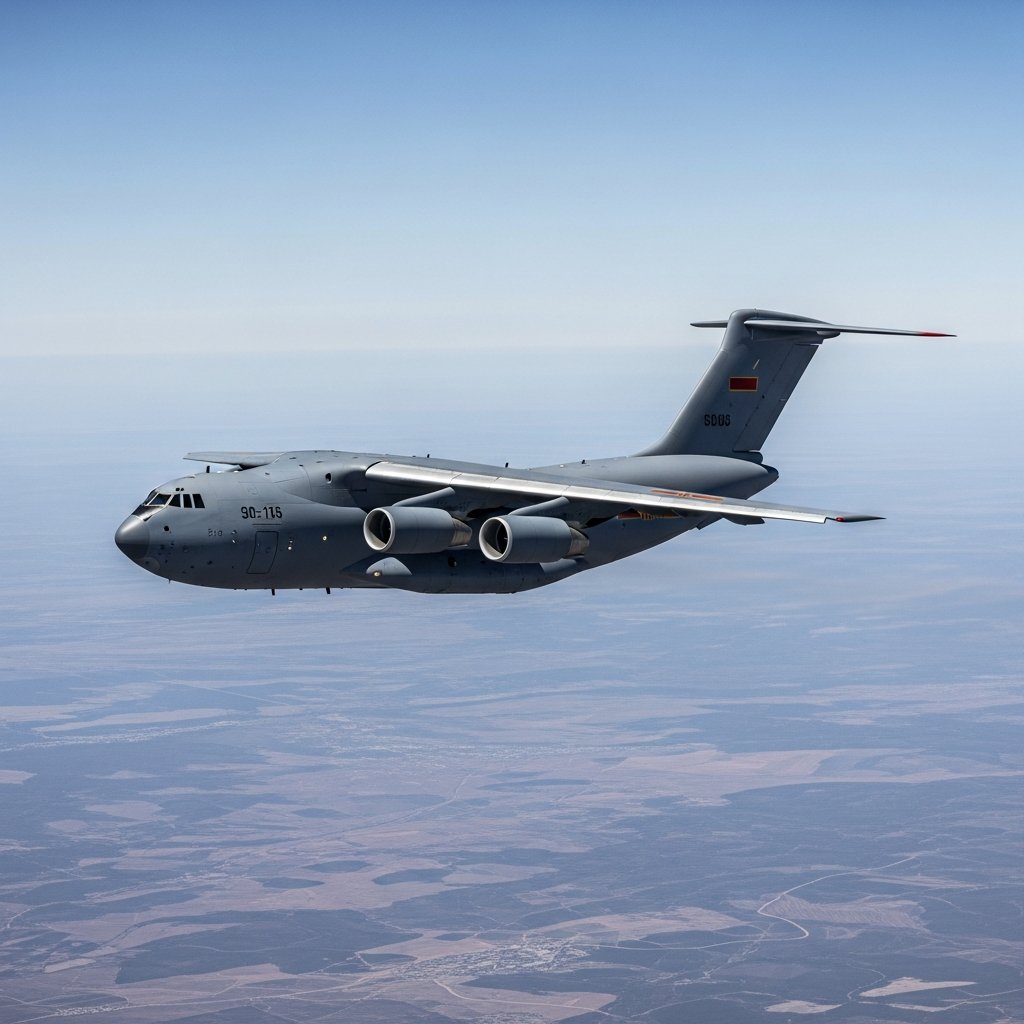
China’s state aviation giant AVIC completed the maiden flight of the Jetank — a purpose-built unmanned drone swarm carrier — on approximately April 23, 2026, in Pucheng County, Shaanxi Province. Beijing is calling it a “new breakthrough in China’s large UAV technology.” Western defense planners will almost certainly see it as something more unsettling.
The aircraft carries two additional designations: “Jiutian” (九天, meaning “Nine Heavens”) and the formal program name SS-UAV — Smart-configuration Support Unmanned Aerial Vehicle. Prototype 004 made its public debut at Airshow China 2024 in Zhuhai on November 17, roughly three and a half weeks before that first powered sortie. Testing has continued into 2026. China’s Civil Aviation Administration of Northwest China inspected the Weinan flight test center as recently as April 15, confirming the program is moving through a structured evaluation phase.
What the Jetank Actually Is
At 16.35 meters long, with a 25-meter wingspan and a 16-ton maximum takeoff weight, the Jetank sits in a class of its own. A single turbofan engine mounts in a dorsal nacelle above the rear fuselage. The H-tail configuration, high-mounted low-sweep wing, and retractable tricycle gear — main units housed in under-wing sponsons — give it a silhouette unlike anything currently in Western inventories. An electro-optical turret sits under the nose alongside a forward-facing radome housing what analysts assess as a search or fire-control radar.
Maximum ceiling is 15,000 meters (49,200 feet). Speed range spans 108 to 378 knots, endurance is 12 hours, and range is quoted at 7,000 kilometers. The MQ-9A Reaper carries a 4.7-ton MTOW against the Jetank’s 16 tons — a ratio that makes plain just how much payload China has engineered into this platform.
The Hive — The Feature That Changes the Math
The defining characteristic is the “isomerism-hive module.” It’s a large, internally carried ventral mission bay with dual sideways-opening doors capable of releasing up to 100 loitering munitions or kamikaze drones per sortie. AI-driven swarm coordination algorithms allow the Jiutian to sequence those smaller UAVs — FPV drones, one-way attack platforms, EW-equipped quadcopters — into precision multi-directional strikes designed to overwhelm integrated air defense networks. Beyond-line-of-sight control runs via satellite data link.
Eight external hardpoints rated for 1,000-kilogram-class guided bombs, PL-12AE and PL-15 air-to-air missiles, anti-ship missiles, and additional loitering munitions round out the weapons suite. Mission reconfiguration — swapping the hive module for cargo, communications relay, or EW payloads — is designed to take under two hours.
“This huge drone can carry a wide range of weapons and equipment comparable to those carried by modern fighter jets and bombers.” — Fu Qianshao, Chinese military aviation analyst and former PLAAF officer, told the Global Times at Airshow China 2024.
Wang Ya’nan, editor of Aerospace Knowledge magazine, called the Jetank a “world-class” carrier drone, citing its payload capacity and swarm-release capability as unprecedented in current production aircraft.
Strategic Weight
The U.S. has explored comparable concepts — DARPA’s Gremlins program aimed to launch and recover drones from a C-130 — but no Western program has produced a purpose-built, jet-powered swarm carrier of this size that has actually flown. The Jetank’s most credible threat scenario involves standoff release of long-range one-way attack drones rather than close-in swarm deployment, given the platform’s conventional radar cross-section and single-engine vulnerability to advanced SAM systems like the Patriot PAC-3. Even so, a mass release of OWA drones capable of flying hundreds or thousands of kilometers creates a saturation problem that no current air defense network can ignore.
AVIC has not announced an operational fielding date. Mass production is reportedly being targeted for 2027. In a Taiwan Strait contingency, analysts project the Jetank as a multiplier for exactly the kind of asymmetric, high-volume strike campaign that U.S. Pacific planners have been war-gaming for years.
Flight test progress out of Weinan bears watching — as does any indication of PLA Air Force or Naval Aviation unit assignments as the program matures.
Stay in the loop
Get the latest aircraft insider updates delivered to your inbox.