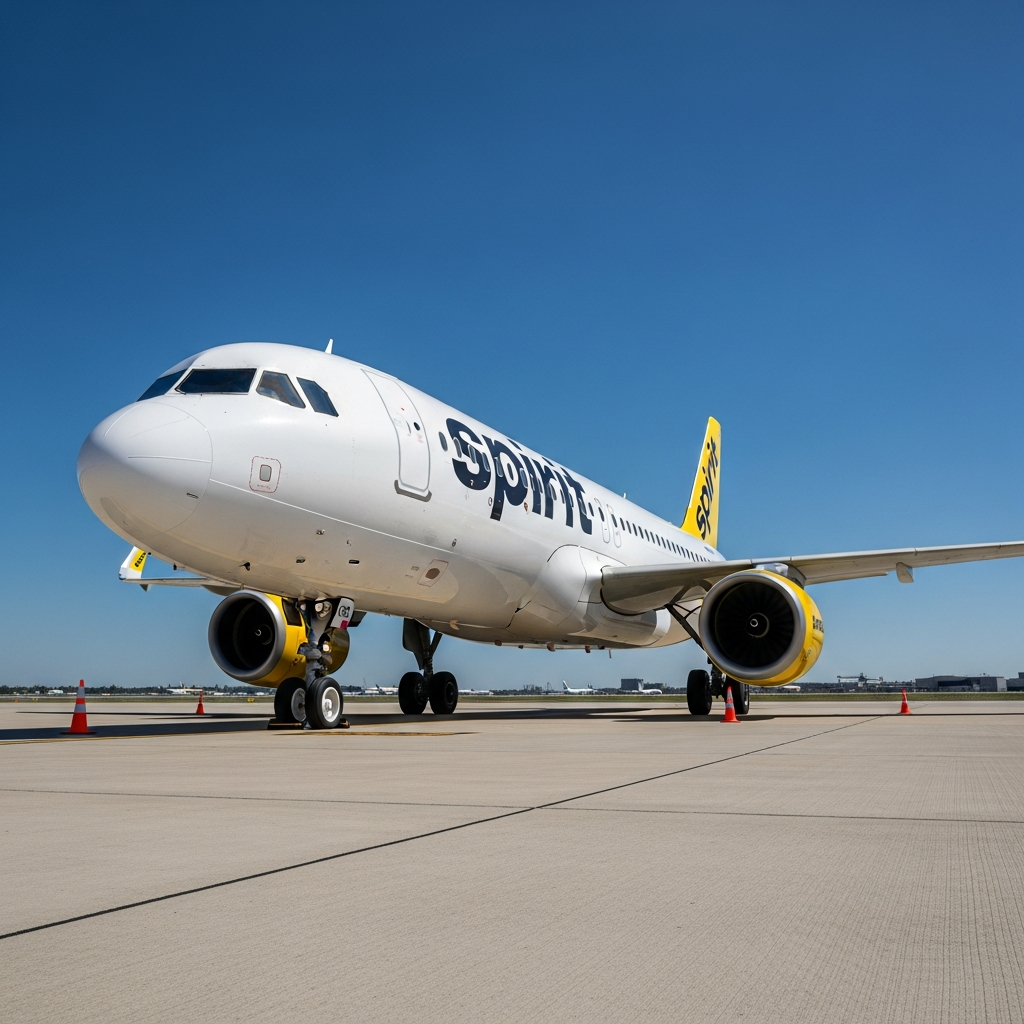
Spirit Airlines could be days away from ceasing to exist. Court filings as of April 15 show the ultra-low-cost carrier’s lenders are actively weighing a full wind-down rather than proceeding with the latest restructuring plan — a decision driven in large part by jet fuel prices that have nearly doubled since the start of 2026.
Bloomberg reported on April 15 that the Florida-based carrier could collapse within days. The U.S. bankruptcy trustee has already moved to delay Spirit’s exit from its second Chapter 11 filing, arguing the airline’s disclosure statement lacks “adequate information.” Specifically, there’s no credible accounting of what went wrong in the first bankruptcy — which Spirit exited in March 2025, only to burn through $257 million in three months and return to court by August.
Fuel Prices — The Final Blow
The numbers are stark. Jet fuel averaged roughly $2.50 per gallon in late February. By early April it had surged to nearly $4.90 per gallon at key U.S. hubs, driven by the conflict-related shutdown of the Strait of Hormuz — through which roughly 20 million barrels per day normally flow. Bypass pipelines through Saudi Arabia and the UAE can handle an estimated 3.5 to 5.5 million barrels per day at most. The shortfall is enormous.
JPMorgan analyst Jamie Baker modeled the damage precisely. At $4.60 per gallon for the remainder of 2026, Spirit’s operating margin collapses from negative 7% to negative 20%, adding $360 million in fuel costs alone. Spirit’s year-end cash balance stood at just $337 million. The plan was already underwater before the war started.
Spirit’s March 13 Restructuring Support Agreement had called for slashing its fleet from 214 aircraft pre-filing down to 76–80 Airbus A320 and A321ceo aircraft by Q3 2026, cutting debt from $7.4 billion to approximately $2 billion, and reducing fleet costs by $550 million annually. CEO Dave Davis called it “another significant step forward.” That optimism has since curdled. Observers tracking flight data on FlightRadar24 noted this week that a significant number of Spirit NK9*** flight numbers are routing to Victorville (VCV) — the Southern California desert storage facility that has become a well-known parking lot for distressed fleets.
Citibank, representing Spirit’s lenders, has separately objected to the airline’s attempt to split a $275 million loan into two tranches, arguing it violates the original contract and would sever legal protections binding Spirit’s collateral.
“Bottom line, Spirit’s survival is kind of trapped in the Strait of Hormuz.” — Aviation analyst
Neeleman’s Warning — JetBlue Next
Spirit’s crisis isn’t an isolated one. On April 14, a leaked recording from a Breeze Airways pilot session captured founder David Neeleman — who also founded JetBlue — warning that JetBlue itself faces bankruptcy in 2026 under current fuel conditions.
“JetBlue is in a really tough spot. They really are. When Jamie Baker came out with his estimates based on USD4.50 [fuel per gallon], it showed JetBlue losing USD1.3 billion this year. That would probably put them into bankruptcy, I would assume.” — David Neeleman, April 14, 2026
JetBlue closed 2025 with a $602 million net loss and carries $9.4 billion in debt, paying over $600 million annually in interest — a figure Neeleman said could climb to $800 million. Fitch has already downgraded JetBlue’s rating this month. The carrier has separately brought in advisers to explore a potential sale to a rival, though Neeleman noted that United is wary of absorbing JetBlue’s debt load, and Southwest and Alaska have both signaled disinterest.
Why Legacy Carriers Are Weathering This
Not everyone is struggling equally. Delta’s Monroe Energy refinery gives it a structural hedge competitors cannot replicate — expected to offset hundreds of millions in 2026 fuel costs while Delta maintains earnings guidance of $6.50–$7.50 per share. United CEO Scott Kirby acknowledged the scale of the problem, noting that sustained elevated fuel could add $11 billion in annual industry costs, more than double United’s best-ever annual profit. Legacy carriers, though, have pricing power, route flexibility, and cash reserves that ultra-low-cost operators simply lack.
The contagion is already global. Lufthansa is accelerating the shutdown of feeder airline CityLine and grounding 27 older aircraft. Norse Atlantic has cut Los Angeles service. South Korea’s T’way Air is planning cabin crew furloughs.
What Happens If Spirit Goes
Liquidation would send Spirit’s Airbus narrowbodies to auction, with creditors seeking the highest bidder. Fort Lauderdale-Hollywood International Airport — Spirit’s primary hub and the cornerstone of low-fare service to Latin America and the Caribbean — would face an immediate capacity gap. United and JetBlue are the likely beneficiaries in that market, though JetBlue’s own viability is now openly in question.
U.S. Transportation Secretary Sean Duffy said earlier this month he sees room for further consolidation in American aviation. The next few days in bankruptcy court will determine whether Spirit is restructured, sold, or simply ceases to exist. Proceedings are ongoing in the Southern District of New York.

Stay in the loop
Get the latest aircraft insider updates delivered to your inbox.